

NCERT Solutions for Class 9 English Kaveri Chapter 8 Follow That Dream are provided here with simple and easy-to-understand explanations. This letter is included in Unit 8 of the NCERT textbook Kaveri. It explores pursuing dreams with commitment while recognising the effort and sacrifices involved. These NCERT Solutions for Class 9 help students understand the main ideas, complete textbook activities, improve their language skills, and prepare for school examinations.
Follow That Dream Class 9 English Questions and Answers
Reflect and Respond (NCERT Textbook Page No. 231)
I. Read the questions given below and share your answers with your classmates and teacher.
1. What is your dream?
Answer: My dream is to become a scientist who develops technological solutions to help rural communities access better education and healthcare, thereby helping to bridge the digital divide in India.
2. Who inspires you to dream?
Answer: I am inspired by Dr. A. P. J. Abdul Kalam, who rose from a humble background to become one of India’s greatest scientists and the President of India. His life shows that vision, dedication, and hard work can help us overcome obstacles and achieve our dreams. My parents and teachers also inspire me through their constant guidance and encouragement.
3. What qualities should you have in order to fulfil your dream?
Answer: To fulfil my dream, I should have curiosity, determination, discipline, creativity, patience, and perseverance. I must also be willing to work hard, keep learning, accept failures, and make sacrifices when necessary. I should also believe in myself and remain focused even when the journey becomes difficult.
4. Abdul Kalam said, “Dream is not that you see in sleep, dream is something that does not let you sleep.” Discuss.
Answer: Dr. A. P. J. Abdul Kalam’s statement means that a true dream is not merely something we imagine while sleeping; it is a strong goal that constantly motivates us to act. A meaningful dream fills us with passion and determination, making us work hard even when the journey is difficult.
II. What role can parents and community play to help children achieve their dreams?
Answer: Parents and the community can play an important role in helping children achieve their dreams by providing encouragement, guidance, resources, and emotional support. Parents can help children identify their interests, develop confidence, and remain motivated during difficulties. The community can support them by providing access to good education, mentors, training opportunities, scholarships, and safe spaces to learn and practise.
III. Complete the given web chart. Give as many reasons as you can.
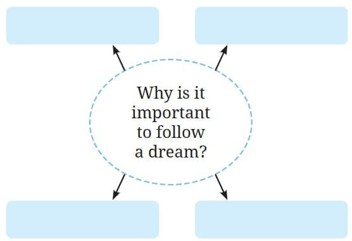
Answer:
- Gives direction and purpose in life
- Motivates us to work hard
- Helps us overcome difficulties
- Encourages personal growth and success
Check Your Understanding (NCERT Textbook Page No. 234)
I. State whether the following sentences are true or false.
Share your answers with your classmates and teacher.
1. Reaching the peak of skill in a field typically demands a focused and intense dedication for about a decade.
Answer: True
2. The mother believes that significant effort and personal sacrifices are essential for turning aspirations into reality.
Answer: True
3. The path to achieving the deepest desires has very little difficulty or a few obstacles.
Answer: False
Reason: The mother explains that the path to success is steep and filled with obstacles.
4. The mother is of the opinion that a person’s life goals and hopes can evolve over time.
Answer: True
5. Having a strong network of individuals can be a hurdle in pursuing one’s ambition.
Answer: False
Reason: The text highlights that successful people are never alone; they rely on a strong support network that provides guidance and encouragement, making the journey to success smoother rather than harder.
6. The mother feels that pursuing a major life goal will not involve any financial expense or sacrifice.
Answer: False
Reason: The mother advises Ming to carefully consider the cost-both financial and personal sacrifice before committing herself to a dream.
7. For many individuals, their aspirations remain just wishes because they don’t move beyond mere daydreaming.
Answer: True
Critical Reflection (NCERT Textbook Page No. 235-237)
I. Read the extracts given below and answer the questions that follow.
1: It starts with a passion for a particular interest, then comes the conviction that it is imperative to realise it. Count the cost in years of effort, financial investments and sacrifice. Then if it is still burning in your blood and you are ready to commit yourself to the task, plunge. It could be in any field-sports, science, arts, business, or design. The road may be uphill most of the way and often you are buoyed up only by the knowledge that you are doing what you love best and are doing the right thing. When stamina is running out, the prospect of success will keep you on track.
(i) Complete the analogy with a suitable word from the extract.
enthusiasm : passion :: belief : _____________
Answer: enthusiasm : passion :: belief : conviction
(ii) Choose the correct option to complete the following sentence appropriately.
The author says that a realistic assessment of effort, investment and sacrifice is crucial for preventing _____________.
A. the need for external support network
B. an early abandonment of the dream
C. initial excitement from fading over time
D. others from questioning one’s commitment
Answer: B. an early abandonment of the dream.
(iii) Complete the following with the correct option from those given in brackets.
The word ‘plunge’ as used in the extract indicates a _____________ (complete/gradual) involvement in a task.
Answer: complete
(iv) Complete the sentence with an appropriate reason.
The author’s emphasis on ‘when you are doing what you love best and are doing the right thing’ works as a form of intrinsic motivation because _____________.
Answer: The author’s emphasis on “when you are doing what you love best and are doing the right thing” works as a form of intrinsic motivation because the person is driven by inner satisfaction, passion, and a sense of purpose rather than by external rewards. This inner motivation helps them continue even when the journey becomes difficult.
(v) Mention one motivating factor besides ‘prospect of success’, that might keep a person on track, despite running out of stamina.
Answer: One motivating factor is the inner satisfaction of doing something one truly loves and believes is right. This sense of passion and purpose can keep a person moving forward even when they feel tired or discouraged.
2: From my own experience, life itself may change a person’s dreams. These hopes and aspirations are no less than the original dream of younger days. To fulfil them you will need to negotiate a path through a maze of hurdles. The dream will take a much longer time to realise, and the people who are participants in your dreamscape would be many more.
(i) Complete the sentence appropriately.
The phrase ‘life itself may change a person’s dreams’ suggests that dreams are not static but rather__________. (evolving/dynamic)
Answer: evolving
(ii) What does the author mean by, ‘hopes and aspirations are no less than the original dream of younger days’?
Answer: The author means that dreams and goals may change as a person grows and gains new experiences, but the new hopes are just as important and meaningful as the dreams one had in youth. A changed dream should not be considered less valuable simply because it was not the original one.
(iii) Identify the phrase from the extract that indicates a complex and challenging journey.
Answer: The phrase is “negotiate a path through a maze of hurdles.”
It indicates that achieving one’s dreams may involve a complex and challenging journey with many difficulties and obstacles.
(iv) Complete the sentence with an appropriate reason.
The author says, ‘people who are participants in your dreamscape would be many more’ because _________________.
Answer: The author says that “people who are participants in your dreamscape would be many more” because as dreams evolve over time, more people may become involved in supporting, guiding, and helping a person achieve them.
(v) What is the tone of the author in this extract?
A. appreciative and celebratory
B. excited and cheerful
C. optimistic and encouraging
D. eager and inquisitive
Answer: C. optimistic and encouraging.
II. Answer the following questions.
1. The letter begins thus, ‘By all means follow that dream’. What do you think Ming must have written to her mother about?
Answer: Ming must have written to her mother about a dream or ambition she wanted to pursue seriously and may have asked for her mother’s advice or approval. Her mother’s reply encourages her to follow that dream, while also reminding her that success requires passion, effort, sacrifice, commitment, and perseverance.
2. How can one attain an international level of skill in any field? Mention any two ways.
Answer: One can attain an international level of skill in any field by:
- Pursuing the chosen field with intense focus and dedication for many years.
- Being ready to invest sustained effort, time, and sacrifice in order to improve continuously.
3. What differentiates the mere dreamers from actual achievers?
Answer: Mere dreamers only wish and imagine what they want, but actual achievers take action and work consistently to turn their dreams into reality. Achievers are willing to invest time, effort, sacrifice, and perseverance, while mere dreamers remain at the stage of wishful thinking.
4. How does Ming’s mother use critical questions and personal anecdotes to persuade Ming and convey her message effectively?
Answer: Ming’s mother uses critical questions and personal anecdotes to make her advice practical and convincing. She asks Ming to consider the time, effort, financial investment, and sacrifices needed to achieve her dream. She also shares examples from her own life and of people whose dreams changed because of circumstances, helping Ming understand that dreams require commitment, patience, and careful planning.
5. How does Ming’s mother balance encouragement with caution in her advice?
Answer: Ming’s mother balances encouragement with caution by strongly urging her daughter to follow her dream, while also reminding her that success requires years of effort, sacrifice, financial investment, and perseverance. She does not discourage Ming, but asks her to think realistically about the difficulties and costs involved before committing herself fully.
6. In the letter, Ming’s mother specifically addresses the challenges people face in pursuing their dreams. Do you think this advice is still relevant in contemporary society? If yes, why? If no, why not?
Answer: Yes, Ming’s mother’s advice is still highly relevant in contemporary society. Today, people have many career choices and opportunities, but achieving a dream still requires time, sustained effort, sacrifice, planning, and perseverance. Her advice reminds us that passion alone is not enough; we must also think realistically about the obstacles and resources involved.
It is also relevant because circumstances can change a person’s goals, and success often depends on the support of others. Ming’s mother shows that dreams may evolve over time, yet they can still remain meaningful and worth pursuing.
7. What ‘costs’ in terms of effort, sacrifice, and time are you willing or unwilling to invest to pursue your goals?
Answer: I am willing to invest consistent effort, several years of learning, and some personal sacrifices to pursue my goals. I am prepared to give up some leisure time, work hard, and remain patient even when progress is slow. However, I would not want to sacrifice my health, important relationships, or personal values for success. The lesson also suggests that one should carefully consider the time, effort, financial investment, and sacrifice required before fully committing to a dream.
Vocabulary and Structures in Context (NCERT Textbook Page No. 237-240)
I. Find the meanings of the ‘-scape’ compound words and fill in the blanks in the dialogue.

Answer: The meanings are:
- mindscape — the inner world of a person’s thoughts and imagination
- seascape — a view or scene of the sea
- landscape — a view or scene of natural land, such as hills, fields, and forests
- cityscape — a view or scene of a city and its buildings
1. Fill in the blanks in the following dialogue between two friends with the words given in the box.
Sneha: Your Goa pictures were beautiful! That (i) _______ was dreamy.
Kiran: Thanks! It was way better than our usual (ii) _______ , so peaceful.
Sneha: I get that. But sometimes the city lights have their own charm.
Kiran: True, but I’m craving a quiet (iii) _______ . Forests, hills-something real.
Sneha: Yes, nature clears the (iv) _______ , doesn’t it?
Kiran: Exactly. Let’s plan a trip that soothes-inside and out.
Answer: (i) seascape
(ii) cityscape
(iii) landscape
(iv) mindscape
II. Read each sentence carefully and choose the best meaning for the underlined expression. Then, use that expression in a sentence of your own.
1. She had a dream that seemed to burn in her blood, and she wasn’t going to give up on it easily.
(i) make her angry
(ii) have a passionate desire
(iii) cause physical pain
(iv) become violent
Answer: (ii) have a passionate desire.
Sentence: The desire to become a scientist burned in her blood, so she worked hard every day.
2. Preparing for the final exam without proper notes felt like an uphill task.
(i) a tough challenge
(ii) a slow progress
(iii) a hard routine
(iv) a difficult choice
Answer: (i) a tough challenge.
Sentence: Completing the project in just one day was an uphill task.
3. The team was buoyed up by their recent victory and felt confident about the next game.
(i) energised by success
(ii) encouraged by the result
(iii) motivated to improve
(iv) lifted in spirit
Answer: (iv) lifted in spirit.
Sentence: She was buoyed up by her teacher’s praise and became more confident.
4. He thought he could ace the exam without studying, but that was just wishful thinking.
(i) a clever shortcut but no real effort
(ii) a confident guess lacking knowledge
(iii) a hopeful belief but unlikely to be true
(iv) a strong desire based on facts
Answer: (iii) a hopeful belief but unlikely to be true.
Sentence: Believing that I would top the class without studying was just wishful thinking.
5. Don’t be a wet blanket – we’re trying to have fun!
(i) spoil-sport
(ii) latecomer
(iii) rule-breaker
(iv) daydreamer
Answer: (i) spoil-sport.
Sentence: Don’t be a wet blanket; come and enjoy the celebration with us.
6. Excitement was coursing through her veins as she stepped onto the stage for the first time.
(i) hiding deep inside
(ii) flowing through her body
(iii) lingering in her thoughts
(iv) causing numbness
Answer: (ii) flowing through her body.
Sentence: Happiness was coursing through his veins when he heard that he had won the competition.
III. Read the following sentence from the text.
After all the obstacles are considered, if the burning conviction is still coursing through your veins, then go ahead and do something about it.
Here, the first conditional is used to talk about real or possible situations in the future. Sometimes, instead of saying ‘will + verb’ in the main clause, we use an imperative (a command or advice).
Complete the sentences using your own words (imperatives):
1. If the idea excites you, _______ .
Answer: If the idea excites you, follow that dream.
2. If you hear strange noises, _______ .
Answer: If you hear strange noises, check the door.
3. If this seems too hard, _______ .
Answer: If this seems too hard, ask for help.
4. If you care about the issue, _______ .
Answer: If you care about the issue, do something about it.
5. If you finish early, _______ .
Answer: If you finish early, check your work.
IV. Read the following sentences from the text. Analyse the usage of ‘could’ and match the sentences with their functions given in the box below.
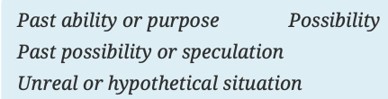
- It could be in any field-sports, science, arts, business or design.
- “I wish I could be this or the other,” they have never got beyond just wishful thinking.
- They could have preferred to trade their dream for security.
- I know too, of people who had wished to finish secondary school but they had to go out to work so that they could support their siblings through school.
Answer:
- Possibility
- Unreal or hypothetical situation
- Past possibility or speculation
- Past ability or purpose
V. Complete the following sentences using ‘could’ with the functions mentioned within brackets.
1. I wish _______ without worrying about money. (unreal or hypothetical)
Answer: I could live
2. They _______ the shorter route, but they didn’t know about it. (past possibility or speculative)
Answer: could have taken
3. When I was younger, I _______ without stopping. (past ability)
Answer: could run
4. She _______ the library right now-she had mentioned it. (possibility)
Answer: could be in
5. _______ repeat the question? I didn’t hear it clearly. (formal/polite request)
Answer: Could you
VI. Fill in the blanks with suitable grammatical forms of the words given in brackets.
Experiential learning is an approach to education that focuses on learning through experience, action and reflection. It 1. _______ (help) students gain practical knowledge and develop real-world skills. Traditionally, students 2. _______ (learn) by listening to lectures and memorising facts, but experiential learning has changed this process.
In an experiential setting, students 3. _______ (work) on projects, solve problems, and take part in activities that reflect real-life challenges. They 4. _______ (apply) what they have learned in class to new and unfamiliar situations. For example, a student studying science 5. _______ (conduct) experiments to test a theory, while a business student 6. _______ (analyse) a case study to understand market trends.
Reflection is key to this process. After completing a task, learners 7. _______ (must/ reflect) on what went well and what could be improved. This reflection 8. _______ (help) them build a deeper understanding of the topic.
Educators believe that experiential learning 9. _______ (be) more effective than passive learning methods because it is engaging and meaningful. In the future, more schools and universities 10. _______ (incorporate) experiential learning into their curriculum to prepare students for the real world.
Answer:
- helps
- learn
- work
- apply
- conducts
- analyses
- must reflect
- will help
- is
- will incorporate
Listen and Respond (NCERT Textbook Page No. 241)
I. You will listen to an announcement regarding vocational courses starting in school. As you listen, fill in the blanks with one to three exact words that you hear. (Transcript for teacher on page 275)
1. Vocational courses will begin in the month of _______ .
Answer: April
2. The objective of the courses is to prepare you with _______ for future studies and jobs.
Answer: practical skill
3. Offered courses include Graphic Design, _______ ,Web Application, and Entrepreneurship Skills, etc.
Answer: Basic coding, Artificial Intelligence, Multimedia, Data Science
4. Classes will be conducted by _______ at school.
Answer: trained professionals
5. The application forms will be available at the _______ .
Answer: school office
6. Choice of course will be given to _______ applicants.
Answer: all
Writing Task (NCERT Textbook Page No. 242-243)
I. Write an email to the Director of a reputed design institute enquiring about a summer workshop and expressing your interest in joining it.
An email (electronic mail) is a method of composing, sending, storing, and receiving messages over an electronic communication system.
I. You are passionate about pursuing a course in designing in future. You come across a summer workshop being conducted by a reputed design institute. Write an email to the Director of the institute enquiring the details of the workshop and expressing your interest in joining it.
Follow the guidelines given below to write the email.
- Use formal language
- Avoid use of abbreviations
- Include the following components:
- Header consisting of-sender, receiver, date, and subject
- The message-introduction, seeking permission, conclusion
- Complementary close-Yours sincerely,
- Name, (designation), and contact details of the sender
Format of an email:

Answer:
From: arjun.sharma@email.com
To: director@designinstitute.edu.in
Cc: admissions@designinstitute.edu.in
Bcc: (left blank)
Date: 18 March 2026
Subject: Enquiry Regarding Summer Design Workshop
Dear Sir/Madam,
I am a student who is deeply interested in pursuing a career in designing. I recently came to know that your reputed institute is organising a summer design workshop, and I am very interested in joining it.
I would be grateful if you could provide me with details regarding the dates and duration of the workshop, course content, eligibility criteria, fees, application procedure, and last date for registration. I would also like to know whether any materials or equipment are required for participating in the workshop.
I believe that attending this workshop will help me improve my creative skills and gain valuable exposure to the field of design. I look forward to your response and hope to get an opportunity to participate.
Yours sincerely,
Arjun Sharma
Student
Contact: 98XXXXXXXX
Class 9 English Chapter 8 NCERT Questions and Answers
The letter Follow That Dream offers a mother’s advice to her daughter about ambition and the future. It combines encouragement with realistic reflection on the time, work, resources, and support needed to pursue a meaningful goal.
Students also explore perseverance, changing aspirations, and thoughtful decision-making. The chapter helps them understand the writer’s caring tone and explain how practical preparation can work alongside enthusiasm and self-belief.