

NCERT Solutions for Class 9 English Kaveri Poem 1 Bharat Our Land are provided here with simple and easy-to-understand explanations. This poem is included in Unit 1 of the NCERT textbook Kaveri. It explores love for India and pride in its natural beauty, knowledge, and cultural heritage. These NCERT Solutions for Class 9 help students understand the main ideas, complete textbook activities, improve their language skills, and prepare for school examinations.
Bharat Our Land Class 9 English Questions and Answers
Reflect and Respond (NCERT Textbook Page No. 23)
I. Recall the lines of the National Anthem and complete the table given below with the names of the states, mountain ranges, and rivers mentioned in it.
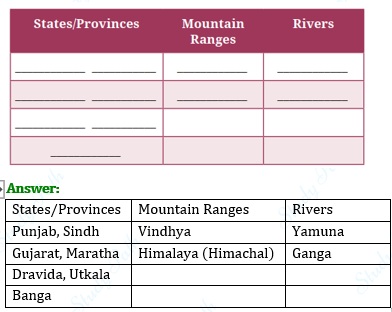
II. Work in pairs. Discuss what the words ‘जय हे’ (Jaya he) in the last two lines of the National Anthem convey. Share your answer with your classmates and teacher.
Answer: The words ‘जय हे’ (Jaya he) mean “victory to you” or “may you be victorious.”
They express a powerful wish that the nation will always emerge victorious over challenges and difficulties. These words convey a feeling of unity, patriotism, and admiration for India.
III. Read the underlined words in the given lines of the poem. Choose the odd one out that does not correspond with the meaning of the underlined word.
1. She’s peerless, let’s praise her! valuable, incomparable, unmatched
Answer: valuable
Peerless means incomparable or unmatched.
2. Many a sage has sanctified this land. blessed, purified, applauded
Answer: applauded
Sanctified means blessed or purified
3. And here all auspicious things are found. fortunate, fantastic, favourable
Answer: fantastic
Auspicious means fortunate or favourable.
4. Of hoary antiquity is Bharat, ancient times, recent past, time immemorial
Answer: recent past
Hoary antiquity means ancient times or time immemorial.
Check Your Understanding (NCERT Textbook Page No. 25-28)
I. Fill in the blanks by choosing appropriate words from the box given below to complete the summary of the poem.
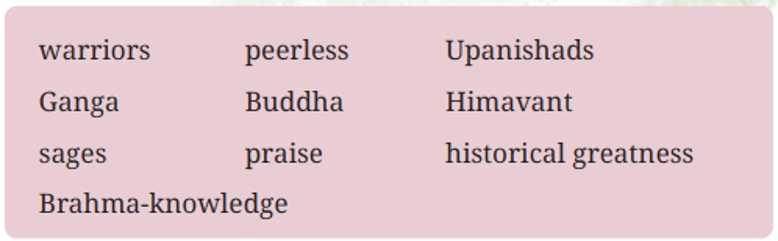
The poem is a tribute to India, celebrating its natural beauty, spiritual heritage, and 1. _______ . The poet praises the 2. _______ , describing it as mighty and unparalleled. The 3. _______ is depicted as generous and graceful, while the 4. _______ are honoured as sacred and unmatched. The poem highlights the contributions of 5. _______ and 6. _______ who have enriched the land with their bravery and wisdom. It also acknowledges the presence of 7. _______ and the teachings of 8. _______ , highlighting India’s deep-rooted spiritual and philosophical traditions. The poet repeatedly asserts that India is 9. _______ , urging everyone to 10. _______ her.
Answer:
1. historical greatness
2. Himavant
3. Ganga
4. Upanishads
5. warriors
6. sages
7. Brahma-knowledge
8. Buddha
9. peerless
10. praise
II. Complete the following features about the poem.
1. The impact on the readers (mood): _______.
Answer: Pride, inspiration, and admiration for the nation
2. The poet’s attitude (tone): _______.
Answer: Proud and celebratory
3. The rhyme scheme: _______.
Answer: The rhyme scheme: ABAB
4. Examples of personification: _______.
Answer: Examples of personification:
- “The generous Ganga is ours” (the river is described as generous)
- “Which other river can match her grace?” (the river is given human qualities)
- “This sunny golden land is ours – she’s peerless” (the land is referred to as a woman (mother land))
- “Let’s praise her” (the land is spoken of as a person)
III. What is the impact of the refrain, ‘she’s peerless, let’s praise her!’?
Answer: The refrain “she’s peerless, let’s praise her!” emphasises that Bharat is unique and unmatched. Its repetition strengthens the poet’s pride and admiration for the country. It also creates a strong feeling of patriotism in the readers and encourages them to appreciate and praise the greatness of India.
IV. Complete the following sentence appropriately.
India is metaphorically described as ‘this sunny golden land, ‘suggesting that it is ______ .
Answer: India is metaphorically described as “this sunny golden land,” suggesting that it is bright, beautiful, prosperous and glorious.
V. The poet uses symbolism. Match the symbols in Column 1 to what they suggest in Column 2.
| Column 1 | Column 2 |
| 1. Himavant | (i) knowledge and enlightenment |
| 2. Ganga | (ii) spiritual and philosophical legacy |
| 3. Upanishads | (iii) purity and generosity |
| 4. Gallant warriors and sages | (iv) richness and glory |
| 5. Brahma-knowledge and Buddha’s Dhamma | (v) strength and permanence |
| 6. Sunny golden land | (vi) courage and wisdom |
Answer:
| Column 1 | Column 2 |
| 1. Himavant | (v) strength and permanence |
| 2. Ganga | (iii) purity and generosity |
| 3. Upanishads | (ii) spiritual and philosophical legacy |
| 4. Gallant warriors and sages | (vi) courage and wisdom |
| 5. Brahma-knowledge and Buddha’s Dhamma | (i) knowledge and enlightenment |
| 6. Sunny golden land | (iv) richness and glory |
VI. The poet uses imagery (descriptive language to create vivid mental pictures that appeal to the senses). Give any two examples from the poem.
Answer: The poet uses imagery, which is descriptive language that creates vivid mental pictures. Two examples of imagery from the poem are:
(a) “The mighty Himavant is ours” – This creates a vivid picture of the majestic Himalayan mountains.
(b) “This sunny golden land is ours” – This creates an image of India as a bright, beautiful and glorious land.
VII. What is the impact of the use of hyphens in the first stanza? Select the options that are true.
1. Creates deliberate pauses to reinforce the sense of admiration and pride
2. Emphasises the contrast between India’s strengths and weaknesses
3. Lends to the lyrical quality giving it a measured, chant-like rhythm
4. Suggests hesitation or uncertainty in the poet’s claims about India
5. Presents a key element of India’s greatness before the hyphen and makes a strong assertion about its uniqueness after the hyphen
Answer: The true options are:
1. Creates deliberate pauses to reinforce the sense of admiration and pride
3. Lends to the lyrical quality giving it a measured, chant-like rhythm
5. Presents a key element of India’s greatness before the hyphen and makes a strong assertion about its uniqueness after the hyphen
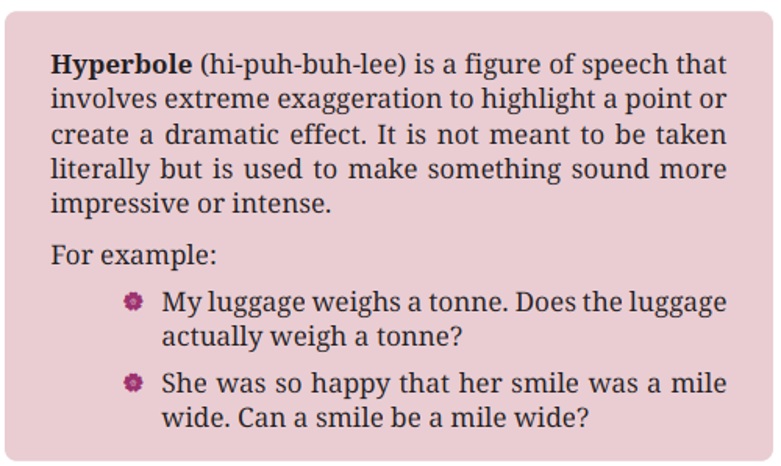
VIII. The poet uses hyperbole in the poem.
IX. The poem is an ode.
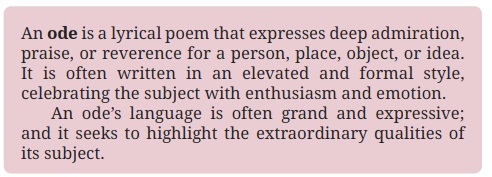
Now, identify examples from the poem that correspond to it being an ode.
Answer: Examples from the poem that show it is an ode include:
- “The mighty Himavant is ours” — praises the greatness and majesty of the Himalayas.
- “The generous Ganga is ours” — expresses admiration for the Ganga and its grace.
- “The sacred Upanishads are ours” — celebrates India’s spiritual and philosophical heritage.
- “This sunny golden land is ours” — glorifies India’s beauty and richness.
- “She’s peerless, let’s praise her!” — directly expresses admiration and encourages everyone to praise India.
- “Gallant warriors have lived here” — honours the courage of India’s warriors.
- “Many a sage has sanctified this land” — praises India’s spiritual heritage and wise sages.
X. The poet uses allusion in the poem.
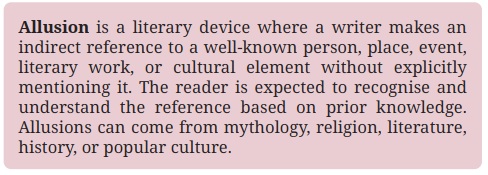
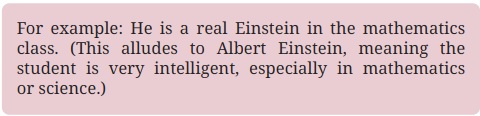
Now, read the explanations and identify the matching allusions from the poem for the following.
- An allusion to the ancient Indian scriptures that form the philosophical core and symbolise deep wisdom and enlightenment.
Answer: Upanishads
- An allusion to the concept of spiritual knowledge associated with self-realisation and ultimate truth.
Answer: Brahma-knowledge
- An allusion to Gautama Buddha’s teachings, which include compassion, non-violence, and enlightenment. This highlights India’s role in shaping major religious and philosophical traditions.
Answer: Buddha’s Dhamma
Critical Reflection (NCERT Textbook Page No. 28-29)
I. I Read the extract given below and answer the questions that follow.
The mighty Himavant is ours
there’s no equal anywhere on earth.
The generous Ganga is ours
which other river can match her grace?
The sacred Upanishads are ours
what scriptures else to name with them?
1. Complete the sentence.
The word ‘mighty’refers to the _______ of the Himavant.
Answer: strength and greatness.
2. Choose the correct option to complete the sentence given below.
The question mark at the end of the fourth and sixth line of the extract is used to ______.
(i) show doubt and uncertainty
(ii) emphasise a point
(iii) highlight confusion and hesitation
(iv) reveal inquiry and curiosity
Answer: (ii) emphasise a point
3. The poet uses the word ‘generous’ to describe the Ganga. Why?
Answer: The poet uses the word “generous” for the Ganga because it is seen as a giving and life-supporting river. It provides water and supports the lives of people and nature. By calling it generous, the poet highlights the importance, grace and abundance of the Ganga and praises its contribution to India.
4. Why has the movement of the river been described as graceful?
Answer: The movement of the Ganga is described as graceful because the poet imagines the river flowing smoothly, beautifully, and gently. It highlights the river’s natural beauty and adds to the poet’s admiration for the Ganga.
5. Fill in the blank with the correct option from the words given in the brackets.
The poet is implying that the Upanishads are _______ (unmatched/abundant) in their wisdom and spiritual depth.
Answer: unmatched
II. Answer the following questions
1. How does the poem reflect a strong connection to cultural identity and heritage?
Answer: The poem reflects a strong connection to cultural identity and heritage by celebrating India’s natural beauty, spiritual traditions, history, and great people. The poet praises the Himavant, Ganga, Upanishads, warriors, sages, Brahma-knowledge, and Buddha’s Dhamma, showing pride in India’s rich cultural and spiritual heritage.
2. What can you infer about the poet’s attitude towards India from the repeated phrase ‘she’s peerless, let’s praise her!’?
Answer: The repeated phrase “she’s peerless, let’s praise her!” shows that the poet has a deep sense of pride, admiration and love for India. He considers India unique and unmatched in its natural beauty, spiritual heritage and history. The repetition strongly emphasises his patriotic feelings and encourages readers to appreciate the greatness of their country.
3. What does the line ‘many a sage has sanctified this land’ suggest about India’s spiritual heritage?
Answer: The line “many a sage has sanctified this land” suggests that India has a rich and ancient spiritual heritage. Many sages and wise people have lived here and contributed to its spiritual and philosophical traditions. The poet presents India as a sacred land of wisdom, knowledge and spiritual teachings.
4. How does the poet connect warriors and music to India’s greatness?
Answer: The poet connects warriors and music to India’s greatness by showing that the country has produced brave warriors and has also been a home to divine and beautiful music. Together, they represent India’s courage, cultural richness, and artistic heritage.
5. How does this poem foster a sense of national pride?
Answer: The poem fosters a sense of national pride by praising India’s natural beauty, spiritual heritage, history and culture. It celebrates the Himavant, Ganga and Upanishads, and honours the warriors and sages who enriched the land. The repeated line “she’s peerless, let’s praise her!” strengthens the poet’s admiration and encourages readers to feel proud of India.
Vocabulary in Context (NCERT Textbook Page No. 29-30)
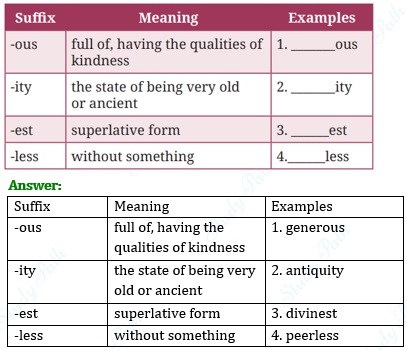
I. Complete the table by choosing words from the poem.
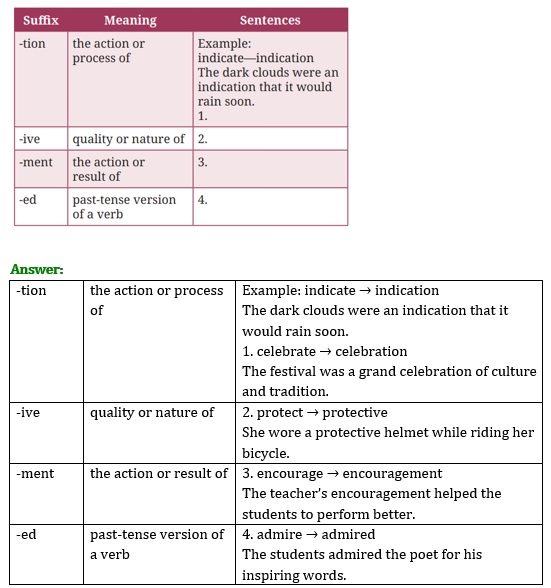
II. Complete the following table by adding a different suffix to form new words. Also, create a sentence using the created word. One example has been done for you.
Listen and Respond (NCERT Textbook Page No. 30-31)
I. You will listen to four people talk about the places they like to travel to. As you listen, write the speaker number for the two pictures given. (Transcript for teacher on page 260)
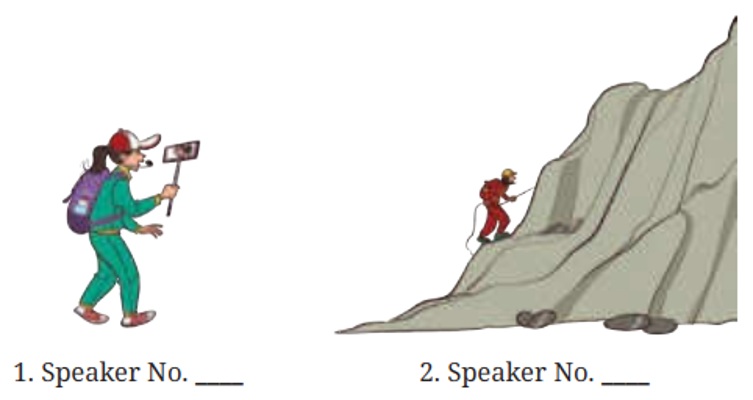
Answer:
1. Speaker No. 4
2. Speaker No. 2
II. You will once again listen to the four speakers. As you listen, match the given statements to the speaker. There are two statements that you do not need. (Transcript for teacher on page 260)
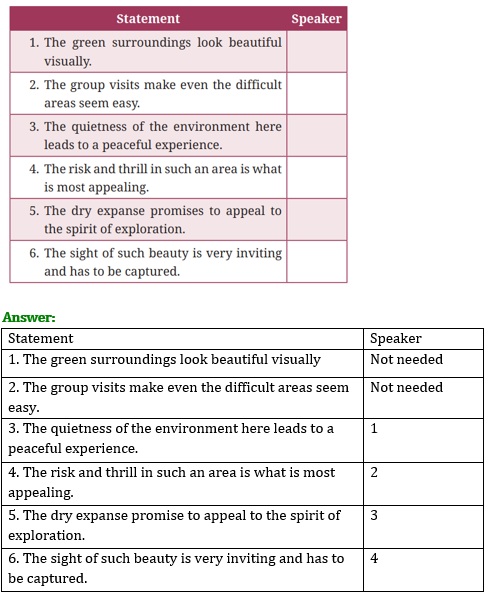
Answer:
| Statement | Speaker |
| 1. The green surroundings look beautiful visually | Not needed |
| 2. The group visits make even the difficult areas seem easy. | Not needed |
| 3. The quietness of the environment here leads to a peaceful experience. | 1 |
| 4. The risk and thrill in such an area is what is most appealing. | 2 |
| 5. The dry expanse promise to appeal to the spirit of exploration. | 3 |
| 6. The sight of such beauty is very inviting and has to be captured. | 4 |
Speaking Activity (NCERT Textbook Page No. 31-32)
I. In pairs, take turns to speak about the aspects of your village/town/city that you feel are an asset. It could be about geographical, cultural, traditional features, or even its history.

Use these cues to express your praise and admiration.
- One thing that I find truly wonderful about my village/town/city is…
- If I had to describe my village/town/city in one word, it would be…
- I have always been fascinated by the way the people of my village/town/city…
- What I want other people to know about my village/town/city is…
- When it comes to the scenery, my village/town/ city truly shines because…
- I feel a deep sense of pride when I think about my village/town/city…
Answer: One thing that I find truly wonderful about my city is its blend of modern life and traditional culture. If I had to describe my city in one word, it would be vibrant. I have always been fascinated by the way people here celebrate festivals and respect different traditions. When it comes to scenery, the green parks and beautiful surroundings make it special. I feel a deep sense of pride when I think about my city.
Writing Task (NCERT Textbook Page No. 32)
I. Write a paragraph about a place that you have visited which has stayed in your memory.
Remember to mention the following:
- Why did you go there?
- Who did you travel with?
- How did you prepare for the travel?
- Where did you stay?
- What activities did you do there?
Answer: Last year, I visited Jaipur with my parents during the winter holidays. We planned the trip a few weeks earlier and packed comfortable clothes, medicines and other essentials. We stayed in a cosy hotel near the city centre. During our visit, we explored the Amber Fort, City Palace and Hawa Mahal. We also enjoyed the local food and walked through the colourful markets. The beautiful architecture and lively atmosphere made the trip unforgettable.
Learning Beyond the Text (NCERT Textbook Page No. 32)
I. Search for poems or songs dedicated to India, your motherland, in your regional language. Share them with your classmates and explain their meaning too.
Answer: A famous patriotic song in Hindi is “ऐ मेरे वतन के लोगों” (Ae Mere Watan Ke Logon). It is dedicated to India and honours the bravery and sacrifice of Indian soldiers. The song reminds citizens to respect the sacrifices made for the country and encourages a feeling of patriotism, gratitude, and national unity.
Meaning: The song calls upon the people of India to remember the soldiers who sacrificed their lives for the nation and to remain proud of their motherland.
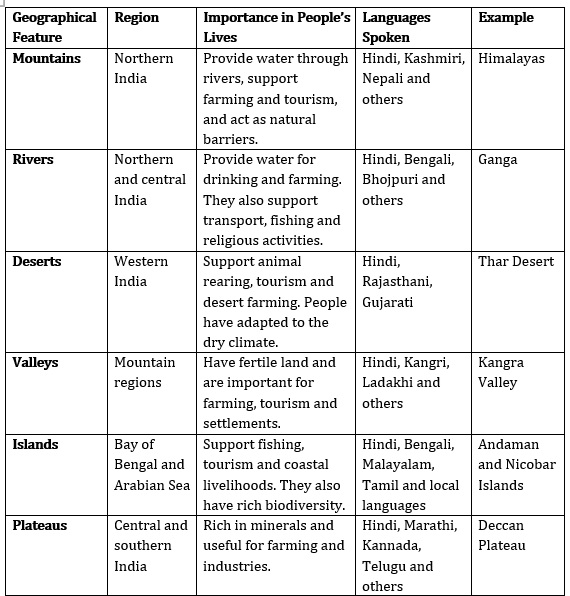
II. In groups of six, prepare an interdisciplinary project on India’s major geographical features. For each feature, describe the region, explain its importance in the lives of the people living there and mention the languages spoken in that region. Include one example of each of the following:
- Mountains – Himalayas, Western Ghats, etc.
- Rivers – Ganga, Yamuna, Krishna, Kaveri, Godavari, etc.
- Deserts – Thar Desert, Rann of Kutch, etc.
- Valleys – Kangra Valley, Nubra Valley, etc.
- Islands – Andaman and Nicobar Islands, Lakshadweep, etc.
- Plateaus – Deccan, Malwa, Meghalaya, etc.
Answer:
About the Poem: Bharat Our Land
The poem Bharat Our Land celebrates India through images of its landscape and its rich spiritual and intellectual traditions. The speaker’s admiration expresses a strong sense of belonging and respect for the country’s heritage.
Students also explore the poem’s imagery, tone, and central idea. The activities help them appreciate patriotic expression, interpret descriptions, and explain how the poet conveys pride in the land.