

NCERT Solutions for Class 9 English Kaveri Poem 2 Gifts of Grace: Honouring Our Vocations are provided here with simple and easy-to-understand explanations. This poem is included in Unit 2 of the NCERT textbook Kaveri. It explores the dignity of work and the contributions of people in different occupations. These NCERT Solutions for Class 9 help students understand the main ideas, complete textbook activities, improve their language skills, and prepare for school examinations.
Gifts of Grace: Honouring Our Vocations Class 9 Questions and Answers
Reflect and Respond (NCERT Textbook Page No. 57)
I. Given below are four riddles. Read and identify who these people are.
1. “In furrows deep, secrets I sow,
As time passes, I watch them grow.”
Who am I? __________.
Answer: A farmer.
The riddle refers to sowing seeds in ploughed soil and watching crops grow, which is the primary work of a farmer.
2. “From wheel to kiln, my skill is born,
Step by step, an art takes form.”
Who am I? __________.
Answer: A potter.
The riddle describes working with clay on a potter’s wheel and firing pots in a kiln, which are the hallmarks of a potter’s craft.
3. “I lay foundations, brick by brick,
To build a house, it’s me you pick.”
Who am I? __________.
Answer: A mason.
The riddle describes laying bricks and building foundations, which is the primary work of a mason or construction worker.
4. “I work with pots, pans, and spice,
Creating dishes that taste so nice.”
Who am I? __________.
Answer: A cook.
The riddle refers to someone who works in a kitchen, using pots, pans, and spices to create delicious food.
II. What is the role and relevance of the people you identified in the riddles? How do they contribute to society? Discuss with your classmates and teacher.
Answer: The farmer grows the food that sustains the population and secures the nation’s food supply. The potter keeps alive a cultural tradition, shaping vessels for daily use as well as decorative items that carry a community’s artistic heritage. The mason builds society’s physical infrastructure, from homes to schools and hospitals. The cook nourishes people and preserves regional food culture. Together, these four vocations meet some of the most basic human needs, yet the people behind them are often overlooked.
Check Your Understanding (NCERT Textbook Page No. 60 – 61)
I. Based on your understanding of the poem, state whether the following statements are true or false. Also, rectify the false statements.
1. The poem highlights the skilled work of craftsperson.
Answer: True
2. The poet shares that musicians express emotions through their instruments.
Answer: True
3. The carpenters in the poem are admired for their logical work.
Answer: True
4. The electricians in the poem are recognised for their crucial role in lighting up lives.
Answer: True
5. The poem pays homage to shoemakers who manufacture quality footwear.
Answer: True
6. The poem celebrates the patriotism of the people of Bharat.
Answer: False
Reason: The poem talks about how different professionals enjoy their work and praises their crucial roles and contribution in the development of Bharat (India) not patriotism.
7. The poet feels that each vocation deserves to be respected.
Answer: True
II. Let us appreciate the poem.
1. Rhyme Scheme and Lineation
(i) Does the poem strictly adhere to a rhyme scheme, or is it in free verse?
Answer: The poem does not follow a traditional rhyme scheme. It is written in free verse. The words at the ends of lines, such as “vocations,” “hues,” “streets,” “precision,” and “work,” do not follow any regular rhyming pattern. This gives the poem a natural and flexible flow.
(ii) What is the impact of the varying length of lines in the poem?
Answer: The varying length of the lines gives the poem a natural and flexible rhythm. It helps the poet give emphasis to different vocations and their contributions. The changing line lengths also create a lively flow, reflecting the variety of work and activities described in the poem.
(iii) What is the pattern in the structure of most lines of the poem?
Answer: Most lines follow a similar sentence structure, beginning with “The” or “I hear” and then describing a particular vocation and the work done by it. This repeated structure creates unity and rhythm in the poem while highlighting the different skills and contributions of various workers.
2: Speaker
(i) Who appears to be the speaker and what is her/his role here?
Answer: The speaker appears to be a person who observes and appreciates the different vocations of people in Bharat. The speaker listens to and describes the work of craftspersons, musicians, carpenters, electricians and other workers. His/her role is to celebrate their skills and contributions and show that every vocation is valuable and deserves respect.
3: Tone and Mood
(i) Fill in the blanks with suitable options from the box given below.
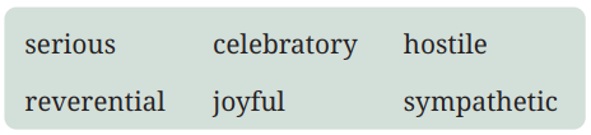
A. The tone is __________ and __________ , depicting a sense of admiration and respect for the artisans and craftspersons.
B. There is a __________ mood throughout the poem, capturing the vibrancy and richness of cultural traditions and skills.
Answer:
A. The tone is reverential and celebratory, depicting a sense of admiration and respect for the artisans and craftspersons.
B. There is a joyful mood throughout the poem, capturing the vibrancy and richness of cultural traditions and skills.
4: Imagery
(i) Select any two descriptions from the poem that evoke visual images.
Answer: 1. ‘The carpenters celebrating; they create anything out of wood with mathematical precision’ — evokes the image of a skilled carpenter measuring and cutting wood with careful accuracy.
2. ‘The boatmen gathering their nets from the shore, sailing, and singing while at work’ — paints a vivid picture of fishermen hauling their nets at dawn on a sunlit shore.
(ii) Fill in the blanks with suitable phrases.
The poem includes auditory imagery through mentions of artisans with lutes, _________________ , and _________________ , emphasising the sounds associated with each vocation.
Answer: The poem includes auditory imagery through mentions of artisans with lutes, the electricians humming, and the delicious singing of the cook, emphasising the sounds associated with each vocation.
5. Metaphor
(i) State whether the following sentence is true or false.
The mention of ‘delicious singing’ of the cook is a metaphor because it implies that the quality of the singing is so enjoyable or pleasing that it can be equated to the experience of tasting something delicious.
Answer: The statement is true.
Explanation: Calling the cook’s singing “delicious” is a metaphor because it compares the pleasure of hearing the singing to the pleasure of tasting something tasty, without using “like” or “as.” It’s a direct figurative comparison, which is the essence of a metaphor.
6: Personification
(i) Select the line that tells us that the poet personifies vocations by attributing humanlike qualities to them.
Answer: The word “celebrating” gives a human quality (celebration) to the vocation/work of carpenters. This makes the work appear alive and joyful, which is an example of personification.
7: Repetition
(i) Why might the poet have begun and ended with the same line- ‘I hear Bharat celebrating, the varied vocations I hear!’?
Answer: The poet begins and ends with the same line to emphasise the celebration of different vocations in Bharat. The repetition gives the poem a strong, rhythmic structure and reinforces the idea that every vocation is valuable. It also leaves the reader with a lasting feeling of admiration and respect for the skills and contributions of workers.
8. Alliteration
(i) Identify two examples of alliteration from the poem.
Answer: 1. ‘celebrating their craft’ — the repetition of the ‘c’ sound.
2. “varied vocations” – repetition of the ‘v’ sound.
9. Symbolism
(i) Each vocation in the poem symbolises something more than just a job. What does it symbolise?
Answer: Each vocation symbolises a valuable skill, identity and contribution to society. The poet shows that every worker, whether a craftsperson, carpenter, electrician, cook or shoemaker, has a unique role in making life better. Thus, the different vocations symbolise the diversity, dignity and richness of Bharat’s people and their work.
Reflect and Respond (NCERT Textbook Page No. 62-63)
I: Read the extract given below and answer the questions that follow.
The shoemakers affirming the quality of their work, for the feet that walk, dance, run, jump, return home.
The delicious singing of the cook, or the rhythm of designer, mason, each celebrating what belongs to them and to none else,
1. The poet says that the shoemakers ‘affirm’ the quality of their work. What does ‘affirm’ refer to here?
(i) to make adjustments in
(ii) to declare with confidence
(iii) to label the goods
(iv) to justify the efforts
Answer: (ii) to declare with confidence
2. What do quality shoes help with, according to the poet?
Answer: According to the poet, quality shoes help the feet to walk, dance, run, jump and return home comfortably.
3. What does ‘return home’ symbolise besides the literal act of returning?
Answer: The phrase “return home” symbolises comfort, safety, and a sense of belonging. It suggests that after walking, dancing, running, or working, people eventually return to a place where they feel safe, connected, and at peace.
4. Identify the phrase that tells us that every worker’s contribution is distinct.
Answer: The phrase is “each celebrating what belongs to them and to none else”. It shows that every worker has a unique skill and contribution that is different from others.
5. Complete the following with suitable words.
…for the feet that walk, dance, run, jump, return home refers to __________ .
Answer: …for the feet that walk, dance, run, jump, return home refers to the varied everyday activities and movements of human life.
II. Answer the following questions.
1. Why does the poet say, ‘I hear Bharat celebrating, the varied vocations I hear’?
Answer: The poet says this because the different vocations of Bharat’s people create a lively and beautiful picture of the country. Craftspersons, musicians, carpenters, electricians, shoemakers, cooks and other workers all celebrate their skills through their work. The line shows that their varied skills and contributions are like a celebration of Bharat’s diversity and richness.
2. What does the electrician ‘humming’ while getting ready for work suggest?
Answer: The electrician “humming” while getting ready for work suggests that he is cheerful, energetic and comfortable with his work. It shows that his vocation is not merely a job but something he takes pride and joy in doing.
3. Explain the significance of the line, ‘The voice of their vocation is the voice of their identity.’
Answer: The line means that a person’s vocation is an important part of their identity. The work they do expresses their skills, talents and individuality. In the poem, each worker celebrates what belongs to their own craft. Thus, the poet shows that every vocation gives a person a sense of identity, pride and purpose.
4. Do you think the role of all the people belonging to different vocations is important in our daily lives? Support your answer with a reason.
Answer: Yes, people belonging to different vocations play an important role in our daily lives. Their skills and services meet our everyday needs. For example, shoemakers provide footwear, carpenters make useful wooden items, electricians brighten our homes, and cooks prepare food. Every vocation therefore makes an important contribution to society.
5. Why is the poet celebrating all the vocations in the poem? Explain by giving examples from your context.
Answer: The poet celebrates all vocations because every kind of work is valuable and contributes to society. He respects craftspersons, musicians, carpenters, electricians, shoemakers and cooks for their skills. In our daily lives, for example, electricians provide light, carpenters make useful furniture, and shoemakers provide footwear. The poem reminds us to respect every worker and their contribution.
6. How does the poet use sensory imagery to bring out the beauty of everyday work?
Answer: The poet uses sensory imagery to make everyday work feel lively and beautiful. We can hear the artisans playing lutes, the electricians humming, and the cook singing. We can also imagine carpenters creating things from wood and shoemakers making footwear. These sounds and images help us visualise and experience the workers’ skills, making their ordinary work seem like a celebration.
Vocabulary in Context (NCERT Textbook Page No. 63)
I. People of different vocations are being described in the poem. Match the vocations given in the box below with the descriptions that follow.

1. A person who studies or grows garden plants: __________.
Answer: horticulturist
2. A trained female community health worker: __________.
Answer: ASHA worker
3. A producer of raw silk: __________.
Answer: sericulturist
4. A person whose job is making or selling sweets and chocolates: __________.
Answer: confectioner
5. A metalworker who specialises in working with precious metals: __________.
Answer: goldsmith
6. A person who fuses materials together: __________.
Answer: welder
II. Identify the word from Column 2 that is NOT a synonym of the word in Column 1.
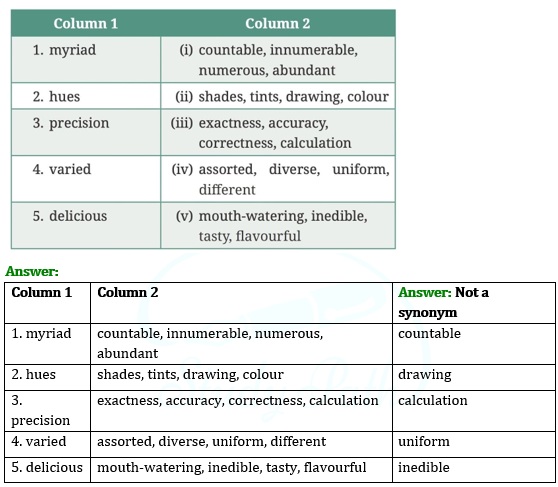
Vocabulary in Context (NCERT Textbook Page No. 64)
I. You will listen to two friends, a boy and a girl, discussing the occupations of their parents. As you listen, answer the following question in two to three words only.
(Transcript for teacher on page 262)
What does the boy use to understand the details of the tools?
Answer: [This is a listening-comprehension question answered from the audio transcript on page 262, which is provided only to the teacher and is not part of the printed text. Please refer to the transcript to confirm the exact answer before publishing.]
II. You will listen to the girl and the boy once again. As you listen, answer the questions by selecting the correct option.
1. The girl is ________ about taking food for her mother at the factory.
(i) happy
(ii) boastful
(iii) unsure
Answer: (i) happy
2. The boy thinks that the job of the girl’s mother carries a lot of ________.
(i) luck
(ii) risk
(iii) responsibility
Answer: (iii) responsibility
3. The girl __________ why the boy is good at science exhibitions.
(i) wonders
(ii) questions
(iii) realises
Answer: (i) wonders
4. The girl shares her __________ about joining the weekend discussion on tools.
(i) doubts
(ii) wish
(iii) ideas
Answer: (ii) wish
About the Poem: Gifts of Grace: Honouring Our Vocations
The poem Gifts of Grace: Honouring Our Vocations celebrates the skills and dedication of workers across a variety of vocations. Its descriptions show how craft, service, and creativity contribute to everyday life and give people a sense of identity.
Students also explore the poem’s appreciation of diversity and the value of every occupation. The activities encourage them to recognise descriptive details, understand the central message, and express respect for the work of others.