

NCERT Solutions for Class 9 English Kaveri Poem 3 Canvas of Soil are provided here with simple and easy-to-understand explanations. This poem is included in Unit 3 of the NCERT textbook Kaveri. It explores the beauty of gardening and the imaginative connection between nature and painting. These NCERT Solutions for Class 9 help students understand the main ideas, complete textbook activities, improve their language skills, and prepare for school examinations.
Canvas of Soil Class 9 English Questions and Answers
Reflect and Respond (NCERT Textbook Page No. 86-87)
I. Work in pairs. Discuss what all you see in a garden. Think of the colours you see and where you see them. Share your responses with your teacher.
Answer: In a garden, we can see green grass, colourful flowers, trees, plants, bushes, butterflies, birds, and sometimes a small pond or fountain. The grass and leaves are mostly green, flowers may be red, yellow, pink, purple, or white, and the sky above may appear blue. These colours make the garden look fresh and beautiful.
II. Look at the picture of a garden and a painting given below. Speak about any similarities between the garden and the painting.
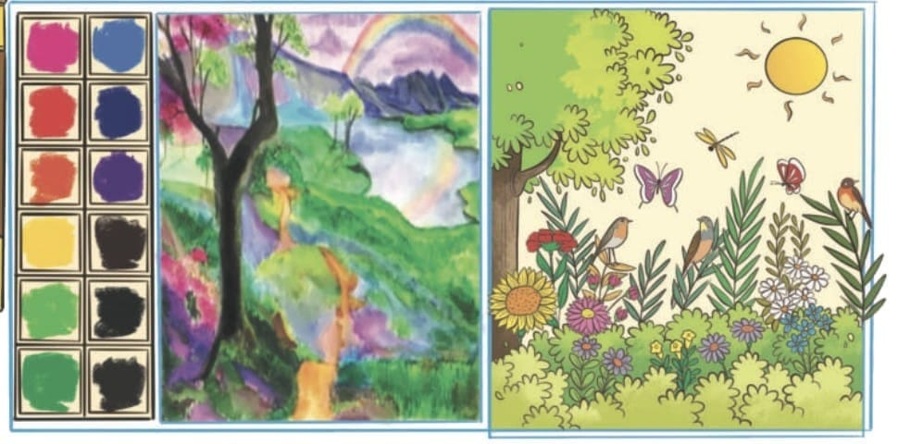
Speak using the following:
- Just as a garden ______________, similarly, a painting ______________.
- A garden and a painting, both ________.
- ______________ is common to both a garden and a painting.
- Like a garden, a painting too __________.
Answer:
- Just as a garden is filled with colours arranged naturally by plants, similarly, a painting is filled with colours arranged deliberately by an artist.
- A garden and a painting, both use colour, contrast, and arrangement to create a harmonious whole that evokes emotion.
- Creativity is common to both a garden and a painting – the gardener and painter both make deliberate aesthetic choices.
- Like a garden, a painting too tells a story through colours, textures, and forms placed with intention.
III. Let us acquaint ourselves with the meanings of palette, hue, and canvas.
- Palette: a thin oval or rectangular board or tablet that a painter holds and mixes colours on.
- Hue: shade of a colour
- Canvas: (here) painting
Now, look at the painting given above and identify palette, canvas, and select a hue.
Answer: The first picture is of the palette, the third picture is of canvas and the second painting is of hue (shades of colour).
- Palette – The earth serves as the palette: the surface on which the colours of flowers, grass, and plants are held. In a painting, it is the board where the artist mixes colours.
- Canvas – Each garden plot is the canvas – the broad surface on which the gardener “paints” with plants and blooms.
- A hue – The vibrant red of spring blossoms or the varied green of leaves.
Check Your Understanding (NCERT Textbook Page No. 87-89)
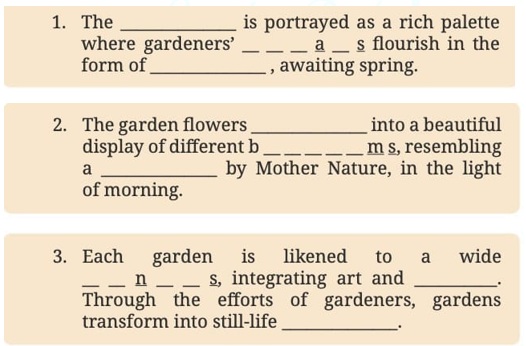
I. Read the poem again and complete the summary of each stanza by filling in the blanks.
Answer:
1. The earth / soil is portrayed as a rich palette where gardeners’ dreams flourish in the form of seeds, awaiting spring.
2. The garden flowers bloom into a beautiful display of different blossoms, resembling a painted artwork by Mother Nature, in the light of morning.
3. Each garden is likened to a wide canvas, integrating art and life. Through the efforts of gardeners, gardens transform into still-life paintings.
II. Select the appropriate title for each stanza from those given below. There are two extra titles.
1. Nature’s Work of Art
2. Sweet-smelling Blossoms
3. Gardens as Living Canvases
4. Earth and Possibilities
5. The Painter’s Canvas
Answer:
- Stanza 1 → Earth and Possibilities – the earth is described as a rich palette and seeds as brushstrokes, full of potential awaiting spring.
- Stanza 2 → Nature’s Work of Art – celebrates the blooming garden as Nature’s own masterpiece with shades of green, red, and blue.
- Stanza 3 → Gardens as Living Canvases – every plot is likened to a canvas where art and life coincide.
- Extra (unused) titles: Sweet-smelling Blossoms | The Painter’s Canvas
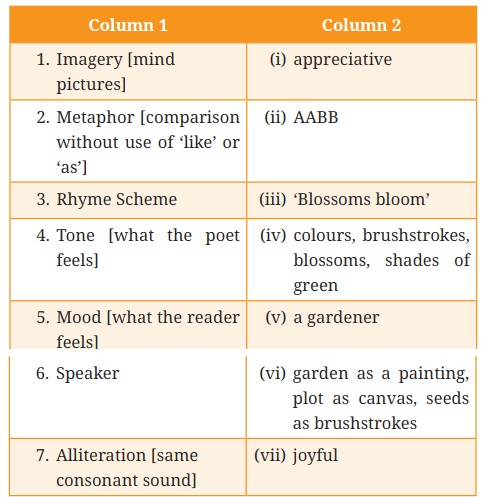
III. Match the poetic devices in Column 1 to the examples in Column 2. Discuss your responses in pairs. Then share the responses with your classmates and teacher.
Answer:
| Column 1 | Column 2 |
| 1. Imagery [mind pictures] | (iv) colours, brushstrokes, blossoms, shades of green |
| 2. Metaphor [comparison without use of ‘like’ or ‘as’] | (vi) garden as a painting, plot as canvas, seeds as brushstrokes |
| 3. Rhyme Scheme | (ii) AABB |
| 4. Tone [what the poet feels] | (i) appreciative |
| 5. Mood [what the reader feels] | (vii) joyful |
| 6. Speaker | (v) a gardener |
| 7. Alliteration [same consonant sound] | (iii) ‘Blossoms bloom’ |
Critical Reflection (NCERT Textbook Page No. 89-91)
I. Read the given extracts from the poem and answer the questions that follow.
1: Brushstrokes of seeds, planted true,
Awaiting spring’s vibrant hue.
(i) The poet has used a metaphor in ‘Brushstrokes of seeds’. Which option from those given below uses a metaphor?
A. Her mother’s heart heard her heartfelt request with kindness.
B. She has a heart of gold.
C. Her heart did a dance of joy on seeing the new doll.
D. She has a very kind heart.
Answer: B. She has a heart of gold.
(ii) Complete the sentence appropriately.
The phrase ‘planted true’ is significant because it implies __________.
Answer: The phrase ‘planted true’ is significant because it implies that the seeds are planted with sincerity, care and honest effort of the gardener.
(iii) Why has the poet used the word ‘hue’ instead of ‘colours’ in the extract?
Answer: The poet uses the word “hue” instead of “colours” because “hue” specifically refers to a shade or variation of a colour. It fits the poem’s artistic imagery and makes the description of the garden’s changing, vibrant colours sound more poetic and vivid.
(iv) Complete the following analogy correctly with a word from the extract.
Summer: hot :: Spring : _________
Answer: Summer: hot :: Spring : vibrant.
(v) Read the Assertion (A) and the Reason (R) and select the option that is correctly suited.
(A): Gardeners wait for Spring.
(R): Gardens are worth painting in Spring.
A. Both (A) and (R) are true and (R) is the correct explanation of (A).
B. Both (A) and (R) are true but (R) is not the correct explanation of (A).
C. (A) is true but (R) is false.
D. (A) is false but (R) is true.
Answer: B. Both (A) and (R) are true but (R) is not the correct explanation of (A).
Explanation:
Assertion (A) is true: Gardeners wait for Spring because it is the season when the seeds planted in the soil can grow and produce vibrant blossoms.
Reason (R) is true: The poem presents gardens as beautiful works of art, especially with their colourful blossoms.
However, R does not directly explain A.
2: Each plot, a canvas wide,
Where art and life coincide.
(i) What does ‘Each plot’ refer to in this extract?
Answer: ‘Each plot’ refers to each individual patch of garden land set aside for growing plants. Just as a painter works on a specific canvas, a gardener works on a specific plot – each separately tended plot is like a unique canvas.
(ii) Select which option imitates the rhyme scheme of the extract.
A. beautiful and clear / laughter and cheer
B. beautiful and clear / laughter and tears
Answer: A. beautiful and clear / laughter and cheer
(iii) Select the line from the extract that conveys that gardening blends aesthetic beauty with natural growth.
Answer: “Where art and life coincide.”
(iv) Complete the following sentence appropriately.
The plot is likened to a canvas suggesting that _____________.
Answer: The plot is likened to a canvas suggesting that a garden is like a painting created by a gardener with his love, care and affection.
(v) Why has the poet most likely used the word ‘wide’ instead of ‘long’ in ‘canvas wide’?
Answer: Because “wide” suggests a broad space for creativity and imagination, like a painter’s canvas.
II. Give reasons for the comparisons made by the poet in the poem.
1. A painter is compared to a gardener because ______________.
2. A palette is like earth as __________________.
3. The brushstrokes are like seeds because __________________.
4. A canvas is similar to a garden plot as __________________.
Answer:
1. A painter is compared to a gardener because both use creativity, skill and care to create something beautiful.
2. A palette is like earth as both hold different colours and possibilities from which beauty can emerge.
3. The brushstrokes are like seeds because both are starting points of creation that lead to a beautiful final result.
4. A canvas is similar to a garden plot as both are spaces where creativity can be expressed and transformed into something beautiful.
III. Answer the Following Questions.
1. How does the metaphor ‘Brushstrokes of seeds’ enhance the understanding of gardening as an art form?
Answer: The metaphor “Brushstrokes of seeds” presents gardening as a form of artistic creation. Just as a painter uses brushstrokes to create a beautiful picture, a gardener plants seeds to create a beautiful garden. It shows that gardening requires creativity, skill and careful effort, just like painting.
2. What can you infer about the poet’s perspective on the relationship between nature and creativity from the following lines?
‘Each plot, a canvas wide, / Where art and life coincide.’
Answer: The poet suggests that nature and creativity are closely connected. Just as an artist uses a canvas to create a painting, a gardener uses each plot of land to create beauty through plants, flowers, and colours. Thus, gardening becomes a form of art where nature and human creativity come together.
3. Do you think the imagery in the poem successfully paints a vivid picture in the reader’s mind? If yes, why? If no, why not?
Answer: Yes, the imagery in the poem successfully paints a vivid picture in the reader’s mind. The poet uses images of colourful blossoms, shades of green, brushstrokes and gardens. These images help us imagine a garden as a beautiful painting created by nature and the gardener.
4. Support the view that the poet’s mention of the colour yellow, besides red, blue and green, would have lent effectively to the imagery.
Answer: Yes, mentioning yellow would have made the imagery more vivid. Along with red, blue and green, yellow would add another bright and cheerful colour to the garden. It would help readers imagine a more colourful and lively garden, making the poet’s picture of nature richer.
5. Considering the line ‘Gardens become paintings still’, what can you interpret about the poet’s view on the timelessness of nature’s beauty?
Answer: The line “Gardens become paintings still” suggests that the poet sees nature’s beauty as lasting and timeless. Just as a painting preserves beauty, a garden can remain a beautiful work of art even as seasons change. The poet suggests that the beauty created through nature and human care continues to leave a lasting impression.
6. Justify the title of the poem, ‘Canvas of Soil’.
Answer: The title “Canvas of Soil” is appropriate because the poem compares a garden to a canvas and gardening to the work of an artist. Just as a painter creates art on a canvas using colours and brushstrokes, a gardener uses soil, seeds, plants and flowers to create a beautiful garden. The title captures the idea that nature and human creativity come together to create living art.
Vocabulary in Context (NCERT Textbook Page No. 92)
I. Discuss two things you can associate with each colour shade.
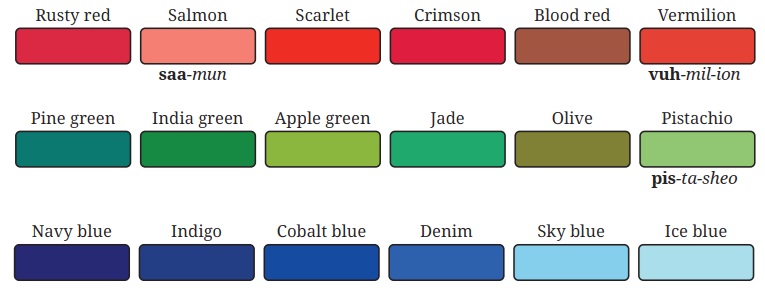
Now, Discuss in pairs, any two things that you can associate with these colours.
Answer: The two things that we can associate with these colours are:
Red – Blood, Rose
Green – Trees, Grass
Blue-Sky, Sea
II. You have studied painting-related words like palette, brushstrokes, shades, hue, colours, and canvas. Now, read the following paragraph and discuss in pairs what the underlined painting-related words might mean.
I think __________ means __________ because the passage talks about __________.
Example: I think portrait means a picture of someone’s face because the passage talks about capturing a friend’s features.
In the art studio, young painters eagerly approached their easels, each framing a canvas that they had to work on. The teacher encouraged them to experiment with a diverse tonal range, playing with shades and hues to bring their paintings to life. One student focused on a detailed portrait, capturing his friend’s features, first with careful underpainting and then filling the final colours. Another student worked on a mural, depicting a Spring Day on the right wall of the classroom. The room continued to buzz with artistic energy.
Answer: Meanings of the underlined words are as follows:
- Easels: I think easels means stands that hold a canvas upright while a painter works because the passage talks about painters approaching their easels and framing a canvas – the easel is what supports the painting surface.
- Tonal range: I think tonal range means the variety of light and dark shades of colour used in a painting because the teacher encourages students to experiment with it by playing with shades and hues – the spectrum of colour values from light to dark.
- Portrait: I think portrait means a painting of a specific person’s face because a student is capturing his friend’s features – a realistic depiction of a particular person.
- Underpainting: I think underpainting means a preliminary layer of paint applied before the final colours because the student completes it first and then fills in the final colours – a foundation layer.
- Mural: I think mural means a large painting done directly on a wall because the student works on a mural on the right wall of the classroom – applied to a physical wall, not a canvas.
Writing Task (NCERT Textbook Page No. 92)
I. Write a descriptive piece of two to three paragraphs describing the details and colours in the garden you have visited.
- Focus on how different shades of blue, red, and green interact, create contrast, and bring the garden to life.
- Pay attention to details like the texture of petals, the varying greens of leaves, and the way light affects the colours.
Answer:
Descriptive Piece: A Visit to a Garden
I recently visited a beautiful garden filled with colourful flowers and lush green plants. The different shades of green in the leaves created a fresh and peaceful background. Some leaves were light green and delicate, while others were dark green and broad. Among them, the bright red flowers stood out beautifully, creating a striking contrast with the greenery. Their soft, velvety petals looked especially attractive in the gentle sunlight.
The garden also had patches of blue flowers that added a cool and calming touch to the scene. The sunlight fell softly on the petals, making their colours appear brighter and more vivid. The combination of blue, red, and different shades of green made the garden look like a living painting. The textures of the petals and leaves, together with the changing light and shadows, made the entire garden feel fresh, lively, and full of natural beauty.
About the Poem: Canvas of Soil
The poem Canvas of Soil presents a garden as a work of art. Images of seeds, soil, and blossoms are linked with the language of painting, helping readers see the growing landscape as a living picture.
Students also explore metaphor, visual imagery, and the relationship between creativity and care for nature. The activities help them explain the poem’s title and appreciate how familiar surroundings can inspire imaginative expression.