

NCERT Solutions for Class 9 English Kaveri Poem 7 Words are provided here with simple and easy-to-understand explanations. This poem is included in Unit 7 of the NCERT textbook Kaveri. It explores the difference between empty speech and a few sincere words that touch the heart. These NCERT Solutions for Class 9 help students understand the main ideas, complete textbook activities, improve their language skills, and prepare for school examinations.
Words Class 9 English Questions and Answers
Reflect and Respond (NCERT Textbook Page No. 220-221)
I. Why are words important? Can we communicate without words? How? Share your answers with your classmates and teacher.
Answer: Words are important because they help us express our thoughts, feelings, ideas, and needs clearly. They allow people to share information, build relationships, and understand one another.
Yes, we can also communicate without words. We can use facial expressions, gestures, body language, signs, pictures, symbols, and sounds.
II. Use the given sentences as clues to find words from the grid and fill the blanks. One example has been done for you.
My mother summoned me to introduce her friends.
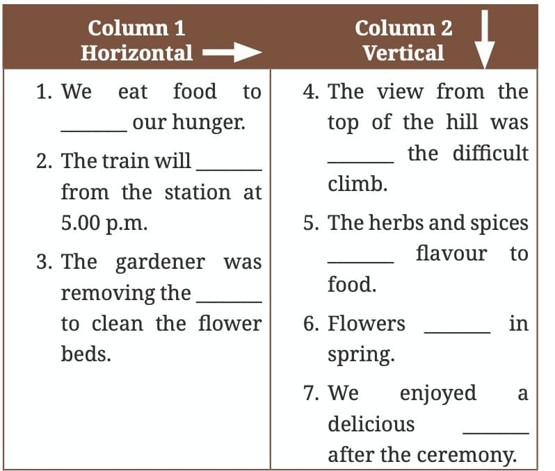
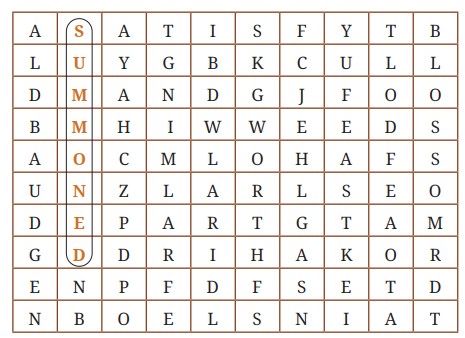
Note: In our opinion, there is a misprint in the crossword, as the answer to question 5 should be “add”, but it does not appear in the grid.
Answer:
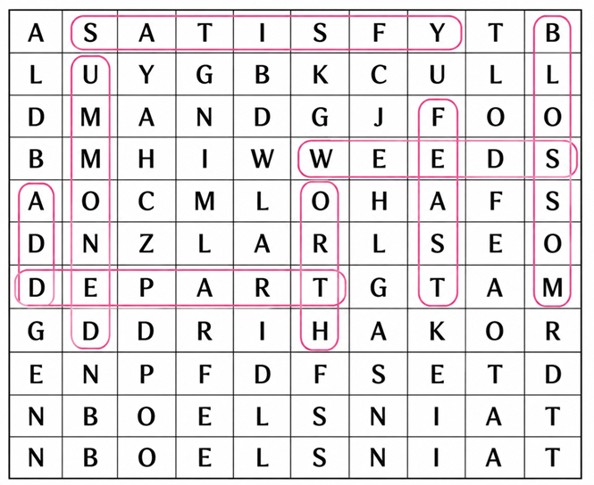
Column 1 – Horizontal:
- We eat food to satisfy our hunger.
- The train will depart from the station at 5.00 p.m.
- The gardener was removing the weeds to clean the flower beds.
Column 2 – Vertical:
- The view from the top of the hill was worth the difficult climb.
- The herbs and spices add flavour to food.
- Flowers blossom in spring.
- We enjoyed a delicious feast after the ceremony.
Check Your Understanding (NCERT Textbook Page No. 222-224)
I. Fill in the blanks with one word from the poem. One example has been done for you.
Answer: In this poem, the poet reflects that words fail to truly satisfy what the heart wants to convey. Words are compared to summer birds who 1. depart, leaving nothing behind. The heart is equated to a 2. pilgrim who finds that words are as worthless as 3. weeds when needed. He feels that a few sincere words can bring more 4. joy than many meaningless ones. He adds that a voice that brings happiness to a 5. lonely place does not say much, but the few words it does, are very precious. Moreover, if words could satisfy us, the 6. world would celebrate but words often fail to do that. The poem ends on the note that empty words may look impressive with lots of flowers, but they cannot produce anything valuable, like a 7. fruit.
II. Let us appreciate the poem.
1. Read the poem again. Find any four sets of rhyming words and also write the rhyme scheme of the poem.
Answer: Four sets of rhyming words: heart/depart, care/air, earth/worth, needs/weeds, said/head, way/say, cheer/dear, impart/heart.
The rhyme scheme of the poem is ABAB.
2. Read the following phrases and sentences taken from the poem. Identify the poetic device in each of them and explain what the poet wants to communicate through their usage.
(i) But words, like summer birds, depart…
Answer: Poetic device: Simile
In the phrase “words, like summer birds, depart,” words are compared to summer birds. Just as birds fly away leaving nothing, words are spoken and vanish, leaving no lasting impact on the heart.
(ii) heart, a pilgrim upon earth…
Answer: Poetic device: Metaphor
In the phrase “the heart, a pilgrim upon earth,” the heart is compared to a pilgrim. The poet suggests that the human heart is always searching for true comfort, meaning, and emotional fulfilment, just as a pilgrim searches for a spiritual destination.
(iii) words are of as little worth / As just so many weeds
Answer: Poetic device: Simile
In the lines “words are of as little worth / As just so many weeds,” words are compared to weeds using the word “as.” The poet suggests that empty or insincere words have very little value, just as weeds are often considered useless and unwanted.
(iv) If words could satisfy the chest… Oft satisfy the least!
Answer: Poetic device: Irony
In the lines “If words could satisfy the chest … Oft satisfy the least!”, the poet points out the contrast between what words are expected to do and what they actually do. Words are meant to comfort and satisfy the heart, yet in reality they often fail to provide deep emotional satisfaction. This contrast creates irony.
(v) The world might hold a feast…
Answer: Poetic device: Hyperbole
In the phrase “The world might hold a feast,” the poet exaggerates the effect words could have if they were truly able to satisfy the human heart. The idea of the whole world celebrating with a feast emphasizes how wonderful and joyful life would be if words could completely fulfil our emotional needs.
(vi) Like plants that make a gaudy show / All blossom to the root
Answer: Poetic device: Simile
In the lines “Like plants that make a gaudy show / All blossom to the root,” words are compared to plants that look bright and attractive because of their blossoms. The poet suggests that some words may appear impressive and beautiful on the surface but may not have real depth or value.
(vii) But whose poor nature cannot grow / One particle of fruit!
Answer: Poetic device: Metaphor
In the lines “But whose poor nature cannot grow / One particle of fruit!”, the poet metaphorically presents meaningful results or true emotional value as “fruit.” He suggests that some words may sound attractive, but they fail to produce anything useful or sincere.
3. Which words are repeated in the poem? Why does the poet use repetition?
Answer: The words “words” and “heart” are repeated several times in the poem.
The poet uses this repetition to emphasise the central contrast between words and true feelings. He wants to show that although people use many words, words often fail to fully satisfy or comfort the heart. The repetition also reinforces the poem’s main message that a few sincere words are more valuable than many empty ones.
4. The stanzas 4, 5, and 6 end with exclamation marks. Choose the option that displays the emotions being expressed through them.
(i) 4. disillusionment 5. admiration and 6. frustration
(ii) 4. frustration 5. admiration and 6. disillusionment
(iii) 4. admiration 5. frustration and 6. disillusionment
(iv) 4. frustration 5. disillusionment and 6. admiration
Answer: (iii)
III. Identify examples of hyperbole from the given lines
If words could satisfy the chest,
The world might hold a feast.
Answer: The example of hyperbole is: “The world might hold a feast.”
The poet exaggerates by imagining that the whole world would celebrate with a feast if words could truly satisfy the human heart. This exaggeration emphasises how rare and valuable such complete emotional satisfaction would be.
Work in pairs. Complete the sentences given below with hyperboles. Use the hints given in the brackets.
1. I have ________ things to do on this weekend. (lots of/tonnes of)
Answer: tonnes of
2. The player missed the basket by ________ . (a mile / an inch)
Answer: a mile.
3. My mother is so tired that she can sleep for a ________ . (night / decade)
Answer: decade
4. I will be back in ________ . (five minutes / two seconds)
Answer: two seconds.
Critical Reflection (NCERT Textbook Page No. 224-225)
I. Read the following lines and answer the questions.
1: “The heart, a pilgrim upon earth,
Finds often, when it needs,
That words are of as little worth
As just so many weeds.”
(i) Why has the poet referred to the heart as ‘a pilgrim’?
Answer: The poet refers to the heart as “a pilgrim” because, like a pilgrim travelling in search of a meaningful destination, the human heart is constantly searching for comfort, truth, and emotional fulfilment. The comparison suggests that the heart goes through many experiences in life but often finds that ordinary words are not enough to satisfy its deeper needs.
(ii) When would a heart ‘need’ words?
Answer: A heart would need words when a person is sad, lonely, troubled, or in need of comfort and reassurance. At such times, sincere and meaningful words can provide emotional support, even though the poet suggests that ordinary or empty words often fail to satisfy the heart completely.
(iii) Complete the sentence with an appropriate reason.
The words are like weeds because __________.
Answer: The words are like weeds because they may be plentiful but have little real value when the heart truly needs comfort and understanding.
(iv) Mention two emotions the heart might be experiencing when it finds words to be of ‘little worth’.
Answer: The two emotions could be sadness and loneliness. At such times, the heart seeks comfort and understanding, but empty or insincere words may seem to have very little value.
(v) What do these lines suggest about the nature of communication?
Answer: These lines suggest that effective communication depends on sincerity and emotional understanding, not merely on the number of words spoken. Words may be plentiful, but if they do not truly express or respond to the feelings of the heart, they can seem useless.
2: “If words could satisfy the chest,
The world might hold a feast;
But words, when summoned to the test,
Oft satisfy the least!”
(i) How can words ‘satisfy the chest’?
Answer: Words can “satisfy the chest” when they are meaningful, sincere, and heartfelt, giving emotional satisfaction and comfort to a person. The poet suggests that if words could consistently achieve this, the effect would bring universal happiness.
(ii) How can words be ‘summoned to the test’?
Answer: Words are “summoned to the test” when they are needed in a real situation to comfort, reassure, or emotionally support someone. The poet means that the true value of words is tested when the heart is troubled or in need, and at such times mere words often fail to give complete satisfaction.
(iii) What does ‘the world’ holding ‘a feast’ imply?
Answer: “The world” holding “a feast” implies that if words could truly satisfy people’s emotional needs, there would be great happiness and celebration everywhere. The poet uses this exaggerated image to show how wonderful it would be if words always brought complete comfort and fulfilment.
(iv) Complete the sentence with an appropriate reason.
The poet mentions that words satisfy the least because __________.
Answer: The poet mentions that words satisfy the least because they often fail to give the heart the deep comfort, understanding, and emotional fulfilment it truly needs.
(v) Select the word that does not mean the same as ‘oft’.
A. always
B. usually
C. frequently
D. often
Answer: A. always.
II. Answer the following questions.
1. What is the comparison that the poet draws between words and ’empty air’?
Answer: The poet compares words to “empty air” to show that words can sometimes disappear quickly and leave nothing meaningful behind. Just as empty air cannot provide substance or support, words that are not sincere or deeply felt may fail to comfort the heart or satisfy its emotional needs.
2. According to the poet, meaningful words are more precious than a lot of them. Explain.
Answer: According to the poet, a few sincere and meaningful words are more valuable than many empty or meaningless ones. Genuine words can touch the heart and bring deeper joy, while a large number of words may only reach the mind without giving real emotional comfort. Therefore, the poet values quality and sincerity in communication over quantity.
3. Do you agree that the poet presents contrasting ideas related to ‘words’ in the poem? If yes, why? If no, why not?
Answer: Yes, the poet presents contrasting ideas about words. On one hand, he shows that a few sincere words can bring deep joy and comfort to the heart. On the other hand, he also shows that many words may be empty, temporary, and of little real value when they fail to express genuine feelings.
Through this contrast, the poet suggests that the true value of words lies not in their number, but in their sincerity, emotional depth, and ability to touch the heart.
4. The theme of loneliness hovers over the poem. Support this statement with examples from the text.
Answer: Yes, the theme of loneliness is present throughout the poem. The poet speaks of the heart as “a pilgrim upon earth,” suggesting that it is often alone in its search for comfort and understanding. He also describes “a lonely home” that is cheered by a voice with only a few sincere words.
These examples show that people may feel isolated even when surrounded by words. The poem suggests that loneliness can be eased not by many words, but by a few genuine and heartfelt words that truly reach the heart.
5. How does the poet convey the superficial nature of words? What ought to be done to address this?
Answer: The poet conveys the superficial nature of words by comparing them to summer birds that depart, weeds that have little worth, and plants that make a gaudy show but produce no fruit. These images suggest that words may sound attractive or plentiful, yet still fail to provide real comfort, meaning, or emotional value.
To address this, people should use fewer but sincere and meaningful words. The poet clearly suggests that “a little said, and truly said” can bring deeper joy than many empty words. Thus, communication should be honest, thoughtful, and heartfelt rather than merely impressive or excessive.
Vocabulary in Context (NCERT Textbook Page No. 226-227)
I. The poet has used some figurative phrases. Match the phrases in Column 1 with their correct meanings in Column 2. Use each phrase in a sentence of your own.
| Column 1 | Column 2 |
| 1. satisfy the heart | (i) many words |
| 2. depart and leave but empty air | (ii) cheers up a person |
| 3. hosts of words | (iii) there is no outcome |
| 4. never touch the heart | (iv) makes one happy |
| 5. wins its sunny way | (v) does not appeal to our emotions |
| 6. plants that cannot grow fruit | (vi) makes no impact |
Answer:
| Column 1 | Column 2 |
| 1. satisfy the heart | (iv) makes one happy |
| 2. depart and leave but empty air | (vi) makes no impact |
| 3. hosts of words | (i) many words |
| 4. never touch the heart | (v) does not appeal to our emotions |
| 5. wins its sunny way | (ii) cheers up a person |
| 6. plants that cannot grow fruit | (iii) there is no outcome |
II. Create a ‘Word Map’ for each of the words from the poem given in the box.

To complete the word map include:
- Meaning (in your own words)
- Synonyms of the word
- Antonyms of the word
- Sentence using the word
- A quick sketch or symbol that represents the word
One example has been done for you.

Word: cheer
Meaning: to give a loud shout of approval or encouragement
Synonym: comfort
Antonym: sadden
Sentence: The audience cheered her for great performance.
Sketch: Picture of sunshine, sunflower, or a smiling face.
Answer:
1. Word: depart
Meaning: to go away
Synonym: leave
Antonym: arrive
Sentence: The birds depart in winter.
Sketch: Picture of a flying bird, person waving goodbye, or setting sun
2. Word: pilgrim
Meaning: a traveller on a spiritual religious journey
Synonym: worshipper, devotee
Antonym: native, inhabitant
Sentence: The pilgrim walked a long distance.
Sketch: Picture of a person walking with a stick, or a traveller with a small bag
3. Word: Cheer
Meaning: a loud shout of approval, or a feeling of happiness and positivity
Synonym: joy, applause, delight
Antonym: sadness, gloom, silence
Sentence: The crowd erupted in cheer as the team scored the winning goal
Sketch: A group of children cheering at a sports event, waving flags and smiling.
4. Word: word
Meaning: a unit of language used to express ideas
Synonym: speech
Antonym: silence
Sentence: One kind word can help someone.
Sketch: Picture of an open book, or “Hello” inside a bubble
5. Word: sunny
Meaning: bright and cheerful
Synonym: cheerful
Antonym: gloomy
Sentence: She has a sunny smile.
Sketch: Picture of sun with rays, clear sky with clouds, or a smiling face
6. Word: satisfy
Meaning: to fulfil a need or desire
Synonym: fulfil
Antonym: disappoint
Sentence: Kind words satisfy the heart.
Sketch: Picture of a smiling face after eating, thumbs-up sign, or a person resting peacefully
7. Word: heart
Meaning: centre of feelings and emotions
Synonym: spirit
Antonym: heartlessness
Sentence: Her words touched my heart.
Sketch: Picture of a simple heart shape
Listen and Respond (NCERT Textbook Page No. 227)
I. You will listen to a conversation between a girl and a boy. As you listen, mark four statements from 1-6 that are true. (Transcript for teacher on page 273)
1. The girl was excited to participate in the declamation contest.
Answer: True
2. The boy was doubtful about the suitability of the topic chosen for the contest.
Answer: True
3. The girl explained that people prefer to keep their personal experiences to themselves.
Answer: False
Reason: The girl says people share experiences, not keep them to themselves.
4. The boy was unaware of the role played by body language in reflecting the speaker’s confidence.
Answer: True
5. According to the girl, body language had an insignificant role to play in communication.
Answer: False
Reason: She says body language is important, not insignificant.
6. The girl had issued the book on body language earlier from the library.
Answer: True
Writing Task (NCERT Textbook Page No. 228-229)
I. Write an essay on any one quotation from the speaking activity. Follow the guidelines given (Introduction, Body, Counterargument, Conclusion).
Essay on: “Whatever words we utter should be chosen with care, for people will hear them and be influenced by them for good or ill.” – Gautama Buddha
Answer:
Essay: The Power of Carefully Chosen Words
Introduction: Gautama Buddha wisely said, “Whatever words we utter should be chosen with care, for people will hear them and be influenced by them for good or ill.” This quotation appeals to me because it reminds us that words are powerful and can affect the thoughts and feelings of others. The purpose of this essay is to explain why we should think carefully before speaking.
Body: Words can encourage, comfort, and inspire people. A few kind words spoken to someone who is sad or discouraged can give them hope and confidence. Similarly, words of appreciation can motivate a person to work harder. Therefore, careful and positive speech can have a good influence on others.
However, careless or harsh words can cause pain, anger, and misunderstanding. Once spoken, words cannot always be taken back, and their effect may remain for a long time. For instance, an insulting remark made in anger may damage a friendship. Consequently, we should pause and consider whether our words are truthful, necessary, and respectful before we speak.
Counterargument: Some people may argue that we should always speak freely and say exactly what we think. Freedom of expression is important, but it does not mean that we should speak without considering the feelings of others. The same idea can usually be expressed honestly without being rude or hurtful. Thus, choosing words carefully does not prevent honesty; it makes communication more responsible and effective.
Conclusion: In conclusion, words have the power to encourage or discourage, heal or hurt, and unite or divide. Therefore, we must use them wisely and responsibly. Buddha’s quotation teaches us that careful speech reflects maturity and kindness. Before speaking, we should remember that our words may remain in another person’s mind long after we have forgotten them.
About the Poem: Words
The poem Words reflects on the limits of language when speech lacks sincerity. The speaker contrasts impressive but ineffective expressions with brief, honest words that bring genuine comfort and joy.
Students also explore comparisons, imagery, and the relationship between words and emotions. The activities help them explain the poem’s central idea and reflect on why thoughtful communication matters more than speaking at length.