

NCERT Solutions for Class 9 Science Chapter 9 Atomic Foundations of Matter are provided here with simple and easy-to-understand explanations. Based on the NCERT textbook Exploration, this chapter introduces atoms, molecules, chemical formulae, and quantitative descriptions of matter. These NCERT Solutions for Class 9 help students understand important concepts, complete textbook activities, and revise the chapter for school examinations.
Atomic Foundations of Matter Class 9 Questions and Answers
Think It Over (NCERT Textbook Page No. 162)
Question: Water can be obtained from various sources. Are all these samples of water chemically identical?
Answer: Pure water is chemically identical everywhere, but real samples of water are often not chemically identical. When water collected from sources such as rivers, borewells or the ocean is purified and analysed, it is always found to contain hydrogen and oxygen in a fixed mass ratio of 1 : 8. This is in accordance with the Law of Constant Proportions.
However, water obtained from different sources such as rivers, seas, rain and taps may contain dissolved salts, gases, minerals and other impurities. Therefore, while pure water has the same chemical composition, natural water samples may differ in composition.
Question: Oxygen is sometimes represented as O and sometimes as O2. What is the difference between these symbols?
Answer: O represents a single atom of oxygen, whereas O₂ represents a molecule of oxygen made up of two oxygen atoms joined together by a double covalent bond. Oxygen exists as a stable gas in the form of O₂, the molecule that is capable of independent existence.
Question: Why does dissolved salt in water conduct electricity, but sugar does not?
Answer: Salt (NaCl) is an ionic compound. When it dissolves in water, it dissociates into free-moving ions (Na+ and Cl–). These free ions carry the electric current, so the salt solution conducts electricity.
Sugar is a covalent compound. Although it is soluble in water, it does not produce any ions in the solution. As there are no free-moving charged particles, a sugar solution does not conduct electricity.
Pause and Ponder (NCERT Textbook Page No. 166)
1: A student burns 10 g of ethanol in an open beaker. After the reaction, no residue is left in the beaker. Does this mean the Law of Conservation of Mass is violated? Explain.
Answer: No, the Law of Conservation of Mass is not violated. When ethanol burns in an open beaker, it reacts with oxygen from the air to form carbon dioxide and water vapour. These gaseous products escape into the surroundings, so no residue is left in the beaker.
If the masses of ethanol, oxygen from the air, carbon dioxide and water vapour were all measured in a closed system, the total mass before and after the reaction would be the same. Thus, the apparent loss of mass is only because the gaseous products have escaped from the open beaker.
2: When 20 g of hydrogen reacts completely with 160 g of oxygen, how much water is formed according to the Law of Conservation of Mass?
Answer: According to the Law of Conservation of Mass, the total mass of the products equals the total mass of the reactants.
∴ Mass of water formed = Mass of hydrogen + Mass of oxygen
= 20 g + 160 g
= 180 g
Hence, 180 g of water is formed.
Pause and Ponder (NCERT Textbook Page No. 167)
3: A compound consists of 40% sulfur and 60% oxygen by mass. In a sample of the same compound containing 20 g of sulfur, what mass of oxygen must be present to satisfy the Law of Constant Proportions?
Answer: In the compound, the mass ratio of sulfur to oxygen is fixed.
Ratio of sulfur : oxygen = 40 : 60
So, for every 40 g of sulfur there are 60 g of oxygen.
∴ Mass of oxygen for 20 g of sulfur = 60/40 × 20 = 30 g
Hence, 30 g of oxygen must be present to satisfy the Law of Constant Proportions.
4: Carbon monoxide (CO) contains carbon and oxygen in the mass ratio of 3:4. How much oxygen will combine with 9 g of carbon to form carbon monoxide?
Answer: In carbon monoxide, the mass ratio of carbon to oxygen is fixed at 3 : 4.
So, 3 g of carbon combines with 4 g of oxygen.
∴Mass of oxygen combining with 9 g of carbon= 4/3 × 9 = 12 g
Hence, 12 g of oxygen will combine with 9 g of carbon.
5: The Law of Definite Proportions holds true for compounds but not for mixtures. Give reason.
Answer: The Law of Definite Proportions holds true for compounds because the elements in a compound are chemically combined in a fixed ratio by mass, regardless of the source or method of formation. In contrast, a mixture is formed by physically combining substances, and its components can be present in different proportions. Therefore, the composition of a mixture is not fixed.
6: Students X and Y, both prepared an oxide of copper by combining copper and oxygen in the ratios of 4:1 and 8:2, respectively. Do their results justify the Law of Constant Proportions? Explain.
Answer: Yes, their results justify the Law of Constant Proportions.
For Student X, the ratio of copper to oxygen = 4 : 1
For Student Y, the ratio of copper to oxygen = 8 : 2 = 4 : 1
Both ratios reduce to the same ratio (4 : 1). Since the same compound contains copper and oxygen in the same fixed mass ratio, irrespective of who prepared it, the results justify the Law of Constant Proportions.
Pause and Ponder (NCERT Textbook Page No. 168)
Question 7:
Assertion (A): 2 g of hydrogen combines with 16 g of oxygen to form 18 g of water.
Reason (R): According to Dalton’s Atomic Theory, atoms combine in a simple whole number ratio by mass to form compounds.
Choose the correct option:
(i) Both A and R are true and R is the correct explanation of A.
(ii) Both A and R are true but R is not the correct explanation of A.
(iii) A is true but R is false.
(iv) A is false but R is true.
Answer: (iii) A is true but R is false.
Explanation
Assertion: In water, hydrogen and oxygen are present in the fixed mass ratio of 1 : 8.
So, 2 g of hydrogen combines with 16 g of oxygen (2 : 16 = 1 : 8) to form 18 g of water (2 g + 16 g = 18 g).
Hence, A is true.
Reason: Dalton’s atomic theory states that atoms combine in simple whole-number ratios by number, not by mass. In H₂O, the hydrogen-to-oxygen atom ratio is 2 : 1.
Thus, R is false.
Pause and Ponder (NCERT Textbook Page No. 170)
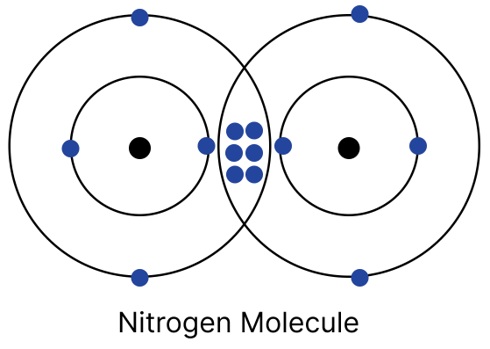
8: Nitrogen has five valence electrons. Draw the structure of the nitrogen molecule (N2).
Answer: Each nitrogen atom has 5 valence electrons and needs 3 more electrons to complete its octet. Therefore, two nitrogen atoms share three pairs of electrons, forming a triple covalent bond. Each nitrogen atom also has one lone pair of electrons. Thus, N₂ contains a triple covalent bond and each nitrogen atom has one lone pair.
The structure of the nitrogen molecule is shown below:
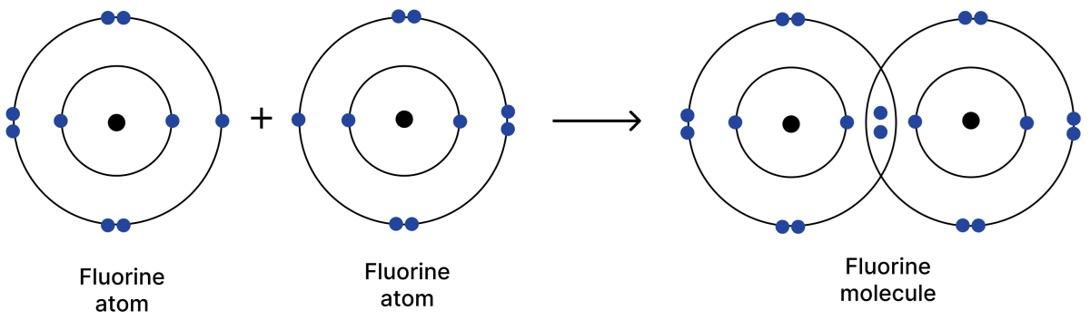
9: The atomic number of fluorine is 9. Explain the formation of the fluorine molecule (F2).
Answer: The atomic number of fluorine is 9, so its electronic configuration is 2, 7. Thus, each fluorine atom has 7 valence electrons and needs one more electron to complete its octet.
Two fluorine atoms therefore share one electron each, forming one shared pair of electrons. This shared pair holds the two atoms together and forms a single covalent bond which is represented as F-F.
10: Show the formation of the following molecules:
(i) Carbon dioxide (CO2)
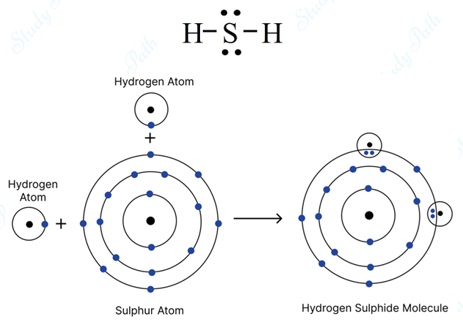
(ii) Hydrogen sulfide (H2S)
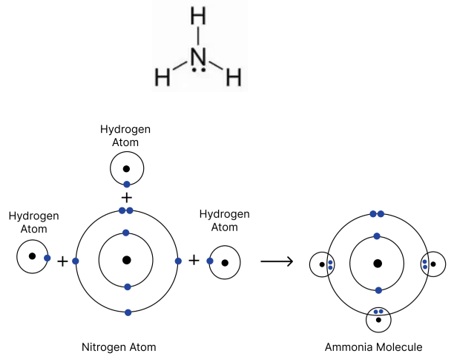
(iii) Ammonia (NH3)
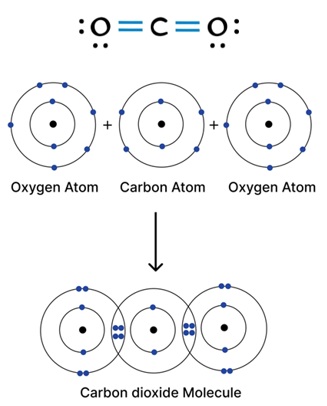
Answer: (i) Carbon dioxide (CO2)
Carbon has 4 valence electrons and each oxygen atom has 6 valence electrons. Carbon shares two pairs of electrons with each oxygen atom to complete the octet of all three atoms. Thus, two double covalent bonds are formed.
(ii) Hydrogen sulfide (H2S)
Hydrogen has 1 valence electron, while sulfur has 6 valence electrons. Sulfur shares one electron with each of two hydrogen atoms, forming two single covalent bonds. Sulfur has two lone pairs of electrons remaining.
(iii) Ammonia (NH3)
Nitrogen has 5 valence electrons, while each hydrogen has 1 valence electron. Nitrogen shares one electron with each of three hydrogen atoms, forming three single covalent bonds. Nitrogen has one lone pair of electrons remaining.
11: Neon (atomic number 10) neither transfers nor shares its valence electrons. Explain.
Answer: Neon has atomic number 10, so its electronic configuration is 2, 8. Its outermost shell already contains 8 electrons, which is a stable octet. Therefore, neon does not need to gain, lose or share electrons to become stable. Hence, neon neither transfers nor shares its valence electrons and generally does not form chemical bonds.
Pause and Ponder (NCERT Textbook Page No. 174)
12: What kind of ion will oxygen (O) form?
Answer: The electronic configuration of oxygen (atomic number 8) is 2, 6. It has 6 electrons in its valence shell and needs 2 more electrons to complete its octet. Therefore, an oxygen atom gains two electrons and forms a negatively charged ion called an oxide ion (O²⁻).
13: Fill in the blanks.
Among magnesium and chlorine, magnesium atom can give two electrons to become Mg2+. However, chlorine can take only one electron to become _____ . Now, ______ ion of magnesium and _____ ions of chlorine combine to give magnesium chloride.
Answer: Among magnesium and chlorine, magnesium atom can give two electrons to become Mg2+. However, chlorine can take only one electron to become Cl– (chloride ion). Now, one ion of magnesium and two ions of chlorine combine to give magnesium chloride (MgCl2).
14: Show the formation of cations of potassium (K) and calcium (Ca) atoms, and the formation of their corresponding chlorides using diagrams.
Answer: Formation of potassium cation (K+) and potassium chloride
The electronic configuration of potassium (atomic number 19) is 2, 8, 8, 1. It has 1 electron in its valence shell, which it loses to attain a stable configuration, forming the cation K+.
K → K⁺ + e⁻
Chlorine (Cl) has electronic configuration 2, 8, 7. It gains one electron to complete its octet
Cl + e⁻ → Cl⁻
The oppositely charged ions attract each other to form KCl
K⁺ + Cl⁻ → KCl
Formation of calcium cation (Ca2+) and calcium chloride
The electronic configuration of calcium (atomic number 20) is 2, 8, 8, 2. It has 2 electrons in its valence shell, which it loses to attain a stable configuration, forming the cation Ca2+.
Ca → Ca²⁺ + 2e⁻
Each chlorine atom gains one electron. Therefore, two chlorine atoms are required:
2Cl + 2e⁻ → 2Cl⁻
The calcium ion then combines with two chloride ions to form calcium chloride
Ca²⁺ + 2Cl⁻ → CaCl₂
Thus, K forms K⁺ and KCl, while Ca forms Ca²⁺ and CaCl₂ through the transfer of valence electrons.
15: Illustrate how sodium sulfide (Na2S) is formed.
Answer: Sodium has atomic number 11 and electronic configuration 2, 8, 1. It has one valence electron, which it loses to attain a stable configuration and forms a Na⁺ ion.
Sulfur has atomic number 16 and electronic configuration 2, 8, 6. It needs two electrons to complete its octet, so it gains two electrons and forms a S²⁻ ion.
Therefore, two sodium atoms each transfer one electron to one sulfur atom:
2Na → 2Na⁺ + 2e⁻
S + 2e⁻ → S²⁻
The oppositely charged 2Na⁺ and S²⁻ ions attract each other, forming sodium sulfide.
2Na⁺ + S²⁻ → Na₂S
Pause and Ponder (NCERT Textbook Page No. 177)
16: Name the following:
(i) CO2
(ii) NO2
(iii) SF6
(iv) PCl3
Answer:
(i) CO2 — Carbon dioxide
(ii) NO2 — Nitrogen dioxide
(iii) SF6 — Sulfur hexafluoride
(iv) PCl3 — Phosphorus trichloride
17: Write the formula for the following:
(i) Sodium hydrogencarbonate
(ii) Sulfur dioxide
(iii) Ferric chloride
(iv) Cuprous oxide
Answer: (i) Sodium hydrogencarbonate — NaHCO3
(ii) Sulfur dioxide — SO2
(iii) Ferric chloride — FeCl3
(iv) Cuprous oxide — Cu2O
18: Write the formulae for the compounds formed from the following pairs of ions:
(i) Fe3+ and OH‒
(ii) K+ and CO32–
Answer:
(i) Fe3+ and OH–
Fe³⁺ has a charge of +3, while OH⁻ has a charge of −1. Therefore, three OH⁻ ions are needed to balance one Fe³⁺ ion.
Formula: Fe(OH)₃
(ii) K+ and CO32–
K⁺ has a charge of +1, while CO₃²⁻ has a charge of −2. Therefore, two K⁺ ions are needed to balance one CO₃²⁻ ion.
Formula: K₂CO₃
Pause and Ponder (NCERT Textbook Page No. 179)
19: What type of chemical bond is present in a solid compound that does not conduct electricity in the solid state but conducts electricity when dissolved in water?
Answer: The compound contains an ionic bond.
In the solid state, the ions are held in a fixed crystal lattice, so they cannot move freely and the compound does not conduct electricity. When dissolved in water, the ions become free to move and can carry electric current. Therefore, the compound has an ionic bond.
20: Metal M, with two electrons in its valence shell (M shell), reacts with oxygen to form a compound that is slightly soluble in water. Predict its:
(i) formula
(ii) type of bond
(iii) electrical conductivity of its aqueous solution.
Answer: The metal M has two electrons in its valence shell, so its electronic configuration is 2, 8, 2. It will lose two electrons to form M²⁺. Oxygen gains two electrons to form O²⁻. Therefore, they combine in a 1:1 ratio.
(i) Formula: MO.
(ii) It is an ionic bond, because electrons are transferred from M to oxygen and oppositely charged ions are formed.
(iii) Its aqueous solution conducts electricity because the ions are free to move in the solution and carry electric current.
21: Find the molecular mass of nitric acid (HNO3).
Atomic mass — H = 1 u; N = 14 u; O = 16 u.
Answer: Atomic mass of H = 1 u
Atomic mass of N = 14 u
Atomic mass of O = 16 u
Nitric acid (HNO₃) contains 1 hydrogen atom, 1 nitrogen atom and 3 oxygen atoms.
∴ Molecular mass of HNO3 = (1 × 1) + (14 × 1) + (16 × 3)
= 1 u + 14 u + 48 u
= 63 u
22: Find the molecular mass of methane (CH4).
Atomic mass — C = 12 u; H = 1 u.
Answer: Atomic mass of C = 12 u
Atomic mass of H = 1 u
Methane (CH₄) contains 1 carbon atom and 4 hydrogen atoms.
∴ Molecular mass of CH4 = (12 × 1) + (1 × 4)
= 12 + 4
= 16 u
Pause and Ponder (NCERT Textbook Page No. 180)
23: Find the formula unit mass of potassium chloride (KCl).
Atomic mass — K = 39 u; Cl = 35.5 u.
Answer: Atomic mass of K = 39 u
Atomic mass of Cl = 35.5 u
KCl contains 1 potassium atom and 1 chlorine atom.
∴ Formula unit mass of KCl = (39 × 1) + (35.5 × 1)
= 39 + 35.5
= 74.5 u
24: Find the formula unit mass of magnesium hydroxide, Mg(OH)2.
Atomic mass — Mg = 24 u; O = 16 u; H = 1 u.
Answer: Atomic mass of Mg = 24 u
Atomic mass of O = 16 u
Atomic mass of H = 1 u
∴ Formula unit mass of Mg(OH)2 = (24 × 1) + {(16 × 1) + (1 × 1)} × 2
= 24 + (17 × 2)
= 24 + 34
= 58 u
Revise, Reflect, Refine (NCERT Textbook Page No. 181-183)
1: A particular element (A) has one electron in its third shell. There is another element (B) with six electrons in its second shell.
(i) How many electrons does A tend to give or take to become stable?
(ii) What kind of ion would it form?
(iii) How many electrons does B tend to give or take to become stable?
(iv) What kind of ion would it form?
(v) If A and B were to combine, what kind of bond would be formed?
(vi) What would be the formula for the compound thus formed?
Answer: Element A has one electron in its third shell, so its electronic configuration is 2, 8, 1.
Element B has six electrons in its second shell, so its electronic configuration is 2, 6.
(i) A has 1 valence electron, so it tends to give (lose) 1 electron to become stable.
(ii) On losing 1 electron, A forms a cation (A+), a positively charged ion.
(iii) B has 6 valence electrons, so it tends to take (gain) 2 electrons to complete its octet.
(iv) On gaining 2 electrons, B forms an anion (B2–), a negatively charged ion.
(v) Since A loses electrons (metal) and B gains electrons (non-metal), an ionic bond would be formed by the transfer of electrons.
(vi) A has valency 1 and B has valency 2. Crossing over the valencies gives the formula A2B.
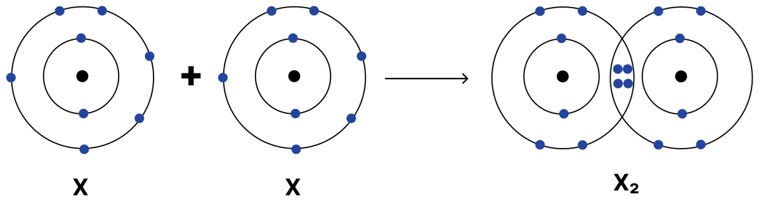
2: An element X has six electrons in its outer shell and forms a diatomic molecule.
(i) Why would that be so?
(ii) What kind of bond would it form?
(iii) Draw the structure of the molecule it would form.
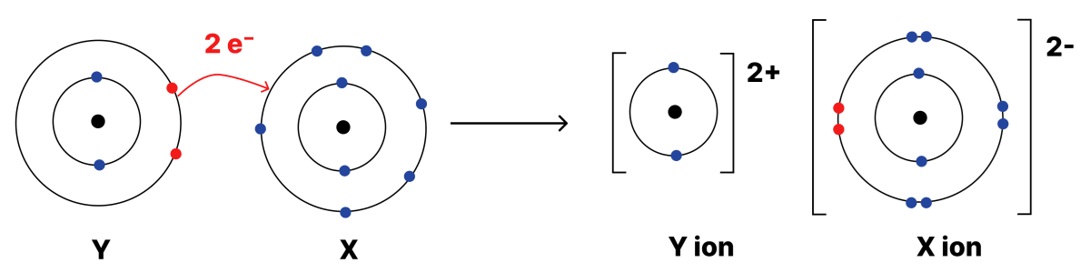
(iv) A certain other element Y has two electrons in its second shell. Draw the structure of the molecule that X would form with Y.
Answer: Element X has six electrons in its outer shell (electronic configuration 2, 6). Element Y has two electrons in its second shell (electronic configuration 2, 2).
(i) X has 6 valence electrons and needs 2 more electrons to complete its octet. To achieve this, two atoms of X share two pairs of electrons with each other, so that both attain a stable octet. Hence, X exists as a diatomic molecule (X2).
(ii) Since the two X atoms become stable by sharing electrons, they form a covalent bond (a double bond, as two pairs of electrons are shared).
(iii) The molecule X2 has a double bond and is represented as X=X.
(iv) Y has 2 valence electrons (valency 2) and X needs 2 electrons (valency 2). Y transfers its 2 electrons to one X atom, forming Y2+ and X2–. These oppositely charged ions are held together by an ionic bond, giving the compound YX.
3: You want to design a new ionic compound, where the total positive charge is 6+ and the total negative charge is 6–. Which of the following combinations gives the correct number of ions?
(i) 2 Al3+ and 3 Cl–
(ii) 3 Mg2+ and 1 PO43–
(iii) 2 Fe3+ and 3 O2–
(iv) 3 Ca2+ and 2 SO42–
Answer: We need the total positive charge = 6+ and the total negative charge = 6–.
(i) 2Al3+ = 6+ ; 3Cl– = 3– → not balanced.
(ii) 3Mg2+ = 6+ ; 1 PO43– = 3– → not balanced.
(iii) 2Fe3+ = 6+ ; 3O2– = 6– → balanced.
(iv) 3Ca2+ = 6+ ; 2SO42– = 4– → not balanced.
Hence, the correct combination is (iii) 2 Fe3+ and 3 O2–, which gives the compound Fe2O3.
4: Choose the correct statement(s) and correct the false statement(s).
(i) Elements are made up of molecules and compounds are made up of atoms.
(ii) The molecule of a compound is always made up of two or more atoms of the same kind.
(iii) One molecule of nitrogen gas contains three nitrogen atoms.
(iv) Water is made of two hydrogen atoms, covalently bonded with one oxygen atom.
Answer:
(i) False.
Reason: Both elements and compounds are made up of atoms. An element is made up of atoms of the same kind, while a compound is made up of atoms of two or more different elements combined in a fixed ratio.
(ii) False.
Reason: The molecule of a compound is made up of two or more atoms of different kinds (different elements). A molecule made of atoms of the same kind is a molecule of an element.
(iii) False.
Reason: One molecule of nitrogen gas (N₂) contains two nitrogen atoms, not three.
(iv) True.
Reason: Water (H2O) is made of two hydrogen atoms covalently bonded with one oxygen atom.
5: Write the chemical formulae for the following compounds.
(i) Aluminium nitrate
(ii) Calcium oxide
(iii) Ferric oxide
Answer: (i) Aluminium nitrate — Al3+ and NO3– → Al(NO3)3
(ii) Calcium oxide — Ca2+ and O2– → CaO
(iii) Ferric oxide — Fe3+ and O2– → Fe2O3
6: Write the formulae of the compounds formed from the following pairs of ions.
(i) Ca2+ and Br‒
(ii) Al3+ and CO32–
(iii) K+ and SO42–
(iv) NH4+ and Cl–
Answer: (i) Ca2+ and Br– → CaBr2
(ii) Al3+ and CO32– → Al2(CO3)3
(iii) K+ and SO42– → K2SO4
(iv) NH4+ and Cl– → NH4Cl
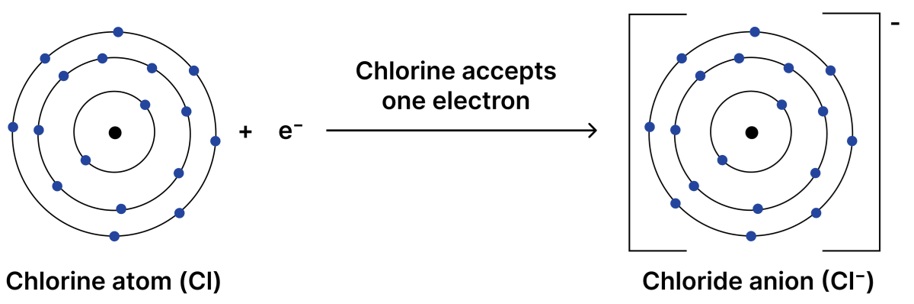
7: Which of the following, in Fig. 9.18, correctly represents Cl– ion (Atomic number of chlorine = 17).
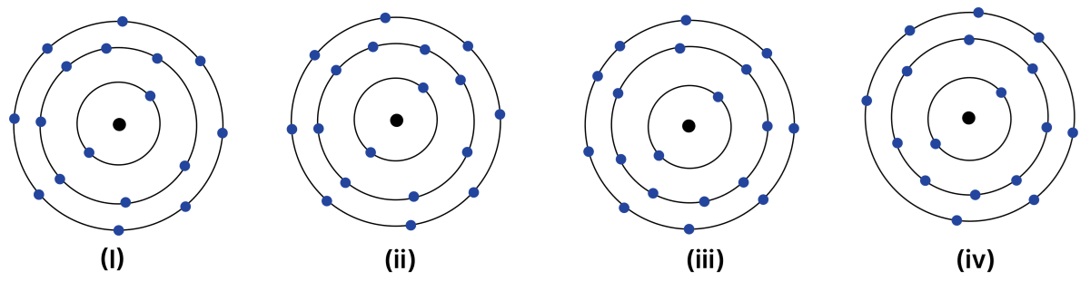
Answer: (ii)
Explanation: A neutral chlorine atom (atomic number 17) has the electronic configuration 2, 8, 7. To form the chloride ion (Cl–), it gains one electron, giving it a total of 18 electrons.
The electronic configuration of the Cl– ion is therefore 2, 8, 8 (a complete octet in the outermost shell).
Hence, the correct representation is the diagram showing the configuration 2, 8, 8 (18 electrons in all).
8: Determine the formula unit mass of the following substances.
(i) Ammonium nitrate (NH4NO3), used as a nitrogen fertiliser, which is essential for plant growth.
(ii) Phosphoric acid (H3PO4), used to make phosphate fertiliser and detergents.
(iii) Sodium hydrogencarbonate (NaHCO3), used to relieve acidity and helps in digestion.
Answer: (i) Ammonium nitrate (NH4NO3)
Atomic masses: N = 14 u, H = 1 u, O = 16 u
NH₄NO₃ contains 2 N, 4 H and 3 O atoms.
∴ Formula unit mass = (14 × 1) + (1 × 4) + (14 × 1) + (16 × 3)
= 14 + 4 + 14 + 48
= 80 u
(ii) Phosphoric acid (H3PO4)
Atomic masses: H = 1 u, P = 31 u, O = 16 u
H₃PO₄ contains 3 H, 1 P and 4 O atoms.
∴ Formula unit mass = (1 × 3) + (31 × 1) + (16 × 4)
= 3 + 31 + 64
= 98 u
(iii) Sodium hydrogencarbonate (NaHCO3)
Atomic masses: Na = 23 u, H = 1 u, C = 12 u, O = 16 u
NaHCO₃ contains 1 Na, 1 H, 1 C and 3 O atoms.
∴ Formula unit mass = (23 × 1) + (1 × 1) + (12 × 1) + (16 × 3)
= 23 + 1 + 12 + 48
= 84 u
9: Write the formulae for the compounds formed by the reaction of:
(i) Magnesium and nitrogen
(ii) Lithium and nitrogen
(iii) Sodium and sulfur
(iv) Aluminium and oxygen
Answer: (i) Magnesium and nitrogen — Mg2+ and N3– → Mg3N2
(ii) Lithium and nitrogen — Li+ and N3– → Li3N
(iii) Sodium and sulfur — Na+ and S2– → Na2S
(iv) Aluminium and oxygen — Al3+ and O2– → Al2O3
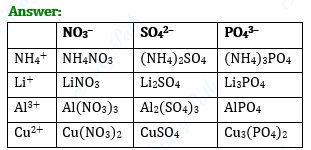
10: Complete the Table 9.3 by writing the formulae of the compounds formed by the cations on the left and the anions at the top. LiNO3 is given as an example.
Table 9.3
| NO3– | SO42– | PO43– | |
| NH4+ | |||
| Li+ | LiNO3 | ||
| Al3+ | |||
| Cu2+ |
11: 5.3 g of sodium carbonate and 6.0 g of acetic acid react to produce 2.2 g of carbon dioxide, 0.9 g of water, and 8.2 g of sodium acetate. Verify whether the law of conservation of mass is valid.
Answer: Total mass of reactants = Mass of sodium carbonate + Mass of acetic acid
= 5.3 g + 6.0 g
= 11.3 g
Total mass of products = Mass of carbon dioxide + Mass of water + Mass of sodium acetate
= 2.2 g + 0.9 g + 8.2 g
= 11.3 g
Therefore, Mass of reactants = Mass of products = 11.3 g
Hence, the Law of Conservation of Mass is valid for this reaction.
12: If a species has 11 protons, 12 neutrons and 10 electrons then
(i) what is its atomic number and mass number?
(ii) is it neutral, a cation or an anion? Explain.
(iii) write its electronic configuration.
(iv) name the species.
Answer: (i) Atomic number = number of protons = 11.
Mass number = number of protons + number of neutrons = 11 + 12 = 23.
(ii) The number of protons (11) is greater than the number of electrons (10). So, the species has one extra positive charge and is a cation (charge = +1).
(iii) The species has 10 electrons, its electronic configuration is 2, 8.
(iv) The element with atomic number 11 is sodium, and the cation with a +1 charge is the sodium ion (Na+).
13: Two elements, A and B, have the following configurations —
A: 2, 8, 5
B: 2, 8, 7
(i) Which element is more reactive?
(ii) Will A and B form ionic or covalent bonds when they combine? Explain using electron transfer or sharing.
(iii) Predict the formula of the compound they would form.
Answer: Given:
- A: 2, 8, 5 → 5 valence electrons
- B: 2, 8, 7 → 7 valence electrons
(i) B is more reactive. B has 7 valence electrons and needs only 1 electron to complete its octet, so it can attain stability easily. A has 5 valence electrons and needs 3 electrons, which is harder to achieve. Hence, B is more reactive than A.
(ii) Both A and B are non-metals and need to gain electrons. Neither can readily transfer electrons to the other, so they attain stability by sharing electrons. Therefore, A and B form covalent bonds.
(iii) A has a valency of 3 (needs 3 electrons) and B has a valency of 1 (needs 1 electron). So, one A atom shares with three B atoms, giving the formula AB3.
14: Assertion (A): Copper sulfate conducts electricity in the molten state but not in the solid state.
Reason (R): Copper and sulfate ions are fixed in the lattice in molten state, while in solid state they can move freely.
Choose the correct option:
(i) Both A and R are true, and R is the correct explanation of A.
(ii) Both A and R are true, but R is not the correct explanation of A.
(iii) A is true, but R is false.
(iv) A is false, but R is true.
Answer: (iii) A is true, but R is false.
Explanation:
A is true because copper sulfate is an ionic compound. It conducts electricity in the molten state but not in the solid state.
R is false because the reason states the situation the wrong way round. In the solid state, the copper and sulfate ions are fixed in the lattice and cannot move, so the solid does not conduct electricity. In the molten state, the ions are free to move and therefore carry the electric current.
15: The species 27Al, 80Br– and 201Hg2+ have 13, 35 and 80 protons, respectively. How many electrons and neutrons do they have?
Answer: Number of neutrons = Mass number – Number of protons.
For 27Al (13 protons, no charge):
Electrons = number of protons = 13
∴ Number of neutrons = 27 – 13 = 14
For 80Br– (35 protons, charge –1):
Since it has gained 1 electron, Electrons = 35 + 1 = 36
∴ Number of neutrons = 80 – 35 = 45
For 201Hg2+ (80 protons, charge +2):
Since it has lost 2 electrons, Electrons = 80 – 2 = 78
∴ Number of neutrons = 201 – 80 = 121
Class 9 Science Exploration Chapter 9 NCERT Questions and Answers
The chapter Atomic Foundations of Matter introduces the laws and ideas that explain how substances combine. Students learn about atoms and molecules, the representation of elements and compounds, and the use of valency in chemical formulae.
Students also explore atomic and molecular masses and apply these ideas in calculations. The chapter connects symbolic representations with the composition of substances and develops careful reasoning when interpreting chemical information.