

NCERT Solutions for Class 9 Social Science Part 1 Chapter 3 Atmosphere and Climate are provided here with simple and easy-to-understand explanations. Based on the NCERT textbook Understanding Society: India and Beyond Part 1, this chapter introduces the structure of the atmosphere, weather processes, and the factors that influence climate. These NCERT Solutions for Class 9 help students understand important concepts, complete textbook activities, and revise the chapter for school examinations.
Atmosphere and Climate Class 9 Questions and Answers
The Big Questions (NCERT Textbook Page no. 40)
1: What is the composition of the atmosphere?
Answer: The atmosphere is composed of a mixture of different gases. The two primary and most abundant gases are nitrogen (78%) and oxygen (21%). It also contains argon (0.93%), carbon dioxide (0.04%), and small amounts of other gases such as helium, neon, krypton, xenon, ozone and hydrogen. In addition, the atmosphere contains water vapour and tiny dust particles.
2: How do the different layers of the atmosphere affect the planet Earth?
Answer: The Earth’s atmosphere has five layers. Each layer protects the planet and makes life possible:
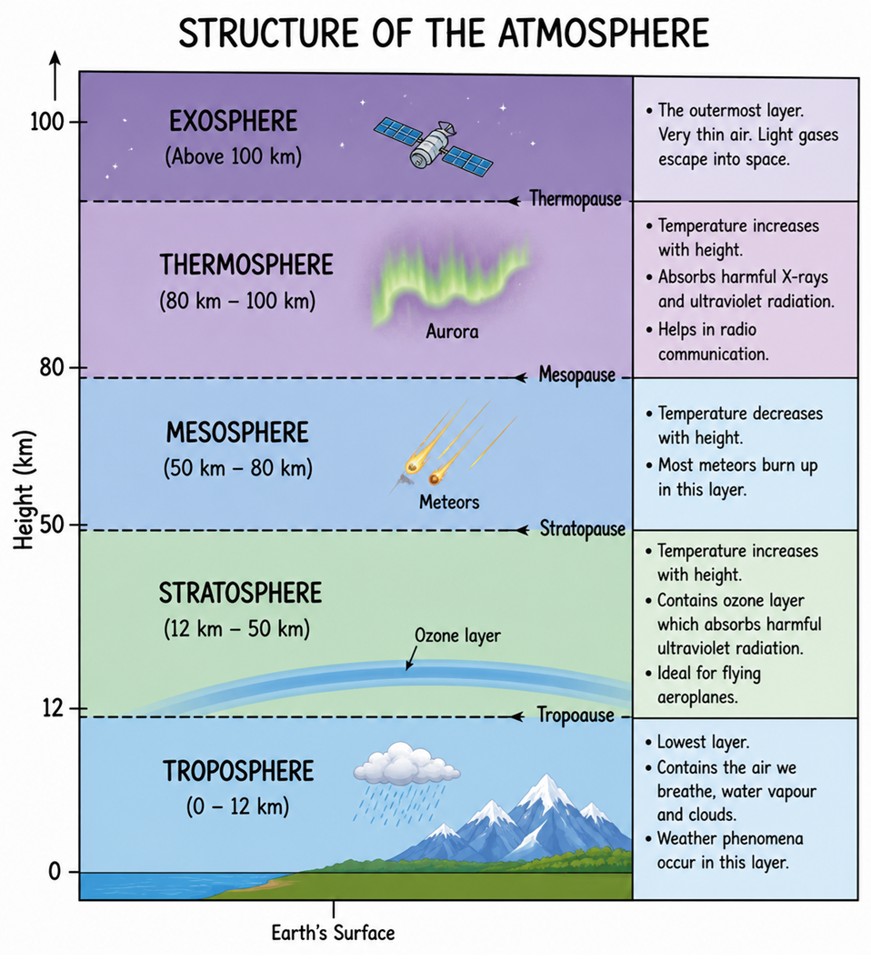
- Troposphere (0 to 12 km): It contains the air we breathe, most water vapour and clouds. Almost all weather phenomena, such as rainfall, fog and hail, occur here.
- Stratosphere (12 to 50 km): It contains the ozone layer, which protects Earth by filtering the Sun’s harmful ultraviolet radiation. It is also suitable for flying aeroplanes.
- Mesosphere (50 to 85 km): This is a very cold layer. It acts as a shield against space rocks. Space rocks (meteors) burn up here before they hit the ground.
- Thermosphere (85 to 700 km): It absorbs harmful X-rays and short-wave ultraviolet radiation. It also helps in radio transmission, and auroras occur here.
- Exosphere (700 to 10,000 km): This is where space begins. It holds many weather and communication satellites.
3: What is the mechanism of monsoon?
Answer: Monsoons are seasonal wind patterns that change direction during the year. The main mechanism is the unequal heating of land and sea. During summer, land heats up faster than the ocean, creating pressure differences that cause moist winds to blow from the ocean towards the land, bringing rainfall. During winter, the pressure conditions reverse, causing the winds to reverse their direction.
OR
The monsoon is a seasonal reversal in the direction of winds during the year. It is mainly caused by the unequal heating of land and sea.
During summer, the landmass of India heats up faster than the surrounding oceans. This creates low pressure over land and high pressure over the Indian Ocean. Winds move from high-pressure areas to low-pressure areas, so moist winds blow from the ocean towards the land, bringing rainfall. This is the south-west monsoon.
During winter, the land cools faster than the surrounding oceans. This creates high pressure over land and low pressure over the seas. Winds reverse their direction, forming the north-east monsoon.
4: How can we reduce our carbon footprint?
Answer: We can reduce our carbon footprint by:
- Walking or cycling instead of using private vehicles for short distances.
- Using public transport or carpooling whenever possible.
- Switching off electrical appliances like lights and fans when they are not in use.
- Using water carefully and avoiding wastage.
- Reusing and recycling materials and avoiding single-use plastics.
- Protecting forests and planting trees.
- Using renewable energy and adopting sustainable lifestyles.
Questions and activities (NCERT Textbook Page no. 57-59)
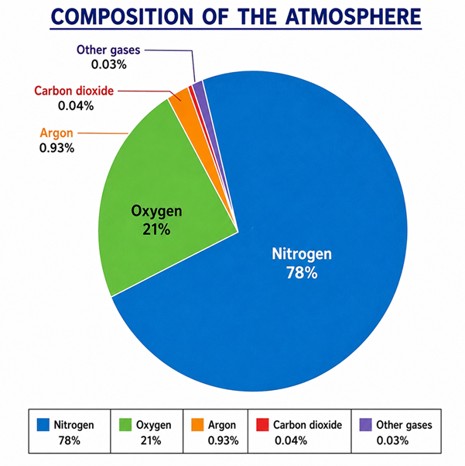
1: What is atmosphere? Explain its composition with the help of a pie diagram.
Answer: The atmosphere is the blanket of air surrounding the Earth. It is a mixture of different gases, along with water vapour and tiny dust particles. It is essential for the survival of living beings and also protects the Earth from harmful radiation.
The composition of the atmosphere is approximately:
- Nitrogen – 78%
- Oxygen – 21%
- Argon – 0.93%
- Carbon dioxide – 0.04%
- Other gases – 0.03%
2: Draw a labelled diagram of the structure of atmosphere.
Answer:
3: Which are the four main seasons of India?
Answer: The four main seasons of India are:
- Winter Season – December to early April
- Summer or Pre-monsoon Season – April to June
- Monsoon or Rainy Season (Advancing Monsoon) – June to September
- Post-monsoon Season (Retreating Monsoon) – October to December
4: Why do you not feel the pressure of the atmosphere?
Answer: We do not feel the pressure of the atmosphere because air presses on our bodies from all sides, while the pressure inside our bodies acts in the opposite direction. These pressures balance each other, so we do not feel the atmospheric pressure.
5: In which layer of the atmosphere do aeroplanes fly and why?
Answer: Aeroplanes generally fly in the lower part of the stratosphere because this layer has stable air conditions, fewer clouds, and less turbulence, which makes flying smoother and safer.
6: Distinguish between the troposphere and the stratosphere.
Answer:
| Troposphere | Stratosphere |
| It is the lowest layer of the atmosphere. | It lies above the troposphere. |
| Weather phenomena such as clouds, rain, and storms occur here. | Weather is generally calm and stable. |
| Temperature decreases with increase in altitude. | Temperature increases with increase in altitude. |
| It contains most of the air and water vapour. | It contains the ozone layer and very little water vapour. |
7: Distinguish between the southwest monsoon and the northeast monsoon.
Answer:
| South-West Monsoon | North-East Monsoon |
| It blows from the south-west towards India. | It blows from the north-east towards the sea. |
| It occurs from June to September. | It occurs from October to December. |
| It brings heavy rainfall to most parts of India. | It brings little rainfall to most parts, but heavy rain to the Tamil Nadu coast. |
| It is known as the summer monsoon. | It is known as the retreating or winter monsoon. |
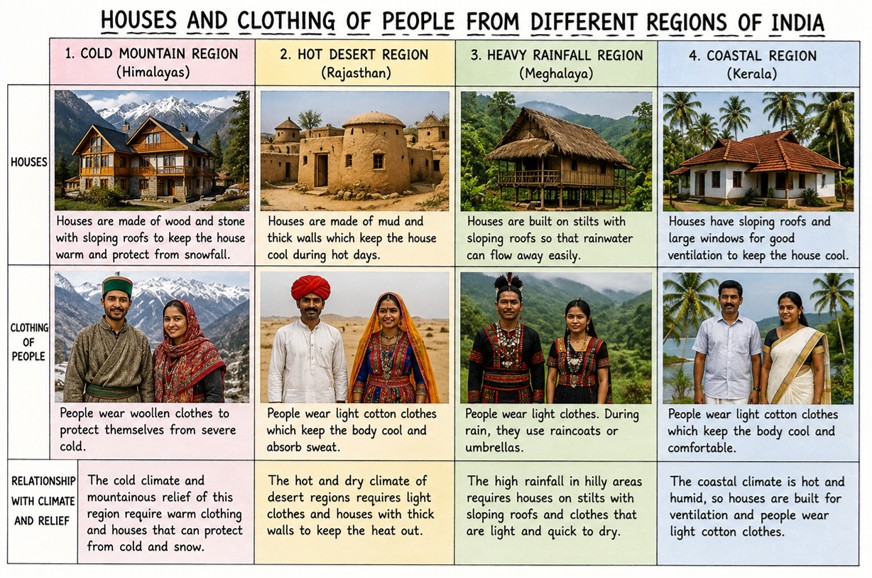
8: Collect pictures of houses and clothing of people from different regions of India. Examine whether they reflect any relationship with the climatic conditions or the relief of those regions.
Answer: Yes, houses and clothing in different regions of India show a relationship with climate and relief.
- In cold regions, people wear woollen clothes, and houses are designed to provide warmth.
- In hot regions, people generally wear light cotton clothes, and houses are designed to allow ventilation.
- In high rainfall areas, houses often have sloping roofs so that rainwater can flow away easily.
- In mountainous regions, houses are adapted to the cold climate and uneven relief.
Class 9 Social Science Part 1 Chapter 3 NCERT Questions and Answers
The chapter Atmosphere and Climate explores the layers and composition of the air surrounding Earth. Students learn how temperature, air pressure, winds, and moisture interact to produce different weather conditions.
Students also examine climatic patterns and the factors that cause differences between regions. The chapter connects atmospheric processes with human life and encourages an understanding of climate change and responsible environmental choices.