

NCERT Solutions for Class 9 Social Science Part 1 Chapter 4 Early Humans and Beginning of Civilisation are provided here with simple and easy-to-understand explanations. Based on the NCERT textbook Understanding Society: India and Beyond Part 1, this chapter introduces early human life, changing ways of living, and the emergence of settled communities and civilisations. These NCERT Solutions for Class 9 Social help students understand important concepts, complete textbook activities, and revise the chapter for school examinations.
Early Humans and Beginning of Civilisation Class 9 Questions and Answers
The Big Questions (NCERT Textbook Page no. 40)
1: How did humans live on Earth before the beginning of civilisation?
Answer: Before the beginning of civilisation, humans mainly lived as hunter-gatherers. They depended on hunting animals, gathering wild plants and grains, and fishing for their food. They used simple stone tools for hunting, cutting meat, digging and other tasks. They often lived in caves and rock shelters and moved from one place to another in search of food and suitable resources.
Later, during the Neolithic period, humans gradually shifted from hunting and gathering to agriculture and settled life, domesticated animals and plants, and established the first village settlements.
2: How did humans communicate before writing was invented?
Answer: Before writing was invented, humans communicated through symbolic forms of communication. They painted pictures on the walls of caves and rock shelters, used pigments to decorate their bodies, and made objects such as beads of stone, bone and shell. These helped them express ideas and communicate with others.
3: How is archaeology helpful in understanding our past?
Answer: Archaeology helps us understand our past by studying tools, bones, fossils and other objects left behind by early humans. Archaeologists examine these remains to reconstruct how our ancestors lived, what tools they used and how they survived. They also make and use similar tools to understand how early humans created and used them.
4: How did early civilisations interact with each other?
Answer: Early civilisations interacted mainly through contacts and trade. Their geographical location, especially their proximity to river valleys, helped them exchange goods and ideas.
The Mesopotamian and Sindhu–Sarasvatī civilisations had strong contacts and trade because their regions were relatively close to each other. In contrast, there is little tangible evidence of direct contact between the Egyptian or Chinese civilisations and the Sindhu–Sarasvatī civilisation.
Think about it (NCERT Textbook Page no. 65)
Q: Why do you think early humans left Africa to migrate to other regions?
Answer: Early humans left Africa and migrated to other regions mainly in search of food, water, and better living conditions. Changes in climate, population growth, and the need to explore new places encouraged them to spread across different parts of the world.
Think about it (NCERT Textbook Page no. 67)
Q: Why do you think the shift to farming during the Neolithic period is called a revolution rather than a simple change? Discuss with your classmates.
Answer: The shift to farming during the Neolithic period is called a revolution because it brought major changes in human life, not just a small change in food production.
- Humans shifted from hunting and gathering to food production.
- They began domesticating plants and animals.
- They developed new tools for farming and food processing.
- They started making pottery and establishing permanent village settlements.
- These changes laid the foundations for the later development of urban civilisation.
Therefore, farming transformed the way humans lived, worked and organised their societies, so it is rightly called the Neolithic Revolution.
Think about it (NCERT Textbook Page no.77)
Q: Why were rivers important in the growth of early civilisations?
Answer: Rivers were important in the growth of early civilisations because they provided water and fertile land for agriculture. The fertile river valleys supported farming and helped people establish permanent settlements. As agriculture developed, surplus food and other resources supported the growth of towns, trade and civilisations. For example, the Sindhu–Sarasvati, Mesopotamian, Egyptian and Chinese civilisations all developed in fertile river valleys.
Let’s Explore (NCERT Textbook Page no.77)
Q: Can you find out which countries constitute West Asia in present times?
Answer: In present times, West Asia includes countries such as Iraq, Kuwait, Iran, Türkiye (Turkey), Saudi Arabia, Syria, Jordan, Lebanon, Israel, Palestine, and Yemen, among others. West Asia, also commonly referred to as the Middle East, is the westernmost subregion of Asia.
Let’s Explore (NCERT Textbook Page no. 80)
Q: Do you find any similarities between the temples in India and those of the Sumerian civilisation as centres of socio-cultural and economic activity?
Answer: Yes, there are some similarities between Indian temples and Sumerian temples as centres of socio-cultural and economic activity.
In Sumerian civilisation, temples were not only places of worship but also centres where agriculture, trade and the transport of goods were connected to temple authority. People’s lives and the growth of cities also centred around these temples.
Similarly, in India, temples have traditionally been important centres of religious and cultural activities and have also supported local economic activities through festivals, markets, crafts and trade.
Questions and activities (NCERT Textbook Page no. 93)
1: Do you think life became easier or more challenging after humans started farming? Give two reasons for your answer.
Answer: Life after farming became both easier and more challenging. It provided a reliable, surplus food supply, ending constant nomadic wandering. However, it also introduced intense labor, as humans were now tied to the land and constantly threatened by unpredictable weather and crop failures.
Two Reasons for this Shift:
- Humans could grow their own food and produce a surplus, which allowed them to settle permanently, build homes and establish villages.
- Farmers had to work regularly to plough, sow, water and harvest crops. They also became dependent on natural conditions, so droughts, floods or crop failures could threaten their food supply.
2: The environment offers human societies both opportunities as well as challenges. Explain with reference to early farming communities and river-valley civilisations.
Answer: The environment provided both opportunities and challenges to early human societies.
Opportunities: Fertile river valleys such as the Sindhu–Sarasvatī, Mesopotamian, Egyptian and Chinese regions provided favourable conditions for agriculture and settlement. Rivers supplied water and fertile land, helping people grow crops and establish permanent settlements. Agriculture and improved productivity later supported the growth of towns and civilisations.
Challenges: Farming communities became dependent on natural conditions, so droughts, floods and crop failures could threaten their food supply. River-valley communities also had to deal with the challenges caused by rivers and their floods.
3: Why do historians divide early human history into different ages such as Stone Age, Bronze Age, and Iron Age? What does this classification tell us about human progress?
Answer: Historians divide early human history into different ages based mainly on major changes in technology, tools and ways of life. For example, the Stone Age is associated with the use of stone tools, the Bronze Age with the development of bronze metallurgy, and the Iron Age with the widespread use of iron.
This classification helps us understand human progress over time. It shows how humans gradually developed better tools and technologies and changed their ways of living, from hunting and gathering to agriculture, settled life and more advanced societies.
4: Imagine you are a Neolithic farmer. Describe one day of your life. What challenges would you face that a hunter-gatherer would not?
Answer: If I were a Neolithic farmer, my day would begin by working in the fields. I would prepare the land, sow seeds, water the crops and care for domesticated animals. I would also make or use polished stone tools and live with my family in a permanent village.
Unlike a hunter-gatherer, I would face the challenge of looking after crops and animals every day. My food supply would depend on the success of the harvest, so unfavourable natural conditions or crop failure could create serious difficulties. I would also have to remain in one place rather than move from one area to another in search of food.
5: Imagine that the Harappan script gets deciphered tomorrow. What new types of information do you think historians might learn?
Answer: If the Harappan script were deciphered, historians might learn:
- Details about the Harappan society and administration.
- Information about their religion, beliefs and customs.
- Details about their trade and economic activities.
- More information about their cities, rulers and daily life.
- It could also help us understand the meaning of inscriptions found on seals and pottery, which are currently not understood.
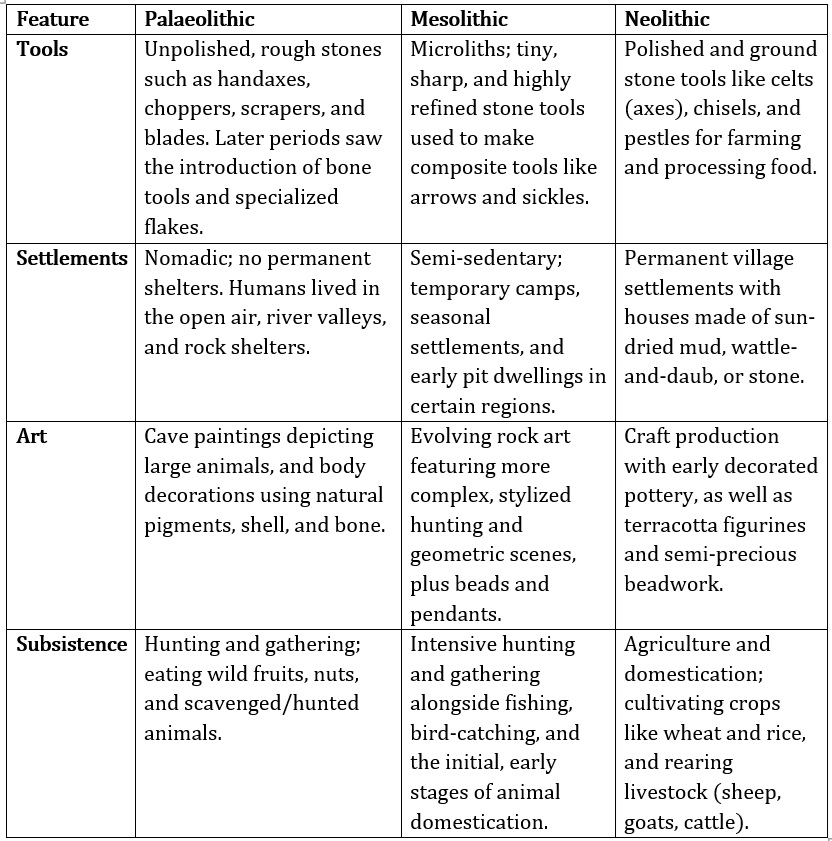
6: Prepare a table with three columns-Palaeolithic, Mesolithic, and Neolithic-and fill in their distinctive features: tools, settlements, art, and subsistence.
Answer:
7: “Bronze Age civilisations developed independently but shared common features.” Examine this statement with reference to the civilisations given in the chapter (Early Humans and Beginning of Civilisation).
Answer: The Bronze Age civilisations developed independently in different regions, but they shared several common features because they faced similar needs and challenges.
The Sindhu–Sarasvati, Mesopotamian, Egyptian and Chinese civilisations all developed in fertile river valleys, which provided favourable conditions for agriculture and settlement. They also developed agriculture, crafts, trade, organised settlements and systems of writing and administration. The Harappans, for example, had planned cities, water-management systems, standard weights and measures, seals and writing.
However, each civilisation developed its own distinctive culture, technologies and traditions according to its local environment and historical circumstances. Thus, although these civilisations developed independently, their similar needs led to many common features such as agriculture, urban settlements, trade, writing and organised social life.
8: Although rivers provided many benefits, they also created challenges for early societies. Discuss both the advantages and disadvantages of settling near rivers.
Answer: Settling near rivers had both advantages and disadvantages for early societies.
Advantages:
- Rivers provided water for drinking and farming.
- River valleys had fertile soil, which supported agriculture and increased food production.
- Rivers helped people establish permanent settlements and supported the growth of civilisations.
- Rivers could also support trade and communication between settlements.
Disadvantages:
- Floods could destroy crops, houses and other property.
- Changes in the river’s course or water availability could make farming difficult.
- People had to develop ways to manage and control water to reduce these risks.
OR
Settling near rivers had both advantages and disadvantages for early societies.
Advantages: Rivers provided water for drinking and agriculture and fertile land for growing crops. They supported the development of permanent settlements, towns and civilisations. Rivers also helped in trade and economic activities.
Disadvantages: Rivers could also create challenges, especially when their waters flooded nearby areas, which could damage crops and settlements. People therefore had to develop ways to manage and control water, such as dams and canals. The Sumerians, for example, developed dams and canals to manage water.
9: With the help of your teacher, find out more about the Code of Hammurabi. Why was it important? Do you think it was fair to all sections of society? Give reasons for your answer.
Answer: The Code of Hammurabi was a set of laws created by Hammurabi, the king of Babylon. The laws were written in cuneiform and covered matters such as property, trade, family life and punishments
It was important because it provided written rules for society and helped maintain order and justice in the Babylonian kingdom. However, I do not think it was completely fair to all sections of society. The punishments and rights could differ according to a person’s social status, so people from different social groups were not always treated equally.
10: If you had to choose one major innovation from early civilisations that changed the world permanently, what would it be and why?
Answer: If I had to choose one major innovation from early civilisations, I would choose writing. Writing changed the world permanently because it allowed people to record and preserve information, such as laws, trade, administration, history and ideas. It also made it possible to pass knowledge from one generation to another more accurately. Early civilisations such as Mesopotamia, Egypt and the Sindhu–Sarasvatī civilisation developed their own writing systems.
11: Compare the social hierarchy and daily life of people in the Egyptian civilisation with those in Mesopotamia or China. What similarities and differences do you notice?
Answer: Both Egyptian and Mesopotamian societies had a clear social hierarchy, with rulers and priests at the top and farmers, artisans and other workers forming the larger part of society.
| Egyptian Civilisation | Mesopotamian Civilisation |
| Pharaoh was the ruler. | Powerful rulers governed the city-states. |
| Below the Pharaoh were government officials, nobles and priests. | High priests and the ruling class held important positions. |
| Farmers, artisans, merchants, serfs and slaves formed other social groups. | Farmers, craftsmen, traders and other workers carried out daily economic activities. |
| Daily life included farming, crafts, trade and religious activities. | Daily life included agriculture, trade, craft production and activities connected with temples. |
A major similarity was that religion and economic activities were closely connected with the ruling and priestly classes. In Mesopotamia, agriculture, trade and transport of goods were tied to temple authority. Egypt also had a clearly divided social hierarchy, from the Pharaoh to officials, nobles, priests, free landholders, artisans, merchants, serfs and slaves.
OR
The Egyptian and Mesopotamian civilisations both had a clear social hierarchy, with rulers and religious or administrative groups at the top and ordinary workers at the lower levels.
In Egypt, the social hierarchy included the Pharaoh, followed by government officials, nobles and priests, then free landholders, artisans and merchants, and finally serfs and slaves. People had different occupations according to their social position.
In Mesopotamia, rulers and high priests were part of the higher social groups. Temples and ziggurats were important centres of life, and economic activities such as agriculture, trade and transport of goods were connected with temple authority.
Similarity: Both societies had a social hierarchy, religious institutions played an important role, and people were involved in activities such as agriculture, crafts and trade.
Difference: Egyptian society was headed by the Pharaoh, while Mesopotamia developed city-states, each centred around a major city and its temple.
12: Activity: Using maps, locate the major rivers and civilisations of Mesopotamia, Egypt, China, and the Sindhu-Sarasvatī Valley. Mark the trade links between them.
Answer: Do it yourself.
13: Activity: Choose one early civilisation (Mesopotamia, Egypt, or China) and prepare a mini-scrapbook or a presentation showing their innovations in tools, writing, art, and architecture. Include pictures, brief descriptions, and explain their significance.
Answer: Do it yourself.
Class 9 Social Science Part 1 Chapter 4 NCERT Questions and Answers
The chapter Early Humans and Beginning of Civilisation explores how human communities developed tools, adapted to their surroundings, and found new ways to obtain food. Students learn about the transition from hunting and gathering to farming and settled life.
Students also examine the growth of early settlements and the features associated with civilisation. Archaeological evidence helps them understand changes in work, technology, trade, and social organisation over long periods of time.