

NCERT Solutions for Class 9 Social Science Part 1 Chapter 5 State and Society up to 1000 CE are provided here with simple and easy-to-understand explanations. Based on the NCERT textbook Understanding Society: India and Beyond Part 1, this chapter introduces early states, political institutions, and changes in Indian society up to 1000 CE. These NCERT Solutions for Class 9 help students understand important concepts, complete textbook activities, and revise the chapter for school examinations.
State and Society up to 1000 CE Class 9 Questions and Answers
The Big Questions (NCERT Textbook Page no. 97)
1: How did society and state organise themselves prior to 1000 CE?
Answer: Before 1000 CE, society in the Indian subcontinent was organised around families and communities, while political organisation gradually developed from clans into kingdoms, republics, and empires. In the Vedic period, the kula (family) was the basic social unit, and clans called janas were led by a raja, assisted by assemblies such as the sabha and samiti. The janas later developed into territorial janapadas and larger mahajanapadas. Empires such as those of the Mauryas and Guptas governed through ministers and local officials. Social life was also shaped by the four varṇas and the many jatis that emerged over time.
OR
Prior to 1000 CE, Indian society and the state gradually developed from small kin-based groups into larger and more organised political and social systems.
In the early Vedic period, society was organised around families (kula). Several families formed a village (grama), villages formed a visha, and several visshas formed a jana, which was headed by a raja.
Over time, Vedic society developed into janapadas and then larger mahājanapadas. Later, powerful empires such as the Mauryas and Guptas developed more complex systems of administration. States were organised into provinces, districts and villages, with officials responsible for governing them.
Society also became more organised through varṇas, jati groups, occupations, trade networks and guilds. Thus, by 1000 CE, Indian society and states had developed complex systems of governance, administration, agriculture, trade and social organisation, while many cultural traditions continued over time.
2: How did states and societies emerge and spread to different parts of the Indian subcontinent?
Answer: States and societies emerged and spread as kin-based groups developed into janapadas and mahājanapadas, and later into large kingdoms and empires. The expansion of agriculture, trade, migration and political power helped these societies spread to different regions. Powerful states such as the Mauryas and Guptas in the north and the Cholas, Cheras and Pandyas in the south played an important role in this process.
OR
States and societies emerged and spread across different parts of the Indian subcontinent gradually over time. In the Vedic period, people were organised into kin-based groups called janas. As people settled in particular territories, these groups developed into janapadas, and later into larger mahajanapadas. Control over land, agriculture and trade routes helped these political units grow.
Some powerful states expanded further and developed into large kingdoms and empires. Magadha became a major power because of its fertile plains, strategic location and strong rulers. Later, the Mauryas and Guptas in northern India and the Cholas in southern India developed powerful political systems.
3: How did the ideas of dharma and chakravarti samrat help create unity in social values and governance, and promote the idea of the Indian subcontinent as one political entity?
Answer: The idea of dharma provided a common set of social and ethical values that guided both individuals and rulers. The idea of the chakravarti samrat, or universal paramount ruler, expressed the ideal of political authority extending over the Indian subcontinent. Together, these ideas helped create continuity in social values and governance and encouraged the vision of the Indian subcontinent as a single political entity, even though it was ruled by different kingdoms at different times.
OR
Dharma provided a common set of ethical and social values. It guided people to fulfil their duties towards their family, teachers, society and others. It also guided rulers to protect people, ensure justice and work for the welfare of their subjects. Thus, dharma provided a common moral basis for social life and governance.
The idea of the chakravarti samraṭ represented the ideal of a universal ruler with authority over the Indian subcontinent. Ideas such as Jambudvipa, Bharatavarṣha, Ashvamedha and chakravarti kṣhetra expressed the idea of sovereignty over a large, unified territory.
Thus, dharma provided unity through shared values and duties, while the idea of the chakravarti samrāṭ promoted the vision of the Indian subcontinent as one political entity.
4: How did different social, administrative, and occupational groups take shape over time and come together culturally?
Answer: Different social, administrative and occupational groups developed as society became more complex. Groups were formed based on occupation, region, kinship and social roles, while administrative units such as villages, districts and provinces organised people politically. They came together culturally through shared traditions, trade, knowledge, religion and practices such as Bhakti, which connected different regions.
OR
Different social, administrative and occupational groups developed gradually as society became more complex. Social groups such as varṇas and jatis took shape, while different occupations such as farmers, traders, artisans, warriors and priests became important.
Administrative groups also developed as kingdoms became larger. States were divided into provinces, districts and villages, with officials and local bodies managing different areas.
These different groups came together through shared economic activities, cultural traditions, religious practices, trade and knowledge traditions. Despite regional and political differences, these connections helped create cultural unity across the subcontinent.
The Big Questions (NCERT Textbook Page no. 134)
1: How did political organisation change from the Vedic period to the age of large empires such as the Mauryas and the Guptas? Explain the administrative system of the early Indian states.
Answer: In the Vedic period, political organisation was mainly based on kin-based groups or janas led by a raja. Over time, these developed into larger territory-based units called janapadas and mahājanapadas, and eventually into powerful empires such as those of the Mauryas and Guptas.
The early Indian states generally followed a mix of monarchy and decentralised administration. Larger kingdoms were divided into provinces, districts and villages. The village was the smallest administrative unit and often had considerable autonomy in practical matters such as infrastructure, social welfare and education. This system allowed large states and empires to govern their extensive territories effectively.
OR
Political organisation changed from small kin-based groups in the Vedic period to large and well-organised kingdoms and empires.
In the early Vedic period, people were organised into janas (tribes) led by a raja. These later developed into janapadas and mahajanapadas. Eventually, powerful rulers established large empires such as the Mauryan and Gupta empires.
The early Indian states developed an organised administrative system. According to Kauṭilya’s Arthashastra, the state had seven important constituents: the king, ministers, territory, forts, treasury, army and allies. Effective governance required these parts to work together.
As kingdoms became larger, they were divided into provinces, districts and villages, with officials responsible for administration. Villages were the lowest administrative units, and local assemblies also played an important role in managing local matters.
2: Describe the role of the king, important officers, and the methods used to govern large territories.
Answer: In early Indian kingdoms, the king held supreme authority and governed with the help of ministers and local officers. His main duties were to protect his subjects, maintain order, and administer justice fairly. The council of ministers included the treasurer, the chief tax collector, the chief legal adviser, and the commander-in-chief. To govern large territories, kingdoms were divided into provinces and districts. District governors called pradeshikas handled administration and justice, while village headmen called gramikas looked after village affairs.
The king held supreme authority and was expected to protect the people and ensure justice. However, he did not govern alone. He was supported by a council of ministers (mantri-pariṣhad), which included important officials such as the treasurer, chief tax collector, chief legal adviser and commander-in-chief of the army.
To govern large territories, kingdoms and empires were divided into provinces, divisions, districts and villages. Provincial governors and district officers carried out administration, while district governors handled judicial and administrative functions.
Cities had governors responsible for revenue collection and maintaining law and order, while village assemblies handled many local matters such as irrigation, gardens and temples. This combination of central authority and decentralised administration helped rulers manage large territories.
3: After studying this chapter, what do you think were the most important features of the state and society in India before 1000 CE?
Answer: The most important feature of state and society before 1000 CE was the gradual development of political, social, economic and cultural institutions while maintaining considerable continuity. Political organisation evolved from kin-based clans (janas) led by a raja to larger kingdoms, republics and powerful empires such as the Mauryas, Guptas and Cholas. These states developed structured systems of administration, taxation, military organisation and governance.
Society became more complex, with different social and occupational groups, while agriculture remained the main economic activity. Irrigation, trade networks, ports and guilds supported commerce and crafts. At the same time, knowledge traditions, cultural practices, trade networks and devotional traditions such as Bhakti continued to flourish across different regions. Thus, the period was marked by both political change and strong cultural continuity.
4: What do early texts such as the Rig Veda, Arthashastra, and the Mahabharata reveal about political and social life?
Answer: Early texts such as the Rig Veda, Arthasastra and Mahabharata are important sources for understanding the political, social, cultural and moral life of early India. The Rig Veda provides insights into kin-based social organisation, early forms of polity and social life. The Arthasastra gives a detailed account of statecraft, administration, the duties of the king and the organisation of the state. The Mahabharata also discusses kingship, governance, justice and dharma. Together, they help us understand how early Indian society and states were organised.
OR
Early texts such as the Rig Veda, Arthashastra and Mahabharata provide valuable information about the political, social, moral and cultural life of early India.
- The Rig Veda gives information about early kin-based social organisation, such as jana and kula, and shows that occupations could be diverse and flexible.
- The Arthashastra provides detailed ideas about kingship, administration and governance. It describes the duties of the king and the importance of ministers and an organised administrative system.
- The Mahabharata provides ideas about kingship, justice, ethical conduct and the responsibilities of rulers towards their subjects. It states that the king was expected to protect people from threats and maintain justice.
These texts therefore help historians understand how society was organised, how rulers governed, what duties people were expected to perform, and what moral values guided political and social life.
5: What can we learn from early Indian society about varna and the role of women?
Answer: Early Indian society had a fourfold varṇa system consisting of brahmaṇas, kṣhatriyas, vaishyas and shudras. However, the textbook explains that early Vedic texts do not indicate a fixed social status strictly based on birth. Social identity was shaped by several factors such as occupation, region, village, gotra, language and kinship, and occupations were relatively flexible.
Women also played important roles in social, economic, cultural and political life. They participated in activities such as agriculture, cattle rearing, spinning, fishing and trade. Some women were poets, artists, donors and rulers; for example, Prabhavati Gupta ruled as a regent and issued land grants in her own name. Later records also mention royal women supporting temples and religious institutions.
6: Explain how assemblies like sabha and samiti limited the power of the raja. Which modern institutions perform similar functions today?
Answer: The sabha and samiti played an important role in limiting the power of the raja. The sabha was a smaller assembly of selected elites that mainly performed judicial functions. The samiti was a larger assembly representing the broader population and discussed political affairs and policy decisions. Both assemblies provided a platform for discussion and decision-making, which meant that the king could not rule alone or make all decisions by himself. These assemblies therefore provided a form of participation and helped check the authority of the raja.
In modern times, similar functions are performed by parliaments, legislative assemblies, and courts. For example, in India, the Lok Sabha and Rajya Sabha (Houses of Parliament) make laws and hold the government accountable, while the judiciary ensures justice and checks the misuse of power. These institutions, like the ancient sabha and samiti, limit the power of leaders and protect the rights of the people by involving representatives in decision-making.
7: What do the terms varna and jati refer to in early Indian society? How were they different, and what factors may have contributed to the formation of various jatis?
Answer: In early Indian society, varna referred to the broad fourfold division of society into Brahmaṇas, Kṣatriyas, Vaishyas and Sudras. Early Vedic texts do not show that social status was strictly fixed by birth. Instead, social identity was influenced by factors such as occupation, region, kinship, language and community.
Jati referred to the various social groups and communities that developed over time. Unlike the four broad varṇas, there was no fixed number of jatis, and their number increased as new social groups and occupations developed. Varṇa and jati were also not always rigid, and there was considerable social and occupational mobility.
Various jatis may have formed due to the growth of new occupations, different communities, regional identities, kinship groups and economic activities. The development of specialised occupations and interactions among different groups also contributed to the growth of various jatis.
8: Why do you think education in early India emphasised both knowledge and moral values? How might this have benefited society?
Answer: Education in early India had a holistic purpose. It focused not only on gaining knowledge but also on developing qualities such as truth, patience, regularity, humility, self-control and reverence for all beings. Students were also expected to live according to dharma and fulfil their duties towards parents, teachers and society. Students studied a wide range of subjects, including grammar, logic, philosophy, ethics, mathematics, science, medicine and astronomy, along with arts, crafts, physical education, yoga and meditation.
Thus, education prepared students not only with knowledge and practical skills but also with good character and moral conduct. This benefited society by producing individuals who were knowledgeable, disciplined and aware of their responsibilities towards others.
9: Look at the major trade routes of early India (Fig 5.12.). How do you think these routes helped people in the exchange of goods skills beliefs, and cultural practices.
Answer: There were two major trade routes in early India:
(a) Uttarpatha
(b) Dakshinapatha
These routes were major trade highways that physically linked distant corners of the Indian subcontinent. While merchants used them to transport goods like textiles, spices, and metals, these routes also acted as cultural highways. As people travelled, artisans shared advanced craftsmanship skills, scholars exchanged scientific knowledge, and monks spread religious philosophies like Buddhism and Hinduism. This continuous movement successfully blended diverse regional traditions into a deeply interconnected, shared Indian culture.
10: What might have been the advantages and challenges of ruling a large empire in the absence of modern communication systems?
Answer: Ruling a large empire without modern communication systems had both advantages and challenges.
Advantages:
- A large empire could bring many different regions and peoples under one political authority.
- Dividing the empire into provinces, districts and villages made administration easier. Local officials could manage different areas while the king remained the supreme authority.
- Village-level administration allowed local communities to manage many practical matters themselves, reducing the burden on the central government.
Challenges:
- It would have been difficult for the king to communicate quickly with distant regions and receive information from them.
- Controlling such a large territory required a large administrative machinery, including provincial governors and district officers.
- Maintaining law and order, collecting revenue and responding to problems in distant areas would have taken considerable time and coordination.
11: Many ideas about governance come from texts composed by scholars and advisors of the king. What might be some limitations of relying only on such sources?
Answer: Texts written by scholars and royal advisors are useful for understanding ideas about kingship, administration and governance. However, relying only on them has some limitations.
- Such texts may mainly present the viewpoint of rulers, scholars and advisers, rather than ordinary people.
- They may describe ideal ways of governing rather than what actually happened in everyday life.
- They may give limited information about the experiences of women, workers, farmers and other social groups.
- They may therefore provide only a partial picture of society and political life.
To understand history fully, historians look for other clues. They study archaeological digs, local taxes, temple records, and even common folktales to see how normal people really survived.
12: Read the source and answer the questions:
The Nashik cave inscription (2nd 2nd century CE) of Ushavadata records:
“Uṣhavadata, son of Dinika, son-in-law of king Nahapana… has bestowed this cave on the Samgha generally; he has also given a perpetual endowment, three thousand-3000 kahapaṇas, which, for the members of the Samgha of any sect, and any origin dwelling in this cave, will serve as cloth money and money for outside life (kushana); have been invested in guild dwelling at Govadhana-2000 in a weavers’ guild, interest one pratika (monthly) for the hundred, (and) 1000 in another weaver’s guild, interest three quarters of a padika (monthly) for the hundred.”
a. What does this source tell us about the economic role of guilds?
b. Why were guilds trusted with money deposits?
c. Identify the donor and the donees from the given source.
Answer: a. The source shows that guilds played an important economic role by accepting money deposits and providing interest on them. They also helped in managing financial resources.
b. Guilds were trusted because they were organised, reliable institutions that managed funds and provided regular interest payments.
c. The donor is Ushavadāta, son of Dinika and son-in-law of king Nahapana. The donees are the members of the Samgha (Buddhist monastic community) of any sect or origin who lived in the cave. The endowment was meant to support their needs, such as clothing and daily expenses.
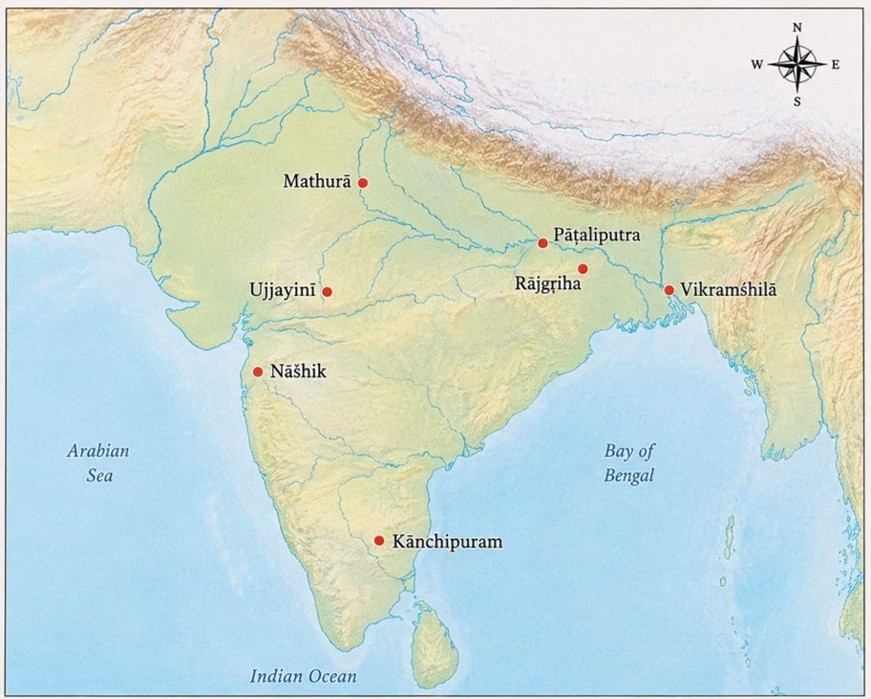
13: Mark and locate on the map of India the following important centres: Pataliputra, Nashik, Ujjayini, Vikramshila, Kanchipuram, Mathura, Rajgriha.
Answer:
14: Prepare a short presentation or poster on one of the following-
a. Life in the Vedic society
b. Early education system (gurukula)
c. Trade and guilds in early India
d. Role of women in early Indian society
Answer: a. Vedic society was based on families (kula) and clans (jana), with most people living in villages. The four varnas divided social roles, but occupations were flexible in the early period. Assemblies like sabha and samiti helped in decision-making. Women participated in education and religious rituals. People worshipped nature gods and followed dharma, valuing knowledge, justice, and harmony.
b. Education in early India took place in gurukulas, where students lived with their guru. They studied the Vedas, grammar, mathematics, science, arts, and practical skills. Along with knowledge, students learned discipline, respect, and moral values. The system focused on character-building and preparing responsible citizens.
c. Trade was important to early India’s economy. Routes like the Uttarapatha and Dakshinapatha connected different regions and promoted the exchange of goods and ideas. Guilds (shrenis) of traders and artisans managed trade, maintained quality, fixed prices, and provided loans. They also supported public works and religious activities, helping economic growth.
d. Women were not confined to the home; they participated alongside men in religious rituals and attended political assemblies like the Sabha. As society transitioned into later periods, patriarchal norms tightened. Property rights and access to education became restricted, shifting their roles primarily to domestic duties.
Class 9 Social Science Part 1 Chapter 5 NCERT Questions and Answers
The chapter State and Society up to 1000 CE explores the development of kingdoms, empires, and regional powers in ancient and early medieval India. Students learn how different forms of rule were connected with administration, economy, and social life.
Students also examine ideas, religious traditions, trade, and cultural developments that shaped communities. Historical sources and timelines help them recognise continuity and change and connect political developments with people’s experiences.