

NCERT Solutions for Class 9 Social Science Part 2 Chapter 4 Governance and Public Policy are provided here with simple and easy-to-understand explanations. Based on the NCERT textbook Understanding Society: India and Beyond Part 2, this chapter introduces the working of public institutions and the processes used to address collective needs. These NCERT Solutions for Class 9 help students understand important concepts, complete textbook activities, and revise the chapter for school examinations.
Governance and Public Policy Class 9 Questions and Answers
The Big Questions (Page no – 81)
Question 1. What is governance, and how have its meaning and practice evolved over time?
Answer: Governance is the process of making, implementing, and monitoring decisions for public welfare. It involves cooperation among government institutions, citizens, civil society, the media, and private organisations.
In ancient India, institutions such as the Sabha and Samiti discussed public affairs. Ideas such as Rajadharma and Ram Rajya emphasised the ruler’s duty to ensure justice, protection, and people’s well-being. Colonial rule imposed different administrative institutions, many of which continued after Independence.
Independent India adapted these institutions through the Constitution and democratic values. Today, governance emphasises transparency, accountability, participation, inclusion, and the rule of law. E-governance also uses technology to improve public services and citizen participation.
Question 2. What is public policy? How does it affect our day-to-day lives, and what makes it ‘public’?
Answer: Public policy is a planned course of action adopted by the government to solve public problems, meet people’s needs, and promote society’s welfare.
It affects our daily lives through services such as education, healthcare, roads, drinking water, electricity, sanitation, and public transport. These services make life safer, healthier, and more convenient.
A policy is ‘public’ because it addresses issues affecting society, serves public welfare, and is implemented by public institutions. It is often financed through public money collected as taxes. Citizens also help shape it by raising concerns, offering suggestions, and providing feedback.
Question 3. What are the various stages of policy-making and policy implementation?
Answer: The various stages of policy-making and implementation are:
- Identify public needs and problems requiring government action.
- Decide which issues need attention first.
- Consult stakeholders, examine possible solutions, draft the policy, and assess financial feasibility.
- Obtain approval and frame the necessary laws, rules, and guidelines.
- Put the policy into action through programmes and schemes involving government departments and other stakeholders.
- Track progress, ensure accountability, and identify shortcomings.
- Assess results and impact, and use feedback to improve the policy.
Question 4. Who are the major contributors to policy-making and implementation? (Page no. 81)
Answer: The major contributors to policy-making and implementation are:
- Citizens, who identify problems, suggest solutions, and provide feedback.
- Elected representatives, who raise people’s concerns, make laws, and approve budgets.
- Government officials and departments, who prepare policies, implement them, and monitor progress.
- NGOs, experts, researchers, and the media, who study issues, create awareness, and suggest improvements.
- Private organisations, which provide resources, technology, and expertise.
- International organisations, which offer technical and financial support.
Question 5. What role do citizens play in shaping public policy and strengthening good governance? (Page no. 81)
Answer: Citizens help shape public policy and strengthen good governance in the following ways:
- They identify public problems and bring them to the attention of authorities.
- They vote to elect representatives who address their needs and concerns.
- They participate in public consultations and offer suggestions for policies.
- They cooperate in implementing policies, follow laws, and take part in community activities.
- They provide feedback on public services and suggest improvements.
- They monitor government actions and hold public officials accountable, promoting transparency and responsiveness.
Let’s Explore (Pages 81 – 82)
Let us see how a government and citizens come together to address various challenges.
Imagine that your town experiences several days of unusually heavy rainfall. Roads become flooded, schools remain closed, electricity is disrupted in some areas, public health concerns rise, and many people find it difficult to reach schools, workplaces, or even hospitals. During such situations, organisations and individuals come together to help all in need.
The municipal corporation clears drains and removes garbage. The Public Works Department repairs damaged roads. The police manage traffic. School authorities inform parents that schools will remain closed. Health workers prevent the spread of diseases. Local representatives raise people’s concerns, while residents volunteer to help vulnerable neighbours and report on flooded areas. The situation improves with collective efforts of all.
Form groups and discuss the following:
Question: Who are the different people and organisations involved in dealing with this situation? (Page no. 82)
Answer: the different people and organisations involved are the municipal corporation, Public Works Department, police, school authorities, health workers, local representatives and residents. Each supplies different information, services or assistance needed for the response.
Question: Why cannot a single department solve the problem on its own? (Page no. 82)
Answer: A single department cannot solve the problem because heavy rainfall affects several services, including roads, drainage, electricity, education, and healthcare. Each department has specific responsibilities and expertise. Therefore, different departments must coordinate with one another and work with citizens to restore services and help those affected.
Question: What would happen if these departments did not communicate or coordinate with one another? (Page no. 82)
Answer: Without communication and coordination, departments might duplicate some tasks while neglecting others. Relief work and the restoration of roads, electricity, and healthcare would be delayed. Conflicting instructions could create confusion, waste resources, and prevent timely help from reaching vulnerable people, making the situation worse.
Question: What role can citizens play before, during, and after the heavy rainfall? (Page no. 82)
Answer: Before heavy rainfall, citizens can keep their surroundings clean, avoid dumping waste into drains, report blocked drains, and follow official weather warnings.
During heavy rainfall, they can report flooded areas, follow safety instructions, cooperate with authorities, and help vulnerable neighbours without putting themselves at risk.
After heavy rainfall, they can assist in community clean-up efforts, report damaged roads and disrupted services, and provide feedback to improve future preparedness.
Question 5: What makes the collective response effective? (Page no. 82)
Answer: The collective response is effective when departments and citizens communicate clearly, coordinate their work, and act promptly. Each organisation performs its responsibilities, shares information, and uses resources efficiently. Active citizen participation, responsible officials, and special attention to vulnerable people ensure that help reaches those in need and normal services are restored quickly.
Let’s Explore (Pages 83 – 84)
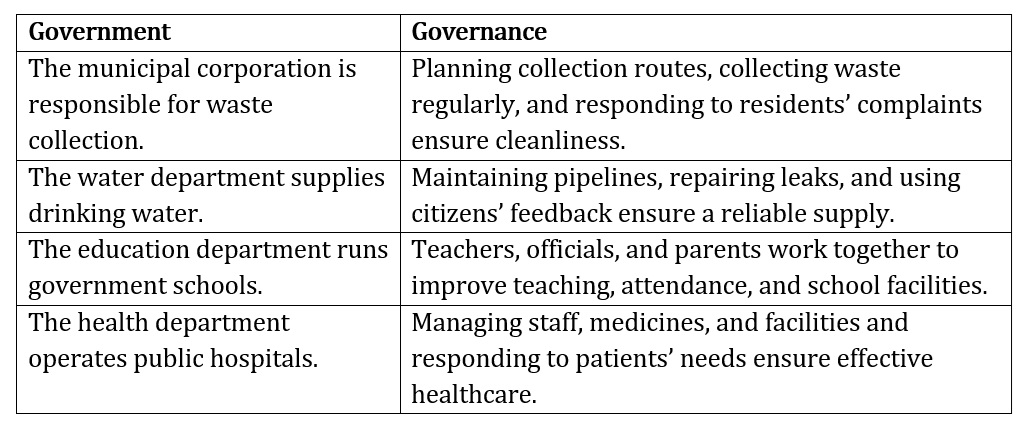
Government refers to the institution that has the authority to provide public services. For example, the municipal corporation or panchayat is responsible for installing street lights. Governance is the process by which this street lighting is planned, implemented, and maintained, involving people in identifying dark spots, reporting non-functional lights, and providing feedback. It ensures the continuous delivery of public services-in this case, well-lit streets and greater public safety.
Question 1: Can you identify more such examples from your day-to-day life to understand the difference between government and governance?
Answer: Some examples showing the difference between government and governance are:
Think About It (Page No. 99)
Question 1: If any step in policy-making and implementation is skipped, what would be the implications? Discuss with a suitable example.
Answer: Skipping a step in policy-making or implementation can make a policy ineffective. Without identifying the problem or consulting stakeholders, it may fail to address people’s actual needs. Poor implementation can waste resources, while a lack of monitoring and evaluation allows shortcomings to continue.
For example, a government may fund a programme to plant one lakh trees, but without arrangements for watering and protection, many saplings may die. Regular monitoring, clear responsibilities, and citizens’ feedback are therefore essential to achieve the policy’s objectives.
Let’s Explore (Pages 102)
Question 1: As a student, what role can you play in the successful implementation of Khelo Bharat Niti 2025?
Answer:
- I can participate regularly in sports, school competitions, and local sporting events.
- I can encourage classmates, especially girls and students with disabilities, to participate and help create an inclusive environment.
- I can use sports grounds and equipment responsibly and help keep them well maintained.
- I can inform teachers about students with sporting talent who may benefit from training.
- I can provide feedback about sports facilities and suggest improvements.
- I can spread awareness about sporting opportunities and practise teamwork, discipline, and fair play.
Question 2: Your school is designated as the ‘state’s sports ambassador’. What actions should it take to fulfil its role as sports ambassador? (Page no. 102)
Answer:
- The school should organise regular sports competitions, training camps, and awareness programmes.
- It should encourage participation by all students, especially girls and students with disabilities.
- It should identify talented students and connect them with qualified coaches and training opportunities.
- It should maintain playgrounds, provide suitable equipment, and promote safe sporting practices.
- It should coordinate with sports authorities, parents, local clubs, and sponsors to support young athletes.
- It should promote fitness, teamwork, discipline, and fair play, setting an example for other schools.
Question 3: Which ministries of the government can contribute towards the success of Khelo Bharat Niti 2025? How? (Page no. 102)
Answer:
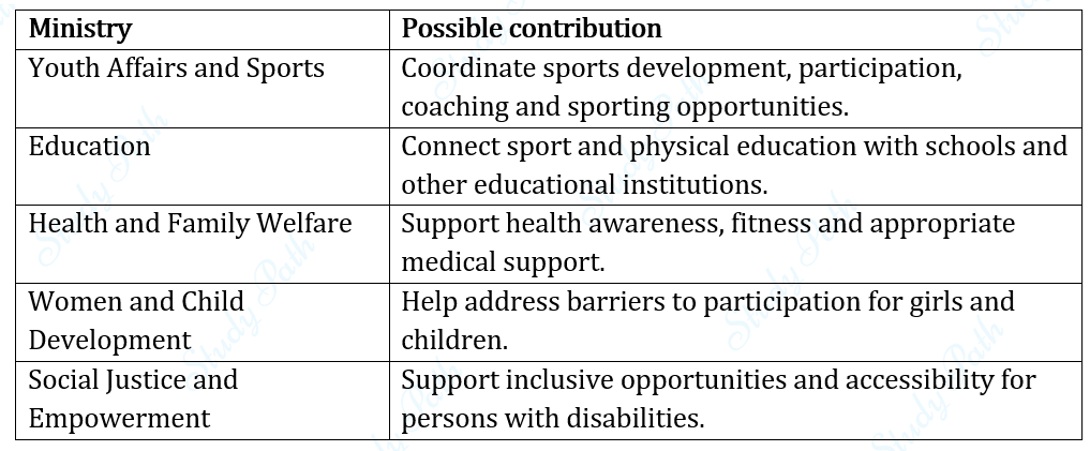
These are suggested areas of coordination for the classroom answer. Different departments should work together according to their actual responsibilities. Official policy reference: Ministry of Youth Affairs and Sports: Khelo Bharat Niti 2025.
Questions and Activities (Page No. 104)
Question 1: “Good governance is the responsibility of the government alone.” Do you agree with this statement? Give reasons to support your answer.
Answer: No, I do not agree. Although the government has the primary responsibility for governance, good governance requires cooperation between the government and society.
- Citizens elect representatives, follow laws, raise concerns, and provide feedback on public services.
- The media informs people about public issues and holds authorities accountable.
- Civil society organisations create awareness, represent community needs, and monitor programmes.
- The private sector contributes resources, technology, and innovation.
- Government departments must coordinate with these groups to implement policies effectively.
Thus, transparency, accountability, and active public participation are essential for good governance.
Question 2: Do you think students can contribute to good governance? Write a short note describing any five ways in which students can become more responsible and active citizens. (Page no. 104)
Answer: Yes, students can contribute to good governance by becoming responsible and active citizens in the following ways:
- They can follow school rules and laws, respect others’ rights, and protect public property.
- They can report problems such as water wastage, littering, or unsafe roads to teachers or local authorities.
- They can participate in student representative bodies and discussions, offering suggestions for improvement.
- They can join community activities such as cleanliness drives and environmental awareness campaigns.
- They can verify information before sharing it and provide constructive feedback on public facilities and services.
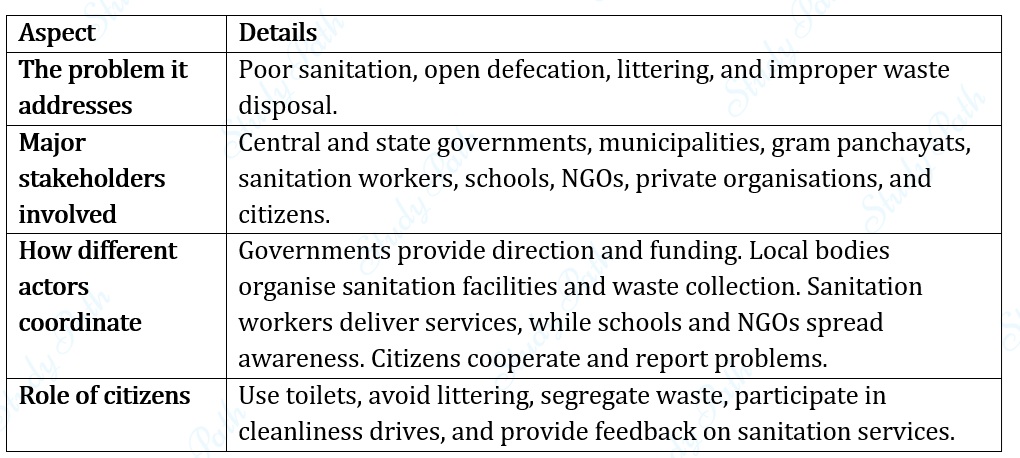
Question 3: Choose any one public policy [for example, Right to Education (RTE), Swachh Bharat Mission, PM POSHAN, Ayushman Bharat, Digital India, or Jal Jeevan Mission] and prepare a chart showing the following aspects: The problem it addresses; The major stakeholders involved; How different actors coordinate; The role of citizens in its success. Present your findings to the class. (Page no. 104)
Answer: Swachh Bharat Mission
Question 4: Answer the following in one or two sentences.
(a) What is governance?
(b) How is governance different from government?
(c) What is meant by public policy?
(d) Name any four principles of good governance.
Answer: (a) Governance is the process of making, implementing, and monitoring decisions for the welfare of people.
(b) Government refers to the institutions that exercise political authority, while governance refers to how decisions are made and carried out with the participation of government and society.
(c) Public policy is a planned course of action adopted by the government to solve public problems, meet people’s needs, and promote public welfare.
(d) Four principles of good governance are transparency, accountability, participation, and the rule of law.
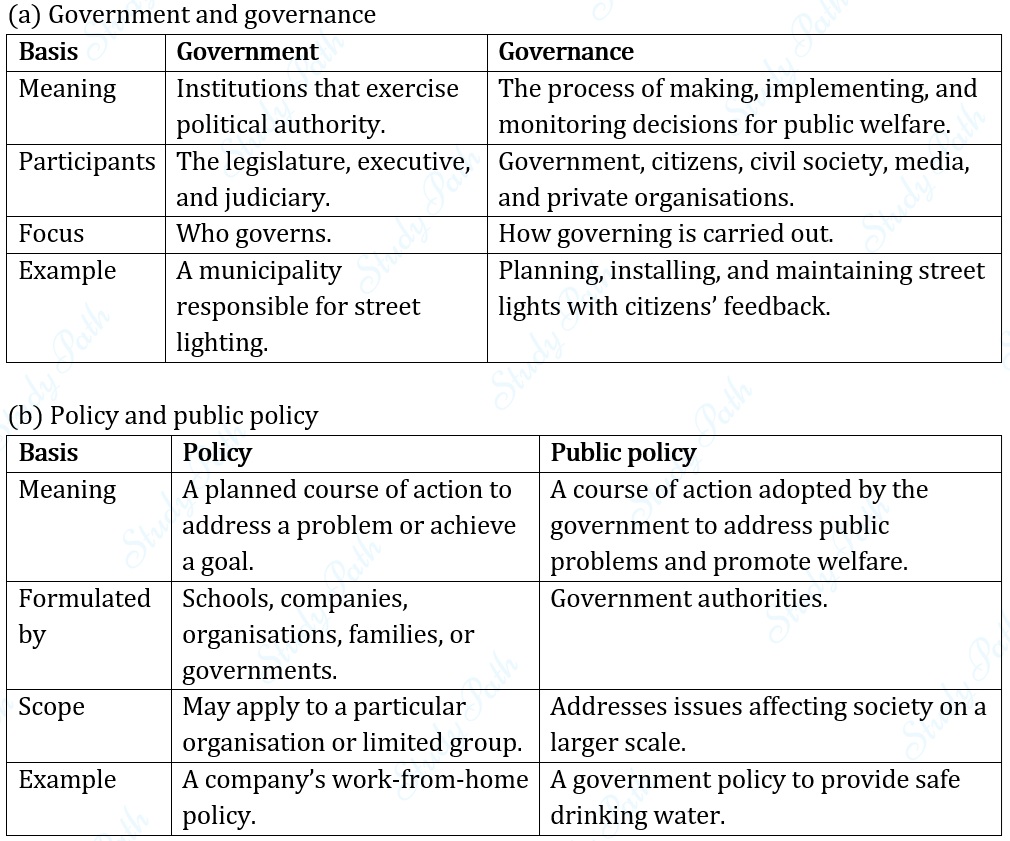
Question 5: Compare the following and present your answer in a tabular form.
(a) Government and governance
(b) Policy and public policy
Answer:
Question 6: Imagine you have been appointed to advise the district administration on improving governance. You have proposed six points (given below), but the administration decides to prioritise only three areas for improvement. Which three would you recommend as priority areas, and which one out of the three do you feel is the most important? (Page no. 105)
(a) Improve drinking water facilities in schools.
(b) Improve sanitation and public toilets in schools and market areas.
(c) Provide tricycles for orthopaedically challenged students.
(d) Install open-area swings and open-air gym in public parks.
(e) Ensure the vaccination of stray dogs to prevent rabies.
(f) Ensure distribution of iron and folic acid tablets for female students in schools.
Answer: I would recommend the following three priority areas:
- Improve drinking water facilities in schools to ensure that students have access to safe water.
- Improve sanitation and public toilets in schools and market areas to maintain hygiene and protect public health.
- Provide tricycles for students with orthopaedic disabilities to improve their mobility and access to education.
Among these, safe drinking water in schools is the most important because it meets a basic daily need and supports students’ health and attendance.
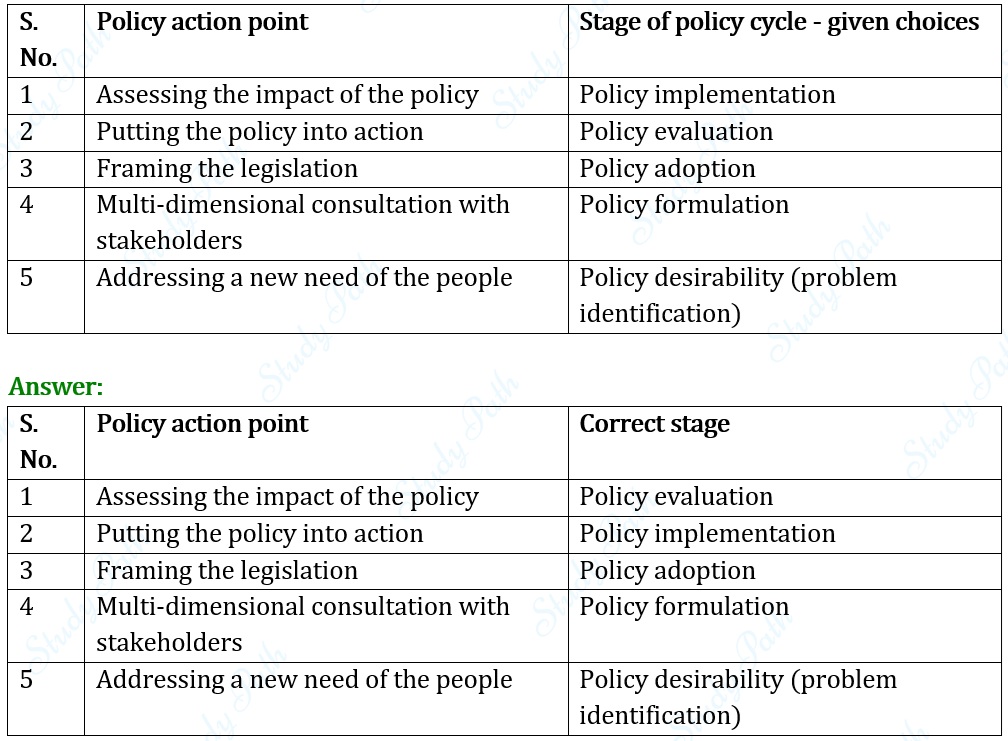
7: Match the policy action point to its corresponding stage in the policy cycle. (Page no. 105)
Question 8: Read the following case and answer the given questions. (Page no. 105)
The government launches a programme to plant one lakh trees in a city. Funds are allocated, but only a few saplings survive because they are not watered or protected.
(a) Which stage of the policy cycle appears to be weak?
Answer: Policy implementation is weak because the saplings were not watered or protected. Monitoring also appears inadequate, as these shortcomings were not corrected.
(b) Which organisations should coordinate to improve the programme?
Answer: The municipal corporation, Forest Department, local community organisations, NGOs, and residents should coordinate to plant and maintain the saplings.
(c) Suggest two measures that could improve the outcome.
Answer:
- Assign clear responsibility for regular watering and protection through tree guards.
- Monitor sapling survival regularly, replace dead saplings, and involve residents in their care.
9: Read each statement carefully. Do you agree or disagree? Give reasons for your answer. (Page no. 106)
(a) A good public policy can fail if it is not implemented properly.
Answer: I agree. Even a well-designed policy cannot achieve its objectives without proper action, coordination, and monitoring. For example, a tree-planting programme may fail if saplings are not watered or protected.
(b) Citizen participation sometimes makes decision-making slower, but it can improve governance.
Answer: I agree. Consultation takes time, but it helps authorities understand people’s needs and consider different viewpoints. This makes decisions more inclusive and responsive and builds public trust.
(c) Technology alone cannot ensure good governance.
Answer: I agree. Technology can improve public services, but good governance also requires honest officials, accountability, coordination, and citizen participation. Digital services must be accessible to people with limited internet access or digital skills.
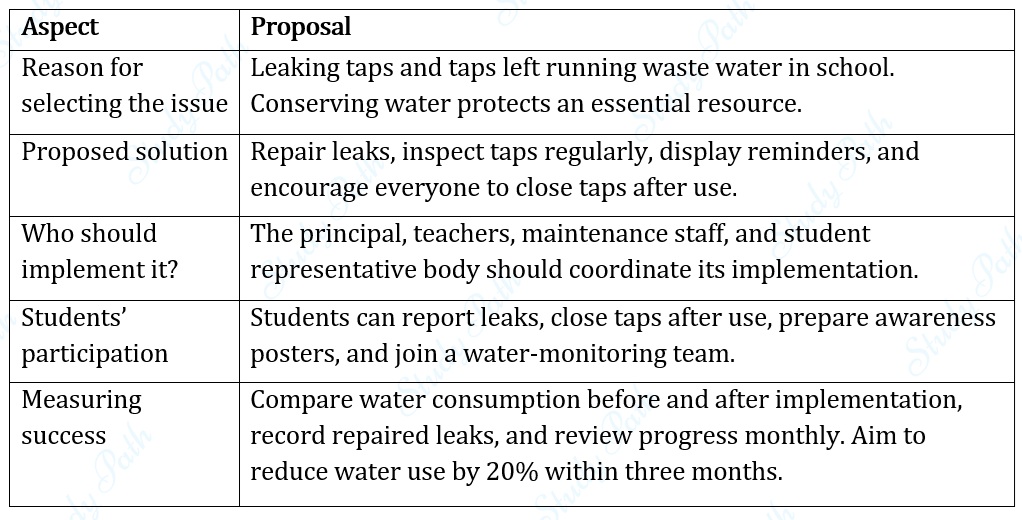
Question 10: Design a public policy. (Page no. 106)
You are a member of your school’s student representative body. Identify one issue, for example, plastic waste, water wastage, road safety, energy conservation, or littering in public places. Prepare a simple policy proposal that includes the following aspects of policymaking:
- The reason for selecting the issue
- Your proposed solution
- Who should implement it?
- How will students participate?
- How will you know whether the policy has succeeded?
Present your proposal to the class as a chart or slideshow presentation.
Answer: School Water Conservation Policy
Class 9 Social Science Part 2 Chapter 4 NCERT Questions and Answers
The chapter Governance and Public Policy explores how decisions affecting society are made and implemented. Students learn about public responsibilities, the role of institutions, and the relationship between policy goals and the services people receive.
Students also consider accountability, participation, and the importance of evaluating outcomes. Familiar examples help them connect public policy with everyday concerns and understand how citizens can contribute to better governance.