

NCERT Solutions for Class 9 Social Science Part 2 Chapter 6 From Ideas to Startups are provided here with simple and easy-to-understand explanations. Based on the NCERT textbook Understanding Society: India and Beyond Part 2, this chapter introduces entrepreneurship, the development of business ideas, and the planning involved in starting an enterprise. These NCERT Solutions for Class 9 Social help students understand important concepts, complete textbook activities, and revise the chapter for school examinations.
From Ideas to Startups Class 9 Questions and Answers
The Big Questions (Page No. 125)
Question 1: How does entrepreneurship impact society and the economy?
Answer: Entrepreneurship benefits society and the economy in the following ways:
- It creates jobs and income, helping people become financially independent.
- It produces goods and services that meet people’s needs and increase economic activity.
- It encourages innovation by turning ideas into solutions that improve quality of life.
- It generates tax revenue that helps fund public services such as schools, hospitals, and roads.
- It empowers communities, as shown by Lijjat Papad’s contribution to women’s financial independence.
- It promotes local solutions, sustainability, and self-reliance, contributing to national development.
Question 2: What are some functional areas of a business?
Answer: The four main functional areas of a business are:
- Management and operations: Planning and organising resources, managing daily activities, and ensuring efficient production and delivery.
- Finance and accounting: Arranging funds, preparing budgets, managing cash flow, and recording income and expenses.
- Human resources: Recruiting and training employees and maintaining a supportive workplace.
- Marketing and sales: Promoting products or services, attracting customers, and increasing sales.
Question 3: How can a business plan be developed?
Answer: A business plan is a written document explaining a business’s goals and the steps needed to achieve them. It can be developed by:
- Identifying a customer need or problem and proposing a suitable business idea.
- Determining the target customers and understanding their preferences.
- Estimating costs and deciding how to arrange funds.
- Choosing where to produce and sell the product or service.
- Identifying the workers and skills required.
- Setting prices that cover costs, remain affordable, and generate profit.
- Planning advertising, promotion, and sales.
- Assessing possible risks and preparing ways to manage them.
Think About It (Page No. 128)
Question 1: What problem was Lijjat solving beyond just selling papads?
Answer: Beyond selling papads, Lijjat addressed women’s need for income and financial independence. It enabled homemakers to earn while managing household responsibilities. Through equal ownership and profit-sharing, it empowered women, supported their families, and strengthened communities. It also provided scholarships for members’ children.
Question 2: What challenges could the founders have faced at the start? How might they have overcome them?
Answer: The founders of Lijjat could have faced limited funds, a lack of equipment and business experience, difficulty attracting customers, and the challenge of maintaining consistent quality. They also had to balance production with household responsibilities.
They could overcome these difficulties by borrowing equipment, starting on a small scale, sharing work, and supporting one another. Making good-quality papads consistently and reinvesting earnings could help build customers’ trust and expand the business.
Question 3: Can you think of a similar cooperative idea you could start in your community?
Answer: We could start a cloth-bag-making cooperative in our community. Members could pool money to buy sewing machines and materials and share tasks such as stitching, designing, and selling bags. Each member would have equal ownership, and profits would be shared fairly. The cooperative could provide income, especially for women, while offering reusable alternatives to plastic bags.
Question and Activities (Page No. 140)
Question 1: Explain why a business can fail even with a great idea if one functional area-finance, HR, operations or marketing-is weak. If you were running a bakery, which would you prioritise first and why?
Answer: A great idea alone cannot ensure success because all functional areas depend on one another. Weak finance can cause a shortage of funds, weak HR can lead to poorly trained staff, weak operations can cause poor quality and delays, and weak marketing can result in low sales.
If I were running a bakery, I would prioritise management and operations first to ensure hygienic preparation, consistent quality, fresh products, and timely service with minimum wastage. These would build customer trust. However, finance, HR, and marketing must also support operations for the bakery to succeed.
Question 2: Do you think innovation alone is enough to make a business successful? Why or why not?
Answer: No, innovation alone is not enough to make a business successful. A new idea must meet customers’ needs and be supported by proper planning, adequate finance, skilled workers, efficient operations, and effective marketing. The business must also maintain quality, control costs, set suitable prices, and satisfy customers. Teamwork, perseverance, and the ability to adapt to challenges help turn an innovative idea into a successful business.
Question 3: “A business plan is a dynamic roadmap for a startup.” Explain with examples. When should one change the business plan?
Answer: A business plan is a dynamic roadmap because it guides a startup’s goals and activities but can be revised as circumstances change. It outlines customers, costs, funding, staffing, pricing, marketing, and risks.
For example, a bakery may introduce whole-wheat bread when customers prefer healthier food or begin online delivery to reach more buyers. Rising ingredient costs may require changes in prices or suppliers.
The plan should be reviewed regularly and changed when customer needs, market conditions, costs, competition, or available resources change, or when actual results differ from expectations.
Question 4: Should every entrepreneur think about the impact of their goods or services on society and the environment? Explain with examples.
Answer: Yes, every entrepreneur should consider the social and environmental impact of their goods or services because business decisions affect people, communities, and natural resources.
For example, producing reusable jute or cloth bags can reduce dependence on plastic bags. A bakery can use recyclable packaging and plan production carefully to reduce waste. Similarly, Lijjat Papad shows how a business can provide income and financial independence to women while supporting their families.
Thus, entrepreneurs should aim to earn profits responsibly while improving people’s lives and protecting the environment.
Question 5: In 1931, two brothers, Digambar and Govind Dandekar, started a small business in South Mumbai selling ink powder. They began with limited resources, using recycled glass bottles to sell liquid ink. At first, they faced financial problems and struggled to convince customers to trust their products. Instead of giving up, they focused on providing good-quality stationery at affordable prices. As the business grew, they noticed that artists in India did not have access to good art materials. Seeing this as an opportunity, they travelled to Glasgow to study colour chemistry and improve their products. After returning to India, they set up a laboratory to develop colours and art supplies suited to Indian needs. Over time, the company expanded into pencils, crayons, geometry boxes, and paints, eventually becoming a well-known brand
- What entrepreneurial qualities did the Dandekar brothers display?
- What opportunity did they identify in the market?
- Was travelling to Glasgow a risky decision?
- Which functional area helped the company improve its products?
- How did they serve society apart from earning profits?
Answer: (i) The Dandekar brothers displayed innovation, resourcefulness, perseverance, risk-taking, and a willingness to learn. They overcame financial difficulties and focused on quality and affordability.
(ii) They identified a shortage of good-quality art materials in India and developed products suited to Indian artists’ needs.
(iii) Yes, travelling to Glasgow involved spending money and time without guaranteed success. However, learning colour chemistry helped them improve their products.
(iv) Management and operations helped improve their products through technical learning, laboratory development, and quality improvement.
(v) They provided affordable stationery and quality art supplies, meeting the needs of students and artists in India.
Question 6: How is entrepreneurship important for India’s goal of becoming a developed nation by 2047?
Answer: Entrepreneurship supports India’s goal of becoming a developed nation by 2047 in the following ways:
- It creates employment and income, improving people’s living standards.
- It encourages innovation and develops solutions to problems in agriculture, healthcare, finance, and other sectors.
- It increases the production of goods and services, contributing to economic growth.
- It promotes local businesses and reduces dependence on imports, supporting Atmanirbhar Bharat.
- It empowers communities, including women, through opportunities for financial independence.
- It encourages sustainable products and practices, helping build a prosperous and environmentally responsible nation.
Question 7: Choose a product or service and develop a business plan using the template: business name, idea, target customers, product/service and price, marketing idea, basic cost and expected profit.
Answer:
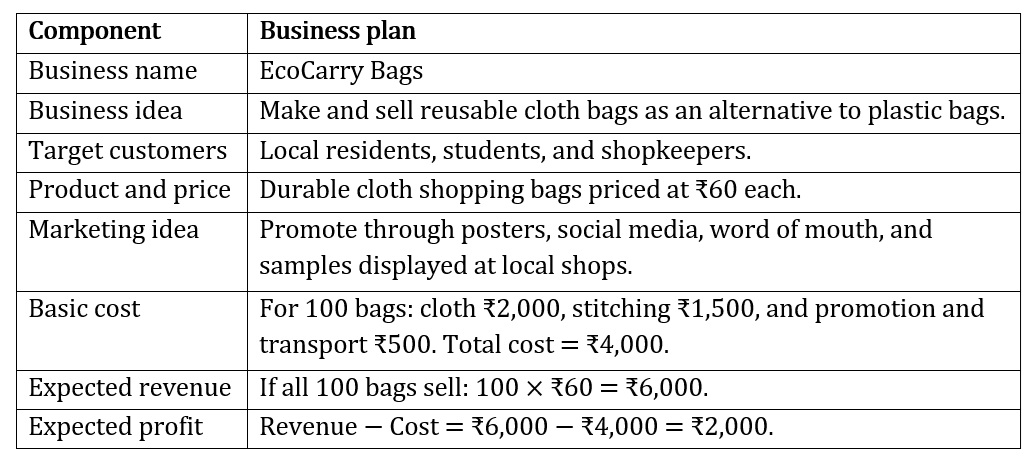
Question 8: Find out about government schemes to promote entrepreneurs in India, learn their eligibility requirements, prepare a write-up and discuss in class.
Answer: The Government of India promotes entrepreneurship through several schemes and initiatives
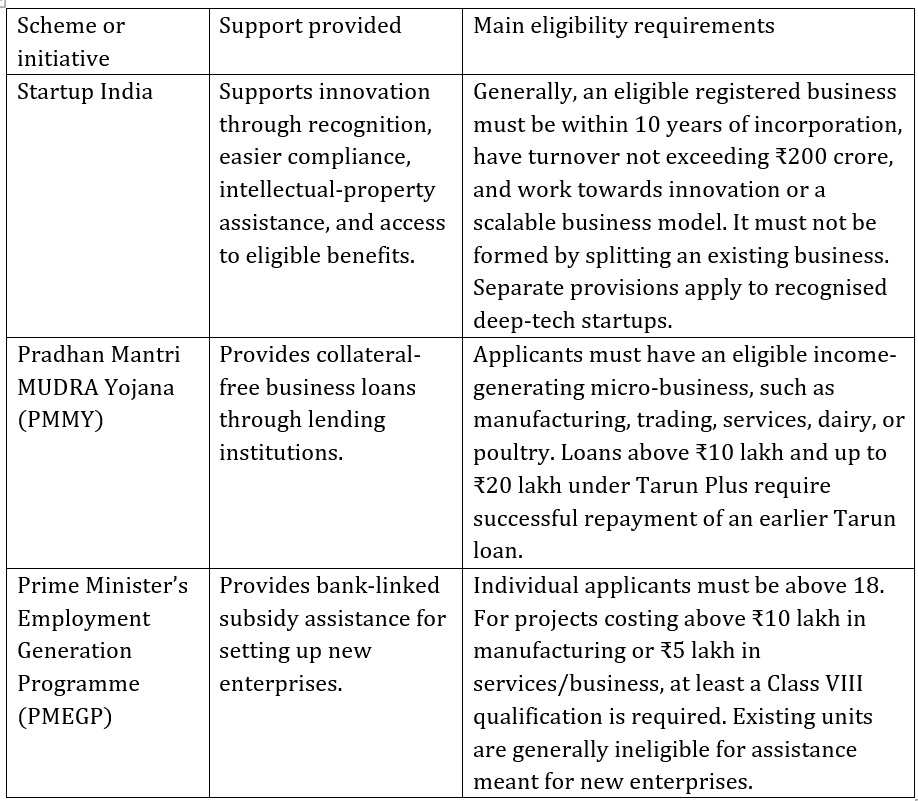
These measures help entrepreneurs obtain finance, develop ideas, become self-employed, and create jobs. Eligibility does not automatically guarantee approval or every benefit.
Question 9: Take any popular brand and identify the problem it tackles, its initial target customers, how it differed from competitors, and the resources it may have started with.
Answer:
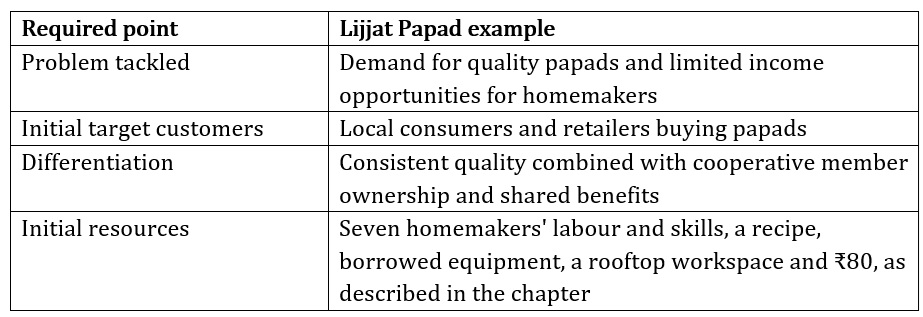
The case shows that organisation and reliable quality can distinguish an enterprise even when its product is familiar.
Question 10: Over the next week, observe your daily routine at school and home. Identify 2-3 problems. For each, record who faces it, frequency, why it remains unsolved, a business idea and whether people would pay.
Answer: Do it yourself.
Question 11: Think of your startup idea and complete every section (a)-(l) of the business plan template on Pages 142-144.
Answer: Do it yourself.
Question 12: Visit a factory or production unit, interview the owner/manager, observe production and resources, create a process map, identify financial, technical, HR, market and regulatory barriers, recommend practical solutions, and prepare a presentation and report.
Answer: Do it yourself.
Class 9 Social Science Part 2 Chapter 6 NCERT Questions and Answers
The chapter From Ideas to Startups explores how people identify problems and turn useful ideas into products or services. Students learn about customers, resources, costs, pricing, and the steps involved in preparing a basic business plan.
Students also examine creativity, calculated risk, and the importance of learning from experience. The chapter connects entrepreneurship with employment and economic development and encourages students to think practically about how an idea can meet a real need.