

NCERT Solutions for Class 6 English Chapter 9 Spices that Heal Us help students understand the importance of common kitchen spices and their traditional uses. Presented as a letter from a grandmother to her grandchildren, the lesson explains how spices such as turmeric, ginger, cumin, cinnamon and black pepper have been used in Indian households for generations. It teaches students about traditional knowledge, natural ingredients and the importance of learning from elders. Here, we provide answers to the textbook questions and activities from Poorvi in simple, student-friendly language.
Class 6 English Poorvi Chapter 9 Spices that Heal Us NCERT Solutions
Let us do these activities before we read. (Page 93)
I. A spice is any seed, fruit, root, bark, leaf or any other part of a plant used to give taste and colour to our food. Try to recall the names of three spices that are used for cooking in your home. Write them below and share your answers with your teacher.
(1) _______________ (2) _______________ (3) _______________
Answer: Three spices used for cooking at home are:
(1) Ginger
(2) Turmeric
(3) Cumin seeds
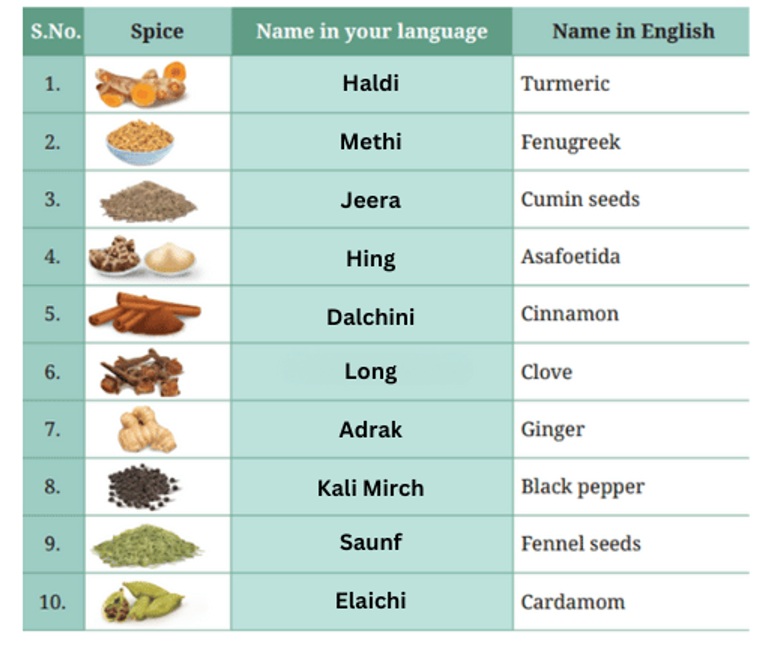
2. Given below are pictures of some spices. Work in pairs and write what you call them in your language. Their names in English are given in the last column. Share your answers with your teacher.
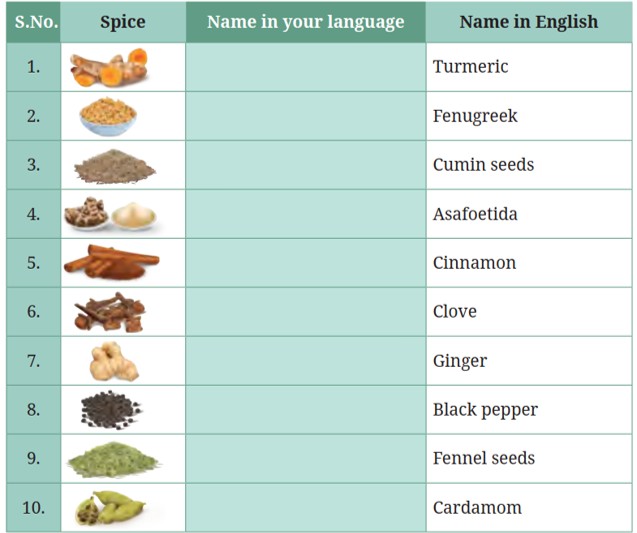
Answer: Names of the spices in Hindi (my language) are:
Let us think and reflect (Page 95)
I. Read the given lines and answer the following questions.
‘When I was a child, I learnt them from my grandmother. She used to find cures for most of the weather-related common illnesses in the kitchen.’
(1) Where exactly in the kitchen did her grandmother find the cures?
Answer: Her grandmother found the cures in the spices and herbs kept in the kitchen.
(2) Give one example of weather-related common illnesses.
Answer: Common cold and cough.
(3) What kind of relationship did the speaker have with her grandmother?
Answer: The speaker shared a warm and affectionate relationship with her grandmother.
II. Fill in the blanks to complete the sentence.
Daadi soaked methi seeds overnight and drank the water in the morning to manage _____________ and ______________.
Answer: Daadi soaked methi seeds overnight and drank the water in the morning to manage sugar levels and body weight.
III. Circle the spice that is not useful for body pain according to Daadi’s letter:
(1) Turmeric
(2) Ginger
(3) Fennel seeds
(4) Black pepper
Answer: (3) Fennel seeds
IV. Why did Daadi ask Vikram and Vaibhavi to share the natural cures with their friends?
Answer: Daadi asked Vikram and Vaibhavi to share the natural cures with their friends so that others could also learn about the benefits of spices and use them to stay healthy naturally.
V. What was Daadi’s final advice to Vikram and Vaibhavi?
Answer: Daadi’s final advice to Vikram and Vaibhavi was to always consult an elder before using any natural cure or spice for treatment.
VI. How do we know that natural cures are passed from one generation to another?
Answer: We know that natural cures are passed from one generation to another because Daadi learnt them from her grandmother when she was a child. Later she taught them to Vikram and Vaibhavi.
VII. Why do you think we should know about the healing properties of spices?
Answer: We should know about the healing properties of spices because they are natural, easily available, and can help cure common illnesses without side effects.
Let us learn (Page 96)
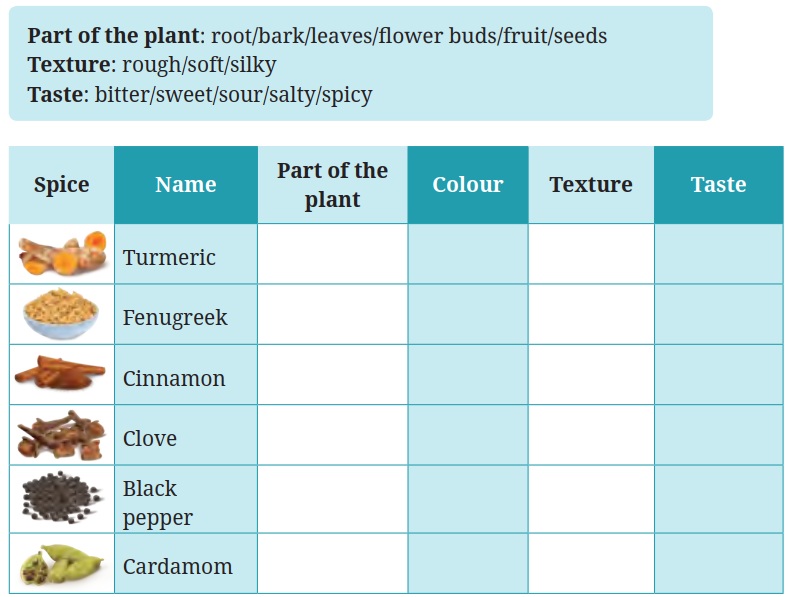
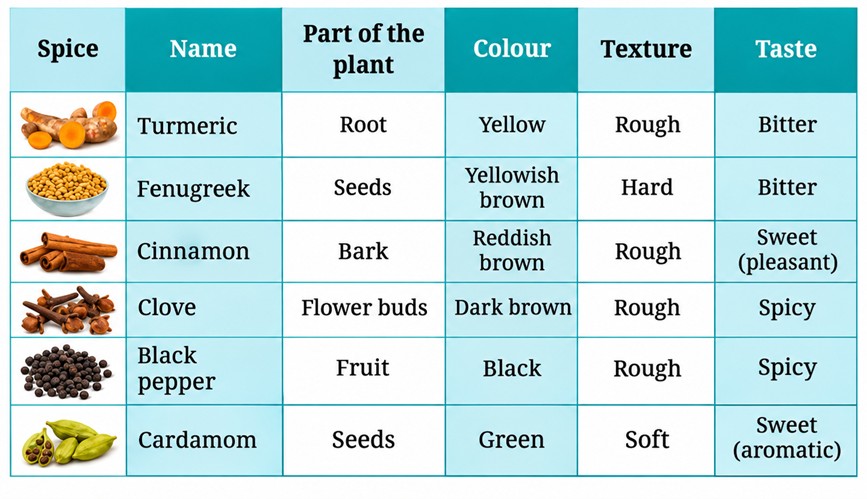
I. You have read the uses of spices in the letter. Complete the following table with the help of your teacher. You may use the words from the box given below.
Answer:
II. Read the sentences given below.
- You may share them with your friends.
- You should try to remember these cures.
- It can help to control cough and cold.
- You must consult an elder before you use them.
- I need to soak the methi seeds overnight.
- I used to put heeng water on your tummy.
The underlined words are known as helping verbs. These are called modal verbs or modals. Each modal verb has a different function.
1. The words given in Column A are helping verbs. Match the helping verbs in Column A with their functions in Column B.
| Column A Helping Verbs | Column B Functions |
| (i) may | A. past habit |
| (ii) should | B. suggestion |
| (iii) can | C. compulsion |
| (iv) must | D. advice |
| (v) need to | E. ability |
| (vi) used to | F. necessity |
Answer:
| Column A | Column B |
| (i) may | B. suggestion |
| (ii) should | D. advice |
| (iii) can | E. ability |
| (iv) must | C. compulsion |
| (v) need to | F. necessity |
| (vi) used to | A. past habit |
(b) Complete the following dialogues with any four modals from the table given above.
(Use a modal only once.)
Ajay : Anand had fever last week. He (i) _____________ take good rest.
Suman : Yes, he (ii) _____________ or he will fall ill again.
Ajay : He (iii) _____________ take grandmother’s natural cures.
Suman : Yes, we (iv) _____________ remember how effective they are.
Answer: Ajay: Anand had fever last week. He (i) should take good rest.
Suman: Yes, he (ii) must or he will fall ill again.
Ajay: He (iii) can take grandmother’s natural cures.
Suman: Yes, we (iv) need to remember how effective they are.
Let us listen (Page no 98)
You will listen to the benefits of Tulsi (Holy Basil), a common herb. As you listen, complete the factsheet given below. (refer to page 102 for transcript)
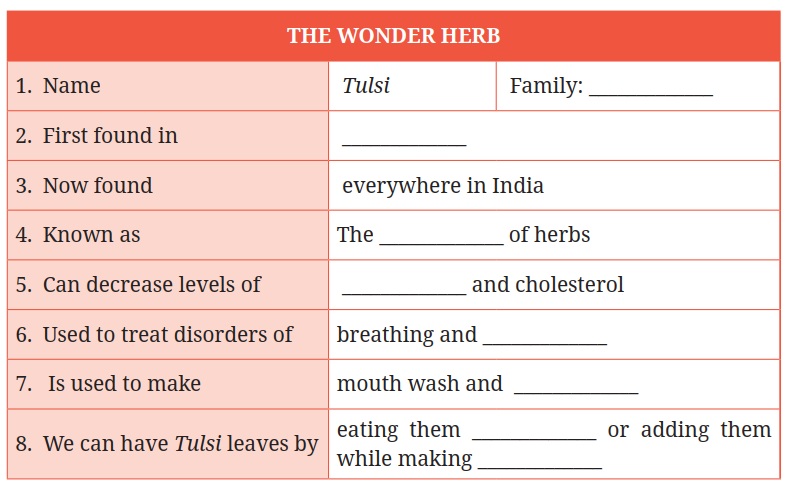
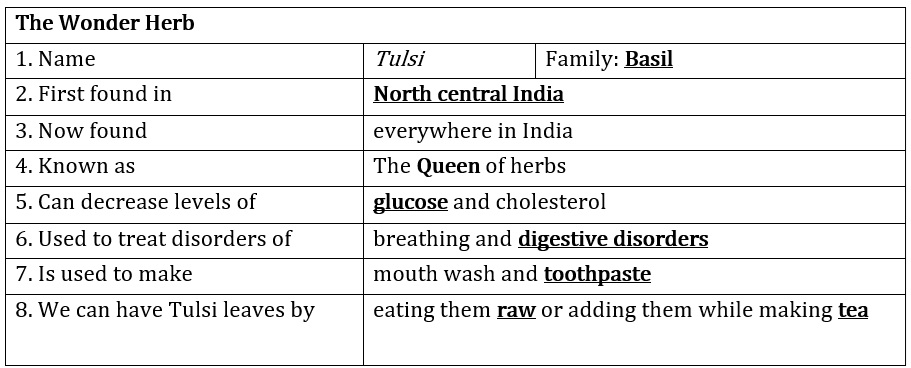
Answer:
Let us speak (Page 98)
1. Daadi told Vikram and Vaibhavi about many spices. Choose one spice and introduce yourself as that spice to the class.
Answer:
Hello Everyone!
I am Turmeric, also known as Haldi in Hindi. I come from the root of the Curcuma longa plant. I am yellow in colour and come from the root of a plant. I have a strong smell and a little bitter taste. People use me in food to give colour and flavour. I also help heal wounds and cure coughs and colds. I am known for my healing power and am found in almost every Indian kitchen.
2. Before you speak, make a spicy headband for the spice you chose. Follow the steps given below.
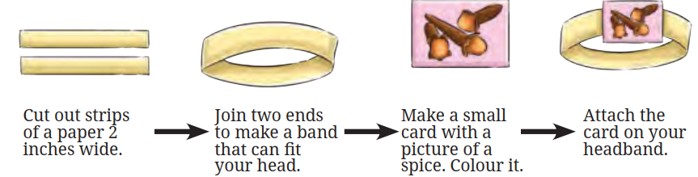
Cut out strips of a paper 2 inches wide. Join two ends to make a band that can fit your head. Make a small card with a picture of a spice. Colour it. Attach the card on your headband. Use the headband while introducing yourself as the spice.
Answer: Do it yourself.
3. Mention the following while speaking.
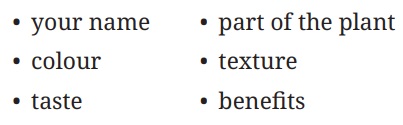
Answer: Do it yourself.
Let us write (Page 99)
I. Vikram’s grandmother shared two natural cures to cure his cough in her earlier letter. It was kept outside and a few drops of rain fell on it. Some of the words got washed away by the rain. Help Vikram complete the natural cures. Use the phrases given in the box below. There are two phrases that you do not need.

Natural Cures for Cough
1. To prepare this home remedy, you just need ginger and honey. First, take a __________, grate it and take the juice from it. Take about two teaspoons of this juice and add about two and half teaspoons of honey to it. Mix it properly. Warm ____________________ slightly on very low heat for a minute. Then ____________________ about three to four times a day to get relief from cough. Have patience to see the effect as natural cures ____________________ with ginger and honey might take some time to show results.
2. To prepare the second ____________________ for cough, take about 10 grams of each long pepper, dried ginger and basil leaves. Add four to six small cardamoms and ____________________ a fine powder. If you take this powder with an equal ____________________, it will give you relief from cough
Answer:
1. To prepare this home remedy, you just need ginger and honey. First, take, a piece of fresh ginger grate it and take the juice from it. Take about two teaspoons of this juice and add about two and half teaspoons of honey to it. Mix it properly. Warm the mixture slightly on very low heat for a minute. Then you can have it about three to four times a day to get relief from cough. Have patience to see the effect as natural cures for cough with ginger and honey might take some time to show results.
2. To prepare the second home remedy for cough, take about 10 grams of each long pepper, dried ginger and basil leaves. Add four to six small cardamoms and grind to get a fine powder. If you take this powder with an equal amount of honey, it will give you relief from cough.
II. Now, write a short paragraph on Tulsi based on the completed factsheet in ‘Let us listen’. (page 100)
Answer: Tulsi: The Queen of Herbs
Tulsi, also known as Holy Basil, is called the Queen of Herbs. It was first found in North Central India and now grows everywhere in the country. Tulsi helps reduce glucose and cholesterol levels and cures breathing and digestion problems. It is also used to make mouthwash and toothpaste. Tulsi leaves can be eaten raw or added to tea. It keeps our body healthy and protects us from many diseases.
Let us explore (Page 100)
I. Now that you have read about many spices, can you guess the spices based on the riddles given below?
1. When your tummy felt funny
I was used by your granny
I made you fit and fine
And brought back your smile.
Who am I?
________________________
Answer: Asafoetida (heeng)
2. I come from under the ground
Thousands of years, I’ve been around.
For cooking you use me daily
From cold I can cure you surely.
Who am I?
________________________
Answer: Ginger (adrak)
II. Fill in the blanks to complete the riddle below.
1. Brownish- _________ in colour,
and _________ to taste,
I help everyone,
to _________ their weight.
Who am I?
Answer: Brownish- yellow in colour,
and bitter to taste,
I help everyone,
to lose their weight.
Who am I?
Answer: Fenugreek (methi)
2. Write another riddle of your own and ask your family members to guess the spice.
Small and slender, I’m brown in hue,
I add flavour to dishes, that’s true.
With a warm, earthy taste, I’m a must,
To aid digestion, in me you can trust.
Who am I?
Answer: cumin (jeera)
3. Close your eyes and learn about spices by smelling and feeling them.
Answer: Do it yourself.
NCERT Solutions for Class 6 English Unit 3 Spices that Heal Us
We hope these NCERT Solutions for Class 6 English Poorvi help students understand the letter, revise its important lessons and prepare confidently for their examinations.
Spices that Heal Us is a letter written by a grandmother, Daadi, to her grandchildren, Vikram and Vaibhavi. She writes to them after learning that they have recovered from their illness with the help of some natural remedies she shared with them. In the letter, she explains the traditional uses of different spices commonly found in Indian kitchens. These include turmeric, fenugreek, cumin seeds, asafoetida, cinnamon, cloves, ginger, black pepper, fennel and cardamom. She also shares how she learned these home remedies from her own grandmother and reminds the children to consult an elder before using them.