

NCERT Solutions for Class 6 English Poorvi Chapter 11 The Winner help students understand a beautiful poem by Georgia Heard. The poem describes children playing ball in a neighbour’s field during the evening. As darkness slowly approaches, the children have to stop playing and return home. Through this simple description, the poet captures the excitement of outdoor games and presents Night as the winner of the game. Here, we provide answers to the textbook questions and activities from Poorvi in simple, student-friendly language.
Class 6 English Poorvi Chapter 11 The Winner NCERT Solutions
Let us do these activities before we read (Page 115)
I. Look at the picture
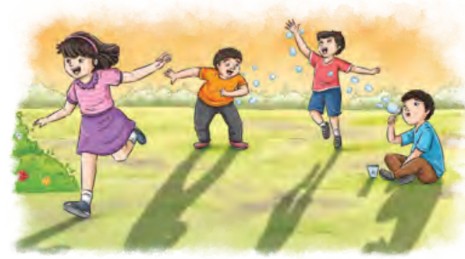
1. What are these children doing?
Answer: The children are playing.
2. Where do you think they are?
Answer: They are in a park.
3. What is the time of the day?
Answer: It is afternoon
II. Discuss the given questions with your classmates and teacher. You may begin your sentences with—
I go to …
I play with …
The place I go to for playing …
I like playing …
Sometimes I come back …
1. When do you go to play after school?
Answer: I go to play in the evening.
2. Who do you play with?
Answer: I play with my friends.
3. Where do you go to play in the evening?
Answer: I go to the park to play in the evening.
4. Which games do you like playing?
Answer: I like to play cricket and football.
5. When do you come back home?
Answer: I come back home at sunset.
Let us discuss (Page 116)
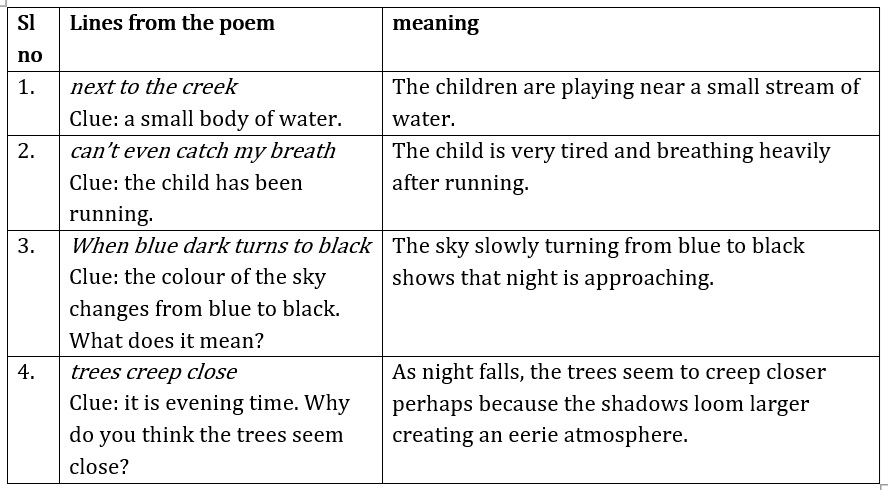
1. Read the given lines from the poem. Write the meaning of the lines by identifying the words/expressions in them.
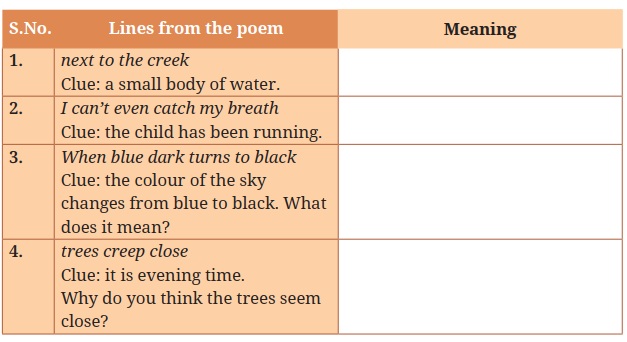
Answer:
2. Read the poem. Complete the following based on the poem.
The children play ______________ in the ______________ in the neighbour’s ______________. They run so ______________ that they run out of breath. They continue to play till the evening when the blue sky turns ______________, and the trees are not clearly visible. They can feel their feet ______________, now that it is cold. Finally, they stop ______________ and go home as it is night.
Answer: The children play ball in the evening in the neighbour’s field. They run so fast that they run out of breath. They continue to play till the evening when the blue sky turns black, and the trees are not clearly visible. They can feel their feet ache, now that it is cold. Finally, they stop playing and go home as it is night.
Let us think and reflect (page 117)
I. Read the given lines and answer the questions that follow.
1. We run so fast
I
can’t
even
catch
my
breath.
(i) Complete the sentence given below with the correct option.
The speaker needs to catch her breath because ____________________________________.
A. everyone decides to walk
B. all the friends wish to go home
C. running fast results in being breathless
D. they need to do breathing exercises
Answer: C.running fast results in being breathless.
(ii) Is the speaker alone? Why do you say so?
Answer: The speaker is not alone. In the poem, the speaker uses the word “we”, which shows that she is playing with other children.
(iii) What does the pattern in the lines tell us?
Answer: The pattern in the lines, where each word is written on a new line, shows that the speaker is breathing heavily and feeling tired after running very fast.
2. When blue dark turns to black,
cold grass aches our feet,
trees creep close—
game’s over.
Night wins!
(i) Give one reason why the grass is cold.
Answer: The grass is cold because temperatures usually drop as night falls and the dew which forms at night makes the grass wet and cold.
(ii) Complete the sentence suitably.
The children’s feet are aching because_________________.
Answer: The children’s feet are aching because they have been running on the cold grass for a long time.
(iii) Why does ‘Night’ win?
Night wins because the ___________________________.
A. time for play has ended
B. children are tired
C. time to play at home begins
D. night follows day
Answer: A. time for play has ended
Let us learn (Page 118)
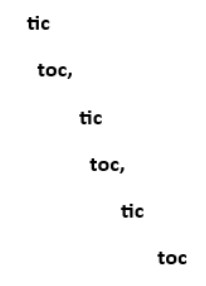
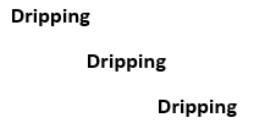
1. Read the information given in the table and see what the poet has done in the poem ‘The Winner’.
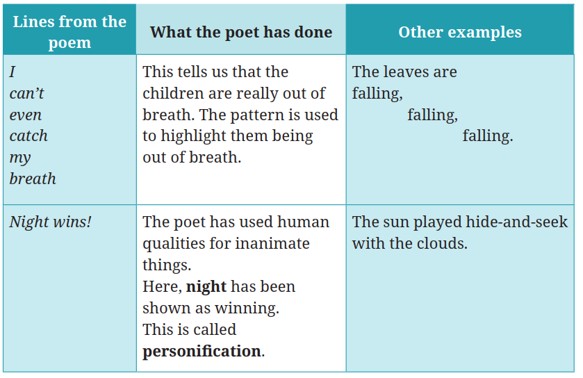
Now, try to write some examples of your own for both. Use your imagination when creating these examples.
Answer: (i) The clock goes
The tap was dripping
Examples of Personification:
- The river sang a soothing song as it flowed gently.
- The stars twinkled mischievously in the night sky.
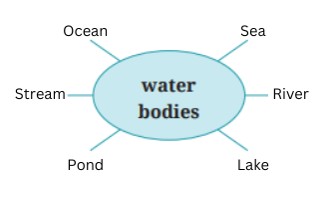
2. The poet has talked about a creek in the poem. You now know that creek is a water body.
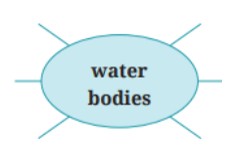
Complete the word web given below by writing which other water bodies you can think of. Discuss with your teacher.
Answer:
Let us listen (Page 119)
Question 1. Listen to the riddles and write which sport is being referred to in the table below.

Riddle 1
Run and pass, run and pass
Kick a black-and-white ball
Kick it straight into the goal
Watch for mud-don’t fall
What sport am I?
Riddle 2
Hold your breath, say Hu-tu-tu,
till you touch one or two.
Take care to keep a distance wide
As you run back to your team’s side.
Which sport am I?
Riddle 3
In the water, hold your breath,
The water is very cool,
Arms turn, legs kick
In the blue pool.
Which sport am I?
Riddle 4
Breathe in, breathe out!
Practice every day just right,
You will be healthy and fit
Get energy and grow in might.
What am I?
Answer:

Try to create a riddle about your favourite game/sport/activity. Share your riddles with your classmates. Let’s see who can guess it right.
Answer:
Black and white squares, kings and queens,
Quiet moves but loud in means.
Check the king and plan your fate —
Strategy’s home, what’s the plate?
What am I? Answer: Chess
Let us speak (Page 121)
Enact the roles of a parent and a child.
Situation 1: Coming home late after play.
(Parent upset/Child explaining)
Answer:
Child: I know, Mom/Dad, I’m really sorry! We were playing football, and the game went longer than I expected.
Parent: That’s not an excuse. You should’ve called or at least sent a message. I was worried sick!
Child: I know, I should’ve. My phone battery died, and I couldn’t borrow anyone’s phone right away. I didn’t mean to make you worry.
Parent: You know the rules, and they’re there for a reason. I just need to know you’re safe.
Child: I understand. Next time, I’ll make sure to tell you if I’ll be late. I promise.
Parent: Alright. I believe you — but please, don’t let it happen again.
Child: Okay. I’m really sorry, Mom/Dad.
Situation 2: Sharing details of the games you played.
(Child excited/Parent asking details with interest)
Answer:
Parent: You’re home! You look so happy today. What games did you play?
Child: (excitedly) Oh, it was so much fun! We played football first, and my team won!
Parent: Really? That’s great! How did your team win?
Child: I scored the final goal! Our goalkeeper kicked the ball really far, and I ran fast and kicked it right into the corner of the net!
Parent: Wow! That must have been exciting. What did your friends say?
Child: They were cheering and calling me “the striker!” It felt awesome!
Parent: (smiling) That’s wonderful. Did you play anything else after football?
Child: Yes! We played tag. I caught almost everyone—except Rohan. He’s too fast!
Parent: (laughing) Rohan always runs like the wind, doesn’t he?
Child: Yeah! But next time, I’ll catch him for sure!
Parent: (proudly) I love hearing about your games. Sounds like you had a great day!
Child: I really did! I can’t wait to play again tomorrow!
Situation 3: Bring a new friend home after playtime.
(Child introducing/Parent welcoming)
Answer:
Child: (cheerfully) Hi, Mom/Dad! I brought my friend home after playtime. This is Aarav.
Parent: (smiling warmly) Oh, hello, Aarav! It’s nice to meet you.
Friend: (politely) Hello, Uncle/Aunty! Nice to meet you too.
Parent: So, you both were playing outside? What game did you play?
Child: We played cricket today! Aarav is really good at batting. He hit two sixes!
Parent: (impressed) Wow, that’s wonderful! You must be a great player, Aarav.
Friend: (shy smile) Thank you! It was really fun playing with everyone.
Parent: I’m glad to hear that. Would you both like some snacks or juice?
Child: Yes, please! We’re really hungry after all that running.
Parent: (laughing) Of course! I’ll bring some for you. Make yourselves comfortable.
Friend: Thank you, Aunty/Uncle!
Parent: You’re welcome. Feel free to come over and play anytime!
Child: Yay! Thanks, Mom/Dad!
Let us write (Page 121)
Write a paragraph about your playtime, using the clues given below.
- What time do I go out to play?
- Who do I play with?
- What games do we play?
- Which is my favourite game?
- What do we gain from playing together?
- When do we finish playing and go home?
Now, give a title to your paragraph.
Answer:
My Playtime
I go out to play every evening at around 5 o’clock. I play with my friends from my neighbourhood. We play many games like cricket, football, hide and seek, and badminton. My favourite game is cricket because I love batting and hitting the ball far. Playing together makes us happy and keeps us healthy. It also teaches us teamwork and sharing. We finish playing when it starts getting dark and then go home tired but smiling.
Let us explore (page 121)
There are many indigenous games in India. Kho-kho is an example of an indigenous game. Indigenous games are native to a region. Find out some native games of your state and other parts of India. Learn the rules of one such game and play it with your classmates under the supervision of your teacher.
Answer: There are many indigenous (traditional) games played in India. Some of them are Kabaddi, Kho-Kho, Gilli Danda, Lagori (Seven Stones), Kite Flying, and Mallakhamb.
In my state, one popular native game is Kabaddi. It is played between two teams. Each team sends one player (called a raider) to the other side. The raider has to touch as many players as possible and come back to his side while saying “kabaddi, kabaddi” without stopping for breath.
This game teaches teamwork, strength, and quick thinking. It also keeps us fit and active. Playing such traditional games with friends is fun and helps us learn cooperation and discipline.
NCERT Solutions for Class 6 English Unit 4 The Winner
The Winner is a poem by Georgia Heard about children enjoying an evening game of ball in their neighbour’s field. They run quickly and play enthusiastically near a creek. As the blue evening sky gradually turns dark, the grass becomes cold and the trees seem to move closer. These changes indicate that it is time to stop playing. Finally, the children have to leave the field as night takes over. The poet creatively describes this natural change as a game in which Night wins.
We hope these NCERT Solutions for Class 6 English Poorvi help students understand the poem, revise its important lessons and prepare confidently for their examinations.